
Key takeaways
- A “square” is 100 sq ft of roof surface: divide total deck area by 100, then add waste — 10% for simple gables, 15% for hips, 15–20% for cut-up roofs.
- Measure the deck, not the house: footprint measurements need the pitch multiplier (6/12 pitch = 1.12×).
- Three bundles of standard architectural shingles cover one square; check the wrapper — specialty shingles can need 4–5 bundles per square.
- Valleys eat roughly 0.03 squares per linear foot and hips about 0.01 — on a valley-heavy roof, budget them separately instead of guessing the waste factor.
To measure a roof for shingles, divide the total deck area by 100 to get squares, add a 10–20% waste factor depending on roof complexity, and round up — a 15-square roof takes 45 bundles of standard architectural shingles. Order starter strips and hip/ridge caps separately; they’re not in the field-shingle count.
This is the field math every roofer needs cold. Getting it right means you stage the right material on day one; getting it wrong means a supply-house run at 4 PM while the crew stands around. Here is the full process, start to finish. If you’re looking for more trade guides written for roofers rather than homeowners, that’s what our Pro section is for.
What a roofing square actually is
One square = 100 square feet of roof surface — a 10×10 ft area on the deck. It is not the house’s living space, and it is not the footprint on the ground. A two-story 1,600 sq ft home can easily carry a 2,400 sq ft roof once you count both stories stacked under one deck, the pitch, and the overhangs.
Manufacturers quote coverage in squares. According to GAF’s published measuring guide, the specs for any given shingle tell you exactly how many bundles make a square, how many nails you’ll need per square, and how many shingles that is — GAF’s guide to measuring a roofing square lays out the convention the whole trade uses.
Step 1: Break the roof into planes
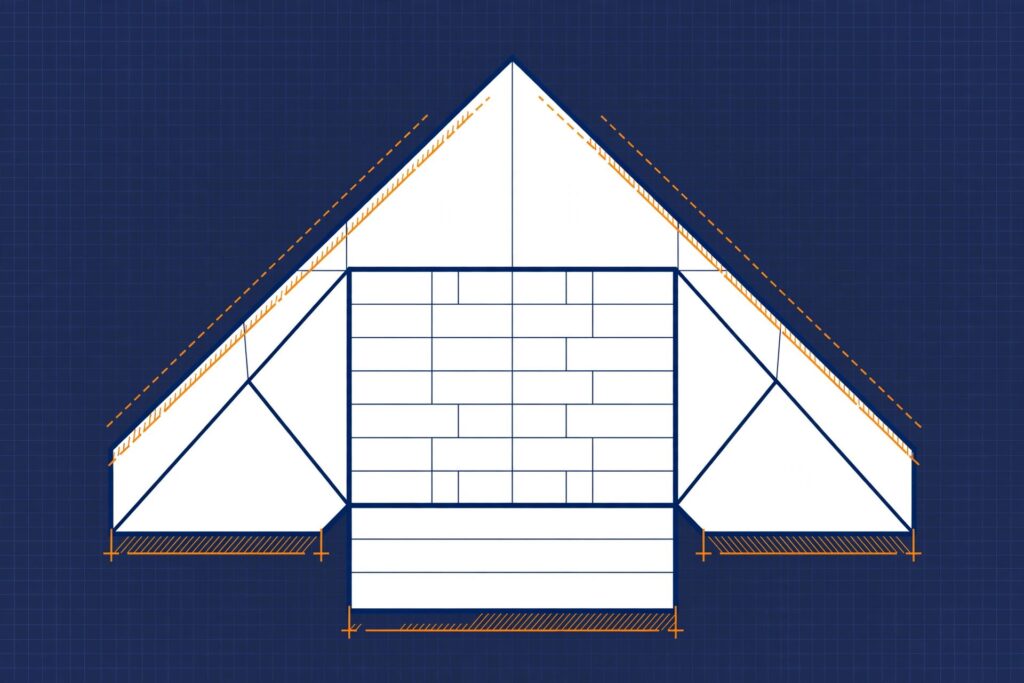
A roof is not one rectangle. It’s a set of planes — rectangles, triangles, trapezoids. Sketch the roof from above on a notepad and mark each plane. For a gable, that’s two rectangles. A hip roof is four planes (two trapezoids, two triangles). Every dormer adds planes of its own.
Measure each plane’s length and width, multiply, and add them up. If you can’t get on the roof yet, measure the ground footprint and apply the pitch multiplier from Step 2. Satellites work too — our free roof measurement tool traces the planes for you from aerial imagery, which is the fastest way to check a bid measurement before you climb.
Step 2: Measure the deck — or the footprint plus pitch
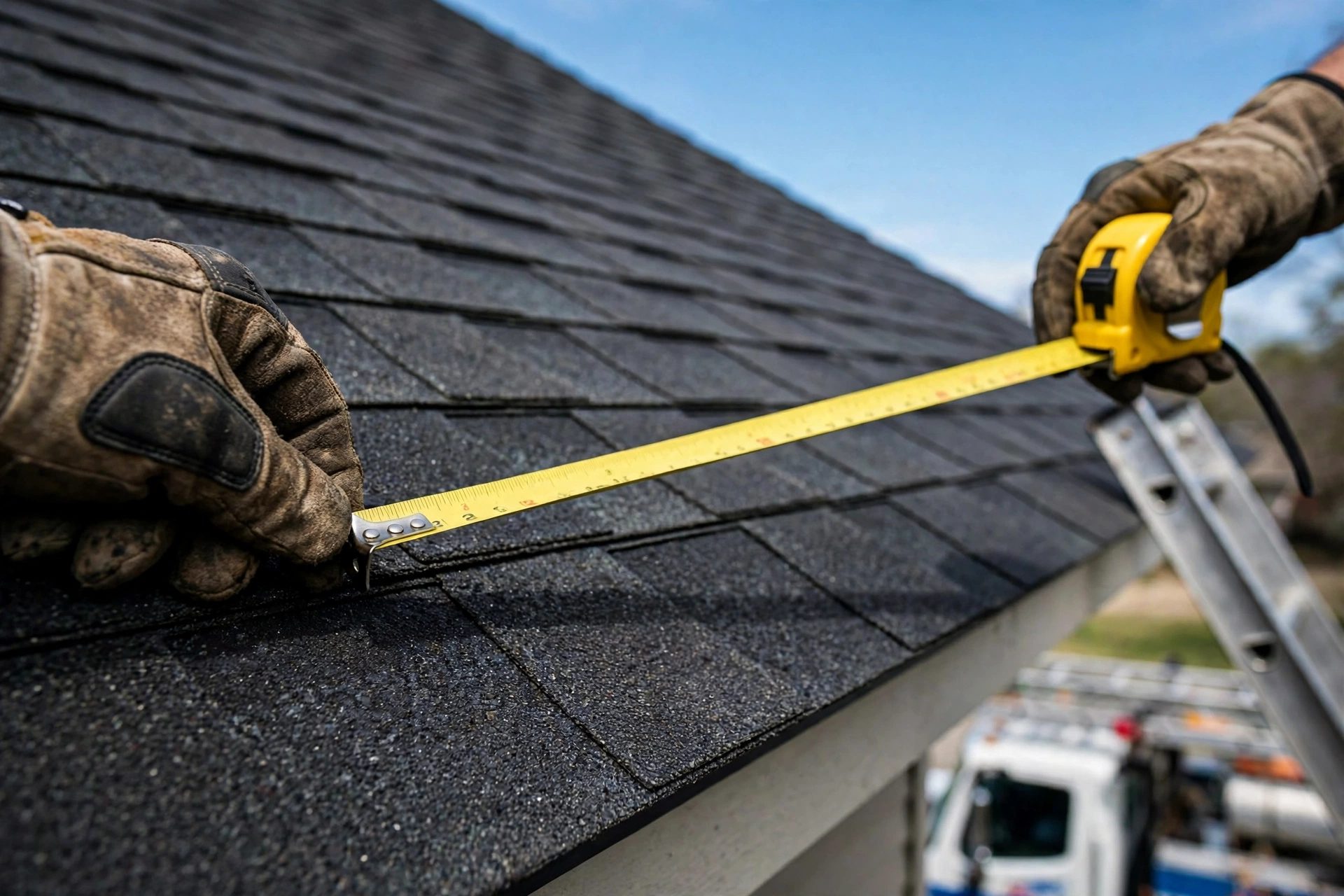
On the roof, a tape measure and a partner are all you need: run eave to ridge for the width, rake to rake for the length, per plane. A 100-foot tape measure covers most residential runs without resetting, and a laser distance measurer speeds up eave-to-ridge shots on steep pitches where footing is sketchy.
From the ground, measure the footprint (house length × depth, including overhangs) and multiply by the pitch factor — the deck is longer than its flat outline because of the slope:
| Pitch | Multiplier | Pitch | Multiplier |
|---|---|---|---|
| 4/12 | 1.05 | 8/12 | 1.20 |
| 5/12 | 1.08 | 9/12 | 1.25 |
| 6/12 | 1.12 | 10/12 | 1.30 |
| 7/12 | 1.16 | 12/12 | 1.41 |
To find the pitch, measure 12 inches horizontally into the roof from the eave and read the vertical rise — a 6-inch rise is a 6/12. A pitch gauge does it faster if you carry one.
Step 3: Add the waste factor for the roof’s complexity
The deck area is the skin — what the shingles have to cover. It is not what you order. Cuts at hips, valleys, rakes, and penetrations eat material, so add waste by roof type:
| Roof complexity | Waste factor |
|---|---|
| Simple gable, few penetrations | 10% |
| Hip roof or multiple gables | 15% |
| Cut-up roof: dormers, skylights, multiple valleys | 15–20% |
Valleys and hips deserve their own math on cut-up roofs. A practical field formula from Caldwell’s re-roof measuring guide: multiply total valley length in feet by 0.03 to get valley waste in squares, and total hip length in feet by 0.01 for hip waste — see Caldwell’s step-by-step reroof measuring guide for the full derivation. Fifty feet of valley at 0.03 is 1.5 squares of pure waste — that’s the difference between a comfortable margin and a shortage.
Step 4: Convert squares to bundles, starter, and caps
Worked example — a 40×30 ft footprint at 6/12 pitch:
- Footprint: 40 × 30 = 1,200 sq ft
- Deck area: 1,200 × 1.12 (pitch multiplier) = 1,344 sq ft
- Squares: 1,344 ÷ 100 = 13.4 squares
- With 10% waste: 13.4 × 1.10 = 14.8 → round up to 15 squares
- Bundles: 15 × 3 = 45 bundles of standard architectural shingles
Three bundles per square is the standard for most architectural shingles (GAF Timberline HDZ, for example), but it’s not universal — GAF’s own Grand Sequoia takes five bundles per square. Always check the coverage printed on the wrapper of the shingle you’re actually installing, especially when comparing products; our architectural vs 3-tab shingles comparison breaks down how bundle coverage and cost differ between shingle types.
How to read a shingle bundle wrapper explains how to check the wrapper’s bundles-per-square figure, exposure, and warranty terms before ordering.
Hip/ridge caps and starter strips are separate line items. Ridge caps: total linear feet of hips and ridges — roughly one square per 100 linear feet if you cut your own, or buy manufactured hip-and-ridge shingles at the published coverage. Starter strips: total linear feet of eaves plus rakes.
Three measuring mistakes that cost real money
Measuring the living space instead of the roof. The number on the listing is floor space, not deck. Measure the deck or the footprint — never the appraisal.
Forgetting the overhangs. The deck extends past the walls. Measure wall to wall on the ground and you’ve undercounted every eave and rake by a foot or more per side.
One waste factor for every roof. 10% is fine for a plain gable. Using 10% on a valley-heavy roof with dormers is how you end up short three bundles with the tear-off already done — and rush orders cost more per bundle than the material you “saved” by ordering lean
How many bundles of shingles do I need for a 20 square roof?
60 bundles of standard architectural shingles at 3 bundles per square — before waste. With a 10–20% waste factor you order 22–24 squares of material, so 66–72 bundles. Always confirm the bundles-per-square on the shingle wrapper first.
How much waste should I add when measuring a roof?
10% for a simple gable, 15% for hip roofs or multiple gables, and 15–20% for cut-up roofs with dormers, skylights, and multiple valleys. On valley-heavy roofs, budget valleys separately at about 0.03 squares per linear foot.
How do you measure a roof from the ground?
Measure the building’s footprint — length × depth including overhangs — and multiply by the pitch multiplier for the roof’s slope (1.12 for 6/12, 1.20 for 8/12, 1.41 for 12/12). Satellite measurement tools do the same math from aerial imagery without a ladder.
Disclosure: RoofAdviceHub is reader-supported. When you buy through links on our site we may earn an affiliate commission at no extra cost to you. As an Amazon Associate we earn from qualifying purchases.
Last updated: October 2026
Leave a Reply