
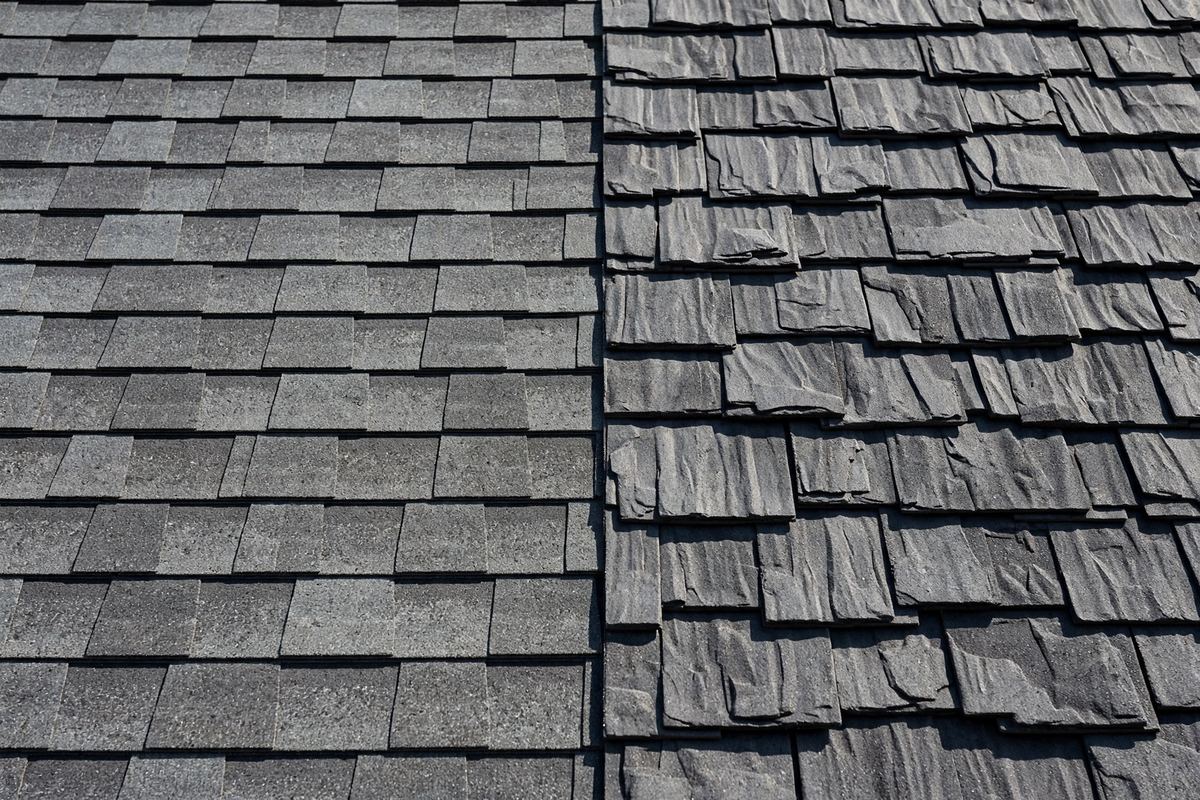
If you’re getting quotes for a new roof, you’ve probably seen the same fork in the road every homeowner hits: one line on the quote says “3-tab shingles,” and another says “architectural shingles,” and the price difference is a few thousand dollars. So the real question behind architectural shingles vs 3-tab shingles isn’t which one looks nicer in a brochure — it’s which one is actually worth your money.
I’ve installed and torn off plenty of both over the years, and I can tell you the honest answer up front: for most homeowners, architectural shingles win. But “most” isn’t “all,” and the details matter — because the price gap, the warranty gap, and the wind-rating gap are all bigger than most contractors bother to explain. Here’s the full breakdown.
Architectural shingles vs 3-tab shingles: what is the actual difference?
Both are asphalt shingles — fiberglass mat soaked in asphalt, coated with granules. The difference is construction.
3-tab shingles are a single flat layer. Each shingle has cutouts (“tabs”) along its bottom edge, so installed they make that classic flat, repeating rectangular pattern you’ve seen on a million roofs. They’re lighter — roughly 175–225 pounds per roofing square (100 sq ft) — and thinner.
Architectural shingles (also called dimensional or laminated shingles) are built from two or more bonded layers of asphalt mat. That laminated construction creates a thicker shingle with a textured, shadow-line look that mimics wood shake or slate from the street. They weigh roughly 240–350 pounds per square — about 50% more material on your roof.
Here’s a side-by-side comparison of the headline specs:
| Feature | 3-Tab Shingles | Architectural Shingles |
|---|---|---|
| Construction | Single flat layer | Two+ laminated layers |
| Installed cost (2026) | $3.50–$5.50 per sq ft | $4.50–$7.50 per sq ft |
| Typical lifespan | 15–20 years | 25–30 years |
| Wind rating | 60–70 mph | 110–130 mph |
| Hail resistance | Class 1–2 (standard) | Class 3–4 available |
| Algae protection | Usually none | 10–25 years |
| Manufacturer warranty | ~25-year limited | Lifetime limited |
| Look | Flat, uniform | Dimensional, textured |
What do they cost in 2026?
This is where the decision usually gets made, so let’s be precise with ranges. Nationally, installed pricing for a standard tear-off and replacement runs roughly $3.50–$5.50 per square foot for 3-tab and $4.50–$7.50 per square foot for architectural. On a typical 2,000 sq ft roof surface, that’s roughly $7,000–$11,000 for 3-tab versus $9,000–$15,000 for architectural — a real-world gap of about $1,500–$4,000 depending on your market, roof complexity, and the shingle line.
Put differently: architectural shingles typically run 20–40% more upfront than 3-tab for the same roof.
Disclaimer: costs vary by region, roof complexity, pitch, and local labor rates. Get local quotes for your specific home — for the full picture of everything that goes into a quote, see our guide on what a roof replacement costs in 2026.
But upfront cost is the wrong number to fixate on. Here’s why: a 3-tab roof that dies at year 17 forces you to pay for a whole second roof — tear-off, labor, dumpster, everything — while the architectural roof is still going. Over a 30-year horizon, many homeowners end up paying for two 3-tab roofs versus one architectural roof. The cheaper option stops being cheaper the moment you replace it twice.
How long do they really last?
Manufacturer warranties say one thing; the roof over your head says another. Real-world lifespan:
- 3-tab shingles: 15–20 years in most climates. In hot southern states with brutal summers, the lower end of that range is common — heat cooks thin shingles fast.
- Architectural shingles: 25–30 years is realistic for a well-installed roof in a moderate climate. Premium lines (like GAF Timberline UHDZ or Owens Corning Duration) can push toward 35–40 years, though that’s the ceiling, not the promise.
The extra thickness of architectural shingles is the whole story here. More asphalt, more granules, more layers to wear through. A single-layer 3-tab has nowhere to hide once granule loss starts; a laminated shingle keeps protecting even after the surface layer starts aging.
What shortens lifespan for both
Installation quality matters more than the shingle on the pallet. I’ve seen cheap architectural roofs fail at 15 years because of bad nailing and zero ventilation, and I’ve seen well-installed 3-tab roofs make it past 20. Ventilation, underlayment, and flashing details decide whether you land at the top or bottom of those ranges.
Wind, hail, and algae: where the money shows up
This is the part of the comparison that doesn’t show up in the brochure photo — and it’s where architectural shingles earn their premium.
Wind resistance
Standard 3-tab shingles are rated for about 60–70 mph winds. Premium architectural lines like GAF Timberline HDZ or Owens Corning Duration are rated for 110–130 mph. That’s not a small difference — that’s the difference between losing shingles in a strong thunderstorm and riding out a tropical system. If you live anywhere with serious storm seasons (Texas, Florida, the Gulf, the Midwest), this alone can settle the debate.
Hail resistance
Standard 3-tab shingles are typically Class 1–2 for impact resistance. Architectural lines offer Class 3 and even Class 4 (impact-resistant) options — and some insurers offer premium discounts for Class 4 roofs. After a hailstorm, the difference between a Class 2 and Class 4 roof can be the difference between a full insurance claim and a roof that shrugs it off.
Algae and black streaks
Those ugly black streaks running down roofs? That’s algae, and 3-tab shingles typically have no algae warranty at all — expect streaks within 3–5 years in humid climates. Architectural lines like GAF Timberline HDZ carry 25-year algae protection; Owens Corning Duration carries 10 years. Your roof stays looking new instead of looking ten years old at year four.
The warranty gap (and what “lifetime” really means)
This is where the fine print matters. Compare the flagship lines:
- GAF Royal Sovereign (3-tab): 25-year limited warranty, wind coverage at 60 mph for 5 years.
- GAF Timberline HDZ (architectural): “Lifetime” limited warranty, up to 130 mph wind coverage, 25-year algae protection.
- Owens Corning Supreme (3-tab): 25-year limited warranty, 60 mph wind — note that Owens Corning discontinued this line in early 2025.
- Owens Corning Duration (architectural): “Lifetime” limited warranty, 130 mph wind, 10-year algae protection.
A few honest notes about these warranties. “Lifetime” means for as long as you own the home — it’s not literally forever, and after the initial non-prorated period (typically the first 10 years on architectural lines), coverage becomes prorated, meaning the manufacturer pays less as the roof ages. Also, the manufacturer warranty only covers material defects — not installation errors. The workmanship warranty from your contractor is what covers leaks from bad flashing or nailing, and that’s a separate conversation you should have before signing anything.
One thing most homeowners don’t know: 3-tab shingles are fading out
Here’s a market reality worth knowing: 3-tab shingles are slowly being discontinued across the industry. Owens Corning discontinued its Supreme 3-tab line in January 2025. Industry data shows roughly two-thirds fewer 3-tab product options available nationwide than five years ago. Manufacturers are consolidating around architectural lines because that’s what buyers and contractors want.
What does that mean for you? Three practical things:
- Matching repairs get harder. If your 3-tab line is discontinued five years from now, finding matching shingles for a repair becomes a treasure hunt.
- Some insurers are getting picky. A growing number of carriers prefer or effectively require architectural shingles on new policies in storm-prone regions.
- Resale perception. Buyers and home inspectors increasingly see 3-tab as the “budget roof.” An architectural roof is a selling point; a 3-tab roof is neutral at best.
My honest take: when each choice makes sense
After years around roofing crews, here’s how I’d frame it plainly:
Choose architectural shingles if: this is your home (not a flip or rental), you plan to stay 7+ years, you live anywhere with real storms, or you care about resale value. The extra $1,500–$4,000 buys you roughly a decade of extra roof life, double the wind rating, real algae protection, and a warranty that doesn’t expire while you own the house. For most homeowners, it’s the best value in roofing — full stop.
Choose 3-tab shingles if: it’s a rental property where curb appeal and 30-year longevity aren’t your problem, a detached garage or shed, or a home you’re selling within the next couple of years and just need a functional, warrantied roof on it. Even then, check availability first — make sure your contractor can actually still source the line they’re quoting.
The bottom line: architectural shingles cost 20–40% more and deliver roughly 50% more lifespan, double the wind resistance, and warranties that don’t quit at year 25. Unless you have a specific short-term reason to go cheap, the math — and the roof over your head — favor the upgrade.
Frequently asked questions
How much more do architectural shingles cost than 3-tab?
Typically 20–40% more installed. On a 2,000 sq ft roof that works out to roughly $1,500–$4,000 extra, depending on your region and roof complexity. But over 30 years, one architectural roof often costs less than two 3-tab roofs.
Do architectural shingles really last longer than 3-tab?
Yes. Real-world lifespan is about 15–20 years for 3-tab versus 25–30 years for architectural. The laminated, double-layer construction simply has more material to wear through, and the heavier build resists wind uplift and granule loss better.
Are 3-tab shingles being discontinued?
They’re being phased out, yes. Owens Corning discontinued its Supreme 3-tab line in January 2025, and the number of 3-tab product options nationwide has dropped sharply in recent years. Architectural shingles are now the industry standard for residential roofing.
Can you mix 3-tab and architectural shingles on the same roof?
Technically you can, but you shouldn’t. The thickness difference creates an uneven surface, the courses won’t align, and it looks wrong. If part of a 3-tab roof needs repair, the right move is matching 3-tab shingles — or replacing the roof if the line is discontinued.
Do architectural shingles increase home value?
A new architectural shingle roof generally recoups around 60–68% of its cost at resale according to industry cost-vs-value data, plus it improves curb appeal and inspection results. A new 3-tab roof adds less perceived value — buyers increasingly view architectural as the expected standard.
Is it worth replacing a working 3-tab roof with architectural shingles?
If the 3-tab roof is under 10 years old and healthy, no — ride it out and maintain it. If it’s past 15 years, showing granule loss, curling, or leaks, then yes: replace with architectural. Tearing off a healthy mid-life roof just to upgrade shingle type rarely pays back.
Leave a Reply