
Key takeaways
- Standard: 4 nails per laminated shingle; high-wind zones: 6.
- CertainTeed’s wind warranty rises from 110 mph to 130 mph with 6 nails plus matching starter and ridge caps.
- A nail outside the manufacturer’s nail line can void the warranty — placement beats count.
- Nails must bite at least 3/4 inch into the deck, driven flush and straight.
The standard shingle nailing pattern is 4 nails per shingle for architectural (laminated) shingles, spaced evenly across the manufacturer’s nail line. In high-wind zones — Florida’s high-velocity hurricane zone, the Texas coast, anywhere rated above 110 mph — the spec goes to 6 nails per shingle.
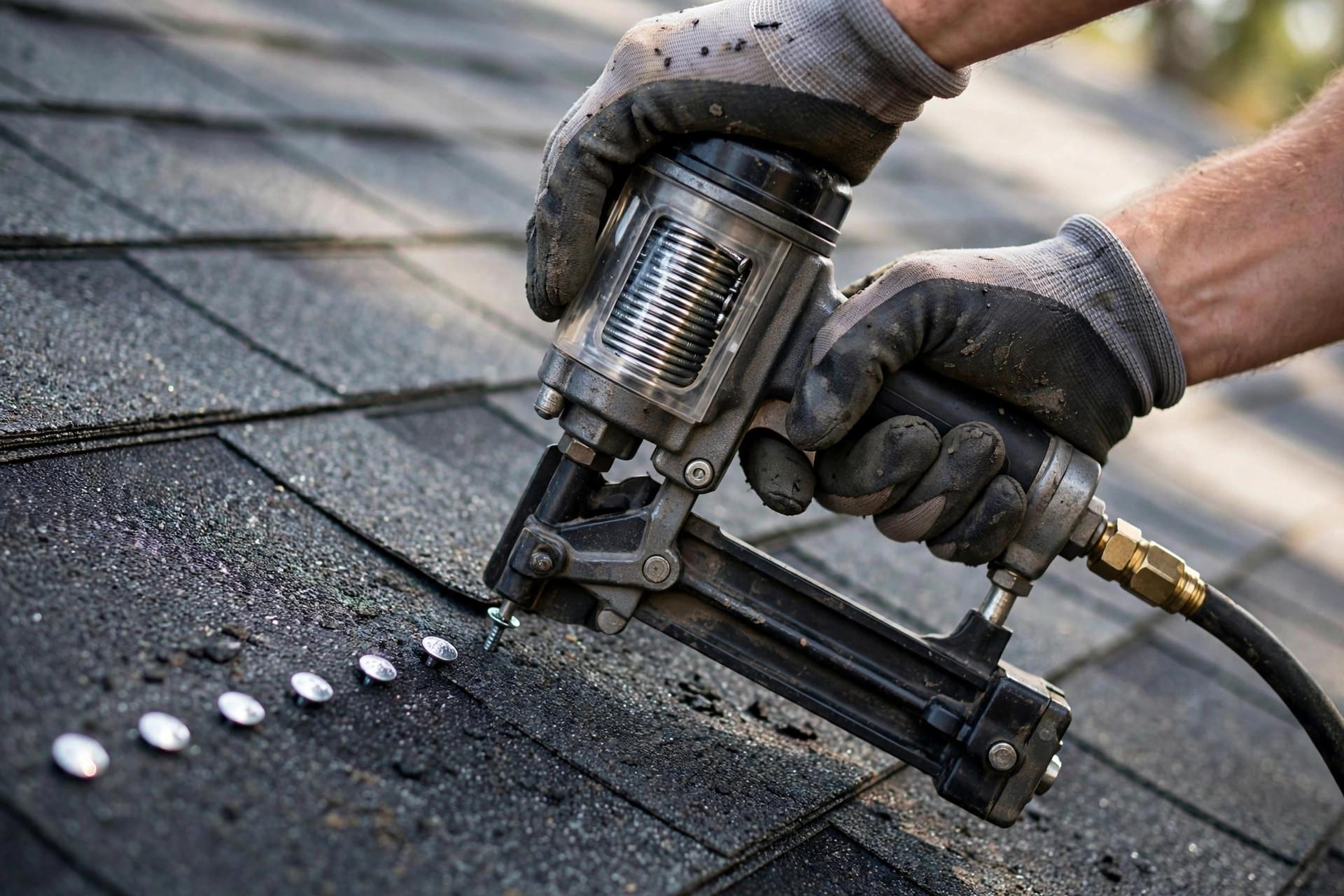
If you’ve ever walked up on a roof after a storm that wasn’t even that bad and found shingles slid halfway down the slope, it usually wasn’t the wind. It was the nailing. I ran a 15-man roofing crew, and nailing was the first thing I checked on every job — and the thing rookie installers got wrong the most. It’s a detail nobody photographs for the portfolio, but it’s the detail that decides whether the wind warranty is real or just marketing paper.
More trade-level how-tos like this live on the RoofAdviceHub Pro hub.
How many nails per shingle? The standard shingle nailing pattern
The default across the big manufacturers — GAF, CertainTeed, Owens Corning — is 4 nails per full architectural shingle, driven through the marked nailing zone. CertainTeed’s shingle applicator’s manual shows exactly that: four nails per full Landmark shingle, spaced across the common bond area — the reinforced band where the shingle’s two layers overlap.
The hardware matters too. Per industry best practices for high-velocity wind zones, use 11- or 12-gauge roofing nails with 3/8- to 7/16-inch heads, long enough to penetrate the deck a minimum of 3/4 inch — or all the way through thinner sheathing. On a single layer of 1/2-inch decking, that usually means a 1-1/4-inch nail; CertainTeed’s Landmark specs call out 1-1/4 inches as the minimum. Grab a box of 11- or 12-gauge roofing coil nails and you’re working with the right fastener for the job.
4 vs 6 nails: when the extra two nails matter
The extra two nails buy wind resistance — and it’s not a marketing gimmick. Shingle wind ratings are tested under ASTM D3161 (Class F, up to 110 mph) and ASTM D7158 (Class G/H, up to 120–130 mph), and the fastening schedule is part of the test.
Here’s what the manufacturer warranties actually say, from current 2026 published specs:
- CertainTeed Landmark: the 15-year wind warranty covers 110 mph with standard 4-nail application, and upgrades to 130 mph when you six-nail the shingle and use CertainTeed starter shingles and hip-and-ridge caps per the instructions. As CertainTeed’s technical literature notes, all three conditions have to be met — the six nails alone don’t trigger the upgrade.
- GAF Timberline HDZ: the WindProven limited wind warranty carries no maximum wind speed when the shingles go on as part of a full GAF roofing system (15-year term). GAF’s installation instructions specify 4 nails standard, 6 nails in high-wind areas.
- Owens Corning Duration: the SureNail fabric strip gives the shingle its 130 mph rating with the standard nailing pattern — no extra nails required — which is a real labor advantage on big roofs.
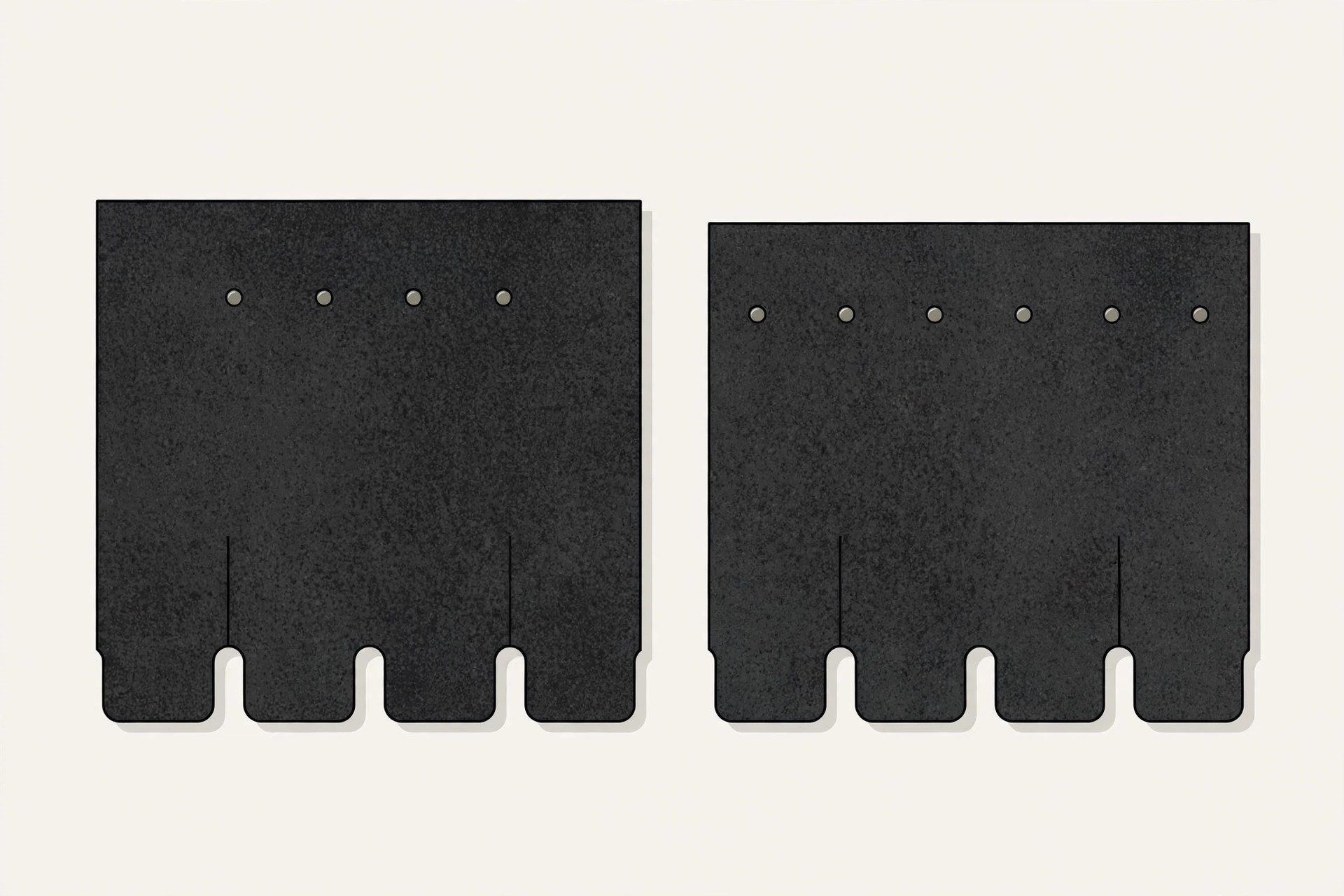
On the ground, the rule is simple: if the building code, the product approval, or the shingle’s install sheet calls for high-wind fastening, you six-nail. In Florida’s HVHZ (Miami-Dade and Broward) it’s mandatory, with ring-shank fasteners and additional fastening rules on top — which is one reason Florida roof jobs price differently than inland work. Along the Texas coast and anywhere else the design wind speed exceeds 110 mph, assume 6 nails until you’ve read the actual product approval. On gable rakes and eave edges — where uplift hits hardest — I’d six-nail even when the spec allowed four. Cheap insurance.
The nail line: why placement beats count
Laminated shingles carry a marked nailing zone — GAF calls it the StrikeZone (up to 600% larger than older nailing areas, which is why HDZ shingles are so forgiving), CertainTeed calls it NailTrak. If you’re still working architectural vs. 3-tab shingles, know that the nail line is a laminated-shingle feature: the nail has to pass through both layers of the laminate so the fastener clamps the whole shingle.
CertainTeed’s installer training is explicit: when you six-nail, the six nails go spaced evenly across the common bond area. Six nails scattered anywhere else don’t count — and nails that miss the zone do more than nothing. They actively void the wind warranty.
The three killers I pulled guys aside for:
- High nailing — nails driven above the nail line. The head catches only the top layer, or worse, misses the shingle below entirely. The tab can still seal and look right, which is what makes this one dangerous: it fails in the first real windstorm, years later.
- Overdriven nails — the gun cuts through the mat. Flush is the target; anything countersunk is a damaged shingle and a future leak path.
- Underdriven or angled nails — nail pops push the next course up, break the seal strip, and telegraph through the shingles above. Angled nails hold a fraction of a straight-driven nail’s grip, per the Building Enclosure high-velocity wind zone guidance.
The 10-second QC check
On my crew, the first two minutes of every day went like this: fire two nails from your pneumatic roofing nailer into a scrap piece of decking and check the depth setting. Heads flush with the surface, not countersunk, not proud. Then set the compressor and don’t touch it unless the temperature or the hose length changes — both change the pressure and the depth.
During the run, walk the courses behind your nailers. Every few rows, lift a tab and confirm the nails are sitting in the nail zone. A crew that can’t show you nails in the zone is a crew writing callbacks. And if you ever inherit a “three-nailed” roof — a shingle field with three nails per shingle — know that most manufacturers can deny the wind warranty on improper fastening alone. I’ve watched that argument lose more than one storm claim.
Lee esta guía en español: Patrón de clavado en tejas: 4 vs 6 clavos y la línea de clavado
One more place nail discipline matters: at roof-to-wall intersections, keep shingle nails back from the wall so no fastener pierces the step flashing.
The same discipline applies to the metal at the roof’s edge — drip edge nails go high on the flange so the next course covers them, as shown in how to install drip edge the right way.
Nail-line discipline is also the fastest way to spot a good hire — more on how to hire a roofing crew that doesn’t cut corners.
How to read a shingle bundle wrapper explains what the wrapper says about exposure, nail count, and warranty fine print.
How many nails per shingle does code require?
Building code generally points back to the manufacturer’s installation instructions: 4 nails per laminated shingle standard, 6 in high-wind zones, with fasteners long enough to penetrate at least 3/4 inch into the deck. Some local jurisdictions (Florida HVHZ, coastal Texas counties) mandate 6 nails outright — always check the local product approval.
Do I need 6 nails per shingle in Florida?
In Miami-Dade and Broward counties — the High Velocity Hurricane Zone — yes, 6 nails per shingle plus ring-shank fasteners and additional high-wind fastening rules. Elsewhere in Florida, the answer depends on the shingle’s product approval and the design wind speed of the site. Read the approval for the exact product you’re installing.
What happens if shingles are nailed too high?
High nails miss the reinforced nail line and often miss the shingle course below, so the fastener isn’t clamping what it should. The tab can still seal and look normal, then lift off in a moderate windstorm. Because it’s an installation defect, the manufacturer can deny the wind warranty — it’s one of the most common findings on failed wind claims.
Disclosure: RoofAdviceHub is reader-supported. When you buy through links on our site we may earn an affiliate commission at no extra cost to you. As an Amazon Associate we earn from qualifying purchases.
Last updated: October 2026
Leave a Reply