
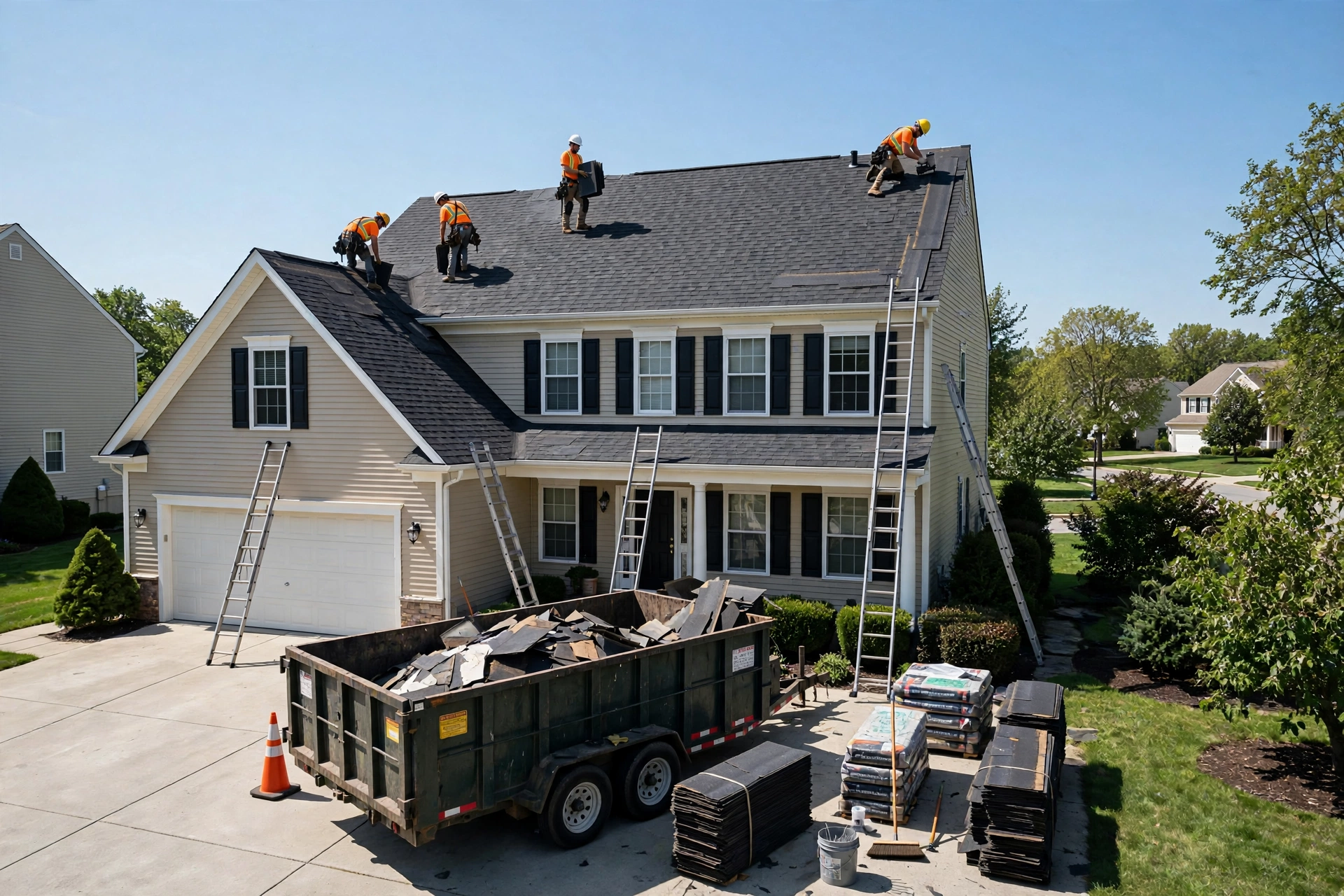
If you’ve been putting off a roof replacement because the price feels like a mystery, you’re not alone. Most homeowners I talk to have no idea what a new roof should cost — and that gap is exactly where bad quotes and overpriced bids thrive. I spent years running a 15-person roofing crew, pricing and replacing roofs of every shape and size. Here’s what a roof replacement actually costs in 2026, what drives the price up or down, and how to know when a quote is fair.
The short answer: national 2026 pricing
Across the United States, a full roof replacement typically runs $4 to $11 per square foot of roof surface, with a national average around $9,600. That means a standard asphalt-shingle replacement on an average-size home usually lands between $8,000 and $20,000, while premium materials or complex roofs can push the total well past $30,000.
Why such a wide range? Because “roof replacement cost” isn’t one number — it’s a combination of roof size, material, pitch, labor, and the condition of what’s underneath. Let’s break each one down.
Cost by roof size (asphalt shingles)
Roofers don’t price by your home’s floor space. They price by roof surface area, measured in “squares” — one square equals 100 square feet of roof. A 2,000-square-foot house can easily have 2,400–3,000 square feet of roof once you account for pitch and overhangs.
| Roof surface area | Typical range (asphalt) |
|---|---|
| 1,200 sq ft | $4,800 – $13,200 |
| 1,500 sq ft | $6,000 – $16,500 |
| 2,000 sq ft | $8,000 – $22,000 |
| 2,500 sq ft | $10,000 – $27,500 |
| 3,000 sq ft | $12,000 – $33,000 |
The low end of those ranges assumes a simple roof shape and basic shingles. Steep pitch, dormers, valleys, skylights, and chimneys all push you toward the higher end — on a complex roof, expect 25–50% more than the same square footage on a simple gable.
Cost by material
After size, your material choice is the single biggest cost driver. Here’s what the most common options look like, installed, in 2026:
| Material | Installed cost per sq ft | Typical lifespan |
|---|---|---|
| 3-tab asphalt shingles | $4 – $6 | 20–25 years |
| Architectural asphalt shingles | $4 – $7 | 25–30 years |
| Metal (standing seam) | $10 – $16 | 40–70 years |
| Metal panels (exposed fastener) | $7 – $12 | 30–45 years |
| Clay or concrete tile | $10 – $18 | 50–100 years |
| Natural slate | $15 – $30 | 75–100+ years |
Architectural (dimensional) shingles are what most American homeowners choose: they cost only slightly more than basic 3-tab shingles and typically last longer and handle wind better. Metal is the natural step up — two to three times the price of asphalt, but with a lifespan that can make it cheaper per year if you stay in the house long enough. For the detailed cost, lifespan, and warranty breakdown, see our architectural vs 3-tab shingles comparison.
What actually drives the price
1. Roof size and complexity
This is about 40% of the cost equation. A big, simple ranch roof can be cheaper per square foot than a small, cut-up Victorian — every valley, dormer, and chimney means extra flashing, extra cuts, and extra labor hours.
2. Pitch (steepness)
Anything above a 6:12 pitch (a fairly steep roof) starts costing more. Crews have to work with safety equipment, materials are harder to stage, and the job takes longer. A very steep roof can add 20–40% to labor costs alone. When I ran my crew, steep jobs were the ones where I told the homeowner upfront: “this will be a different number than your neighbor’s.”
3. Labor
Labor is the elephant in the room — typically 55–65% of the total project cost. Roofing is brutal, skilled work, and experienced crews aren’t cheap. This is also why the cheapest bid is often the most expensive mistake: a rock-bottom price usually means a crew that’s cutting corners on underlayment, flashing, or fasteners.
4. Tear-off and disposal
Ripping off the old roof down to the bare deck typically costs $100–$150 per square ($1–$2 per sq ft), plus dumpster and landfill fees of a few hundred dollars. If your roof has two layers of shingles — the legal maximum under most building codes — the tear-off labor roughly doubles. That old weight adds up fast.
5. Decking repairs
You can’t see the plywood or OSB decking until the old shingles come off, and that’s where surprise costs live. Rotten or soft sheets typically cost $70–$100 per sheet installed to replace. A fair contract includes a per-sheet allowance so a few bad sheets don’t become a mid-job argument.
6. Your location
The same roof can cost 15–30% more in an expensive metro area than in a rural town — same materials, different labor market and permit fees. Coastal and high-wind areas also tend to require upgraded fastening that adds cost.
Tear-off vs. overlay: the shortcut question
An overlay means laying new shingles directly over your old ones, without tearing off. It typically costs $5,000–$9,000 on an average home and can save 25–30% compared to a full tear-off. But — and this matters — most building codes allow a maximum of two shingle layers, and most shingle manufacturers won’t honor their warranty on an overlay. You also can’t inspect the decking underneath.
My rule from the field: an overlay is acceptable only when the existing single layer is in good shape, the deck is solid, and there are no widespread leaks. If there’s rot, multiple problem areas, or you’re already at two layers, it’s tear-off or nothing.
Hidden costs homeowners forget to budget
- Flashing replacement: new metal flashing at valleys, chimneys, and walls is standard on a proper job. Cheap quotes sometimes “reuse” old flashing — that’s a leak waiting to happen.
- Underlayment: synthetic underlayment costs more than basic felt but is worth every penny, especially in storm-prone areas.
- Ventilation: ridge vents, soffit vents, and new pipe boots are often listed as line items. A hot, unventilated attic cooks shingles from below and shortens their life.
- Permits: most cities require a roofing permit, typically $100–$500 depending on location.
- Gutters: usually priced separately ($5–$14 per linear foot), but replacing them during the roofing job saves on labor.
How to keep the cost down without cutting corners
You don’t have to overpay, but saving money on a roof should never mean buying a worse installation. The smart savings are:
- Get three or more quotes with identical scopes, and throw out any bid that isn’t itemized.
- Schedule in the off-season. Late fall through early spring usually means 8–12% lower pricing when contractors are less busy.
- Choose architectural shingles over premium materials unless the roof’s long-term lifespan math favors metal for your situation.
- Ask about the tear-off assumptions: how many layers, what’s the per-sheet decking rate, and what’s included in disposal.
- Don’t pay in full upfront. A reasonable deposit with the balance due on completion protects you.
How much does it cost to replace a roof on a 1,500 sq ft house?
A 1,500 sq ft home usually has about 1,800 sq ft of roof surface. With architectural asphalt shingles, expect roughly $7,400–$10,000 installed. A simple roof shape lands at the low end; steep pitch or multiple layers push it higher.
What is the cheapest way to replace a roof?
A full tear-off with 3-tab asphalt shingles is the cheapest proper replacement, typically $4–$6 per sq ft. An overlay over a single existing layer is cheaper still ($5,000–$9,000 typical), but it shortens the roof’s life and usually voids the manufacturer warranty.
How long does a roof replacement take?
Most residential replacements take 1–3 days of actual on-roof work. Larger homes, steep pitches, bad decking, or weather delays can stretch that to a week.
Does homeowners insurance cover roof replacement?
Only when the damage comes from a covered event — typically a storm, hail, wind, or fire. Insurance doesn’t cover normal wear, aging, or neglect. If your roof is simply old, replacement is on you.
Can I finance a roof replacement?
Yes. Many contractors offer financing or partner with lenders, and home equity loans are common for this size of project. Just make sure the total financing cost doesn’t eat up the value of choosing a cheaper material.
The bottom line
A 2026 roof replacement costs most homeowners somewhere between $8,000 and $20,000 for a quality asphalt-shingle job — more for metal or tile, less for very small or simple roofs. The number that matters most isn’t the national average, it’s the itemized quote for your roof, from a contractor willing to explain every line. Get three of those, compare apples to apples, and you’ll know exactly where the fair price is.
Disclaimer: these are national 2026 ranges gathered from contractor pricing data and cost guides. Actual costs vary by region, roof complexity, and material availability — always get local written quotes before making a decision.
Leave a Reply