
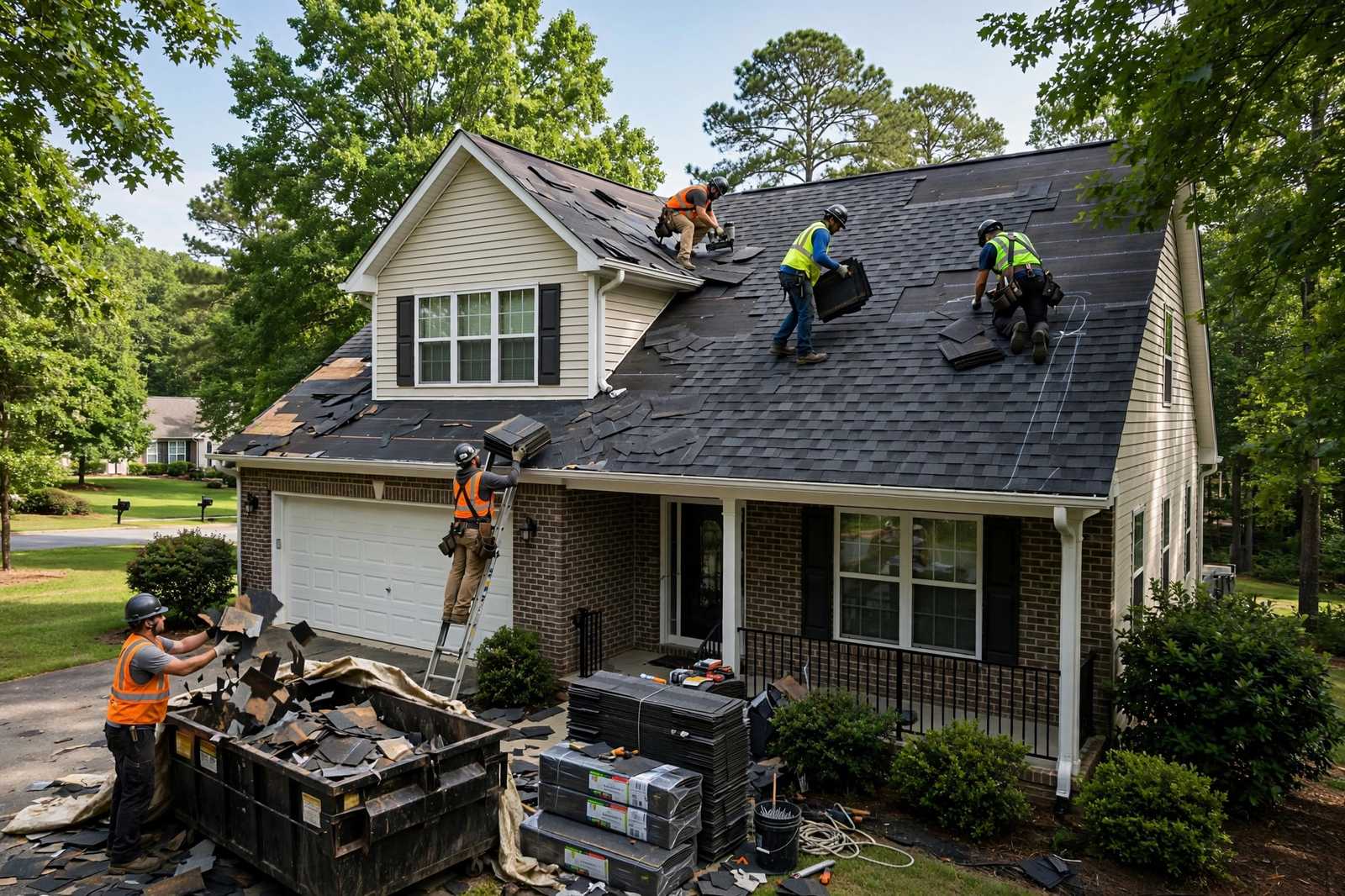
In North Carolina, most homeowners pay about $8,100 to $15,800 for a full roof replacement with architectural asphalt shingles on a typical 2,000-square-foot roof surface in 2026 — roughly $4.05 to $7.90 per square foot installed, about 10% below the national average. Metal, tile, and hail upgrades push the total higher, and steep or cut-up roofs in the Triangle, Charlotte, and the Triad usually land at the top of the range.
The North Carolina discount is real, but material prices rose through 2025 and again in 2026, and this state adds its own pressures: Piedmont hail, hurricane wind on the coast, and humid summers that streak shingles with algae. I ran a 15-person roofing crew for years, and the honest answer is never a statewide average — it is your material, your roof shape, and your storm exposure.
Get your own number first: run your home through our free Roof Cost Calculator with North Carolina preselected — it uses the same North Carolina cost factor as the table below and takes about a minute.
How much does a roof replacement cost in North Carolina?
A North Carolina roof replacement typically costs about 10% less than the national average for the same material: labor rates outside Charlotte and the Triangle run lower, and the state avoids snow-country extras like eave ice barriers.
The table below starts with national installed ranges and applies the North Carolina regional factor of 0.90. Totals assume a 2,000-square-foot roof surface — roofers price by roof surface, not living space, which runs 10–30% larger than floor area once pitch and overhangs are counted. Our complete national roof replacement cost guide explains that measurement in detail.
| Material | NC cost per sq ft (installed) | Typical total — 2,000 sq ft roof | Typical lifespan in NC |
|---|---|---|---|
| 3-tab asphalt shingles | $3.15–$5.85 | $6,300–$11,700 | 15–20 years |
| Architectural asphalt shingles | $4.05–$7.90 | $8,100–$15,800 | 20–30 years |
| Class 4 impact-resistant shingles | $4.30–$7.35 | $8,600–$14,700 | 25–30 years |
| Metal — exposed-fastener panels | $6.30–$10.80 | $12,600–$21,600 | 30–45 years |
| Metal — standing seam | $9.00–$14.40 | $18,000–$28,800 | 40–70 years |
| Clay or concrete tile | $9.00–$16.20 | $18,000–$32,400 | 50+ years |
Most North Carolina homeowners choose architectural shingles: they cost only slightly more than 3-tab and handle hail, heat, and wind better. If you are deciding between those two, our architectural shingles vs 3-tab shingles comparison breaks down the lifespan and warranty math.
What drives roof replacement cost in North Carolina?
Hail, hurricanes, and humidity drive North Carolina roof costs more than labor does — the same house can price very differently in the mountains, the Piedmont, and the Outer Banks.
Hail: the central Piedmont
Central North Carolina’s Piedmont — roughly the Raleigh-Durham, Greensboro, and Charlotte corridors — takes real hail damage from spring and summer thunderstorms. In 2011, hail up to about 4.25 inches was reported across the Piedmont, and 2-inch hail hit Johnston County in September 2026.
That is why Class 4 impact-resistant shingles — the highest UL 2218 rating — are worth pricing in the Piedmont. They cost roughly 10–20% more than standard architectural shingles installed, and some insurers discount premiums for documented Class 4 roofs, though it varies by carrier. Keep the invoice and manufacturer paperwork: no documentation, no discount. Some carriers pair the discount with a cosmetic-damage exclusion — read the fine print. After a hail event, check your roof with our storm damage roof checklist before you call anyone.
Hurricane wind: the coast
From the Outer Banks through Wilmington and the coastal plain, wind rating matters as much as price. Hurricane Florence stalled over the state in 2018 and caused catastrophic flooding and wind damage — a reminder that tropical systems here are a water and wind problem. Look for shingles rated for high winds (many architectural lines carry 110–130 mph ratings with the manufacturer’s high-wind nailing pattern, usually six nails per shingle and sealed starter strips). Coastal jobs may also need enhanced fastening and corrosion-resistant flashing, which adds modest cost but is not the place to cut. Many coastal policies carry a separate hurricane deductible of 1–5% of the dwelling coverage, so know your deductible before storm season.
Humidity and algae: east of the mountains
North Carolina’s humid summers grow Gloeocapsa magma — the blue-green algae behind the black streaks on asphalt shingles. It feeds on the limestone filler in most shingles and is worst on shaded, north-facing slopes. The streaks are mostly cosmetic at first, but the algae wears away granules over time. Algae-resistant shingles with copper granules help, and trimming branches back so the roof dries faster after rain matters more than most people think.
What North Carolina roofs usually do NOT need
Unlike snow-belt states, North Carolina is not required to install ice-and-water shield along the eaves for ice dams in most of the state. Many good North Carolina roofers still use it in valleys and around penetrations, where it earns its keep — but if a quote charges you a large line item for full eave ice barrier in, say, Charlotte, ask why.
Do you need a permit to replace a roof in North Carolina?
In North Carolina, a qualifying non-structural roof replacement does not require a building permit as a matter of state law — but local rules still apply, so this surprises people in both directions.
First, permits: under G.S. § 160D-1110, as amended by House Bill 488 (effective October 1, 2023), a qualifying non-structural project costing $40,000 or less is exempt under state law. That is a state floor, not a local pass: Raleigh generally treats a re-roof as a permitted alteration inside city limits, unincorporated Wake County generally requires a permit above roughly $15,000 or for structural work, and some cities require none for a like-for-like replacement. Fees are usually small (often $50–$200).
Second, licensing: North Carolina requires a general contractor license from the N.C. Licensing Board for General Contractors on any project costing $40,000 or more — raised from $30,000 by House Bill 488 on October 1, 2023 (N.C.G.S. § 87-1). Most asphalt replacements fall under that line; larger metal or tile jobs can cross it. Either way, vet your contractor yourself: verify the license on the state board’s own lookup when required, have the insurer email you the certificate of insurance directly, get the scope in writing, and never pay the full amount up front. After a hailstorm, be extra careful with out-of-state door-knockers.
How to keep a North Carolina roof replacement affordable
The cheapest North Carolina roof is a properly installed architectural or Class 4 shingle roof bought on itemized quotes — not the lowest bid after a storm.
- Get three itemized quotes with the same scope: material line, tear-off layers, decking rate per sheet, flashing, ventilation, and disposal should all be spelled out.
- Price the Class 4 upgrade, then call your insurer: ask exactly what discount that specific roof earns on your policy before you decide.
- Budget a decking allowance: humidity and past leaks mean some North Carolina decks have soft or damaged sheets that only show at tear-off; a fair contract states the per-sheet price in advance.
- Time it if you can: if your roof is not actively leaking, scheduling outside the post-storm rush and hurricane season gives you more contractor choice and calmer pricing.
- Check your number before you sign: compare any quote against the North Carolina roof cost calculator — a bid far outside the range for your material needs an explanation, line by line.
Frequently asked questions
How much does a roof replacement cost in North Carolina?
Most North Carolina homeowners pay about $8,100 to $15,800 for architectural asphalt shingles on a typical 2,000-square-foot roof surface in 2026 — roughly $4.05 to $7.90 per square foot installed. Metal runs $12,600 to $28,800 depending on the system; tile $18,000 to $32,400. Steep, complex, or storm-damaged roofs cost more.
Do you need a permit to replace a roof in North Carolina?
It depends on your city or county. State law (G.S. § 160D-1110, as amended by House Bill 488) exempts qualifying non-structural projects costing $40,000 or less, but local rules vary — Raleigh generally requires a permit for a re-roof inside city limits. Confirm with your local building department before work starts.
Are Class 4 impact-resistant shingles worth it in North Carolina?
For most central Piedmont homes, yes. Class 4 shingles cost about 10–20% more than standard architectural shingles, resist hail better under the UL 2218 test, and some insurers offer premium discounts for a documented Class 4 roof. Confirm your carrier’s exact discount and any cosmetic-damage exclusion first.
Why does my North Carolina roof have black streaks?
The black streaks on most North Carolina shingle roofs are Gloeocapsa magma, a blue-green algae that feeds on the limestone filler in asphalt shingles and thrives in humid, shaded conditions. It is mostly cosmetic at first but wears away protective granules over time. Algae-resistant shingles with copper granules help on a new roof; trimming shade trees matters too.
Disclaimer: these are 2026 North Carolina ranges based on national installed pricing adjusted by a North Carolina regional factor (0.90) and current market reporting. Actual costs vary by city, roof size, pitch, complexity, and material availability — always get local written quotes before making a decision.
Leave a Reply