
Key takeaways
- Texas has no state roofing license, so there is no official “best roofer” list in DFW — vetting is on you, starting with insurance and local registration.
- A fair 2026 DFW roof replacement runs $8,000–$20,000 for Class 3 shingles and $10,000–$25,000 for Class 4 impact-resistant shingles.
- Never sign anything at your door after a storm, and never let a contractor waive your deductible — in Texas, waiving it is a crime.
- Get three itemized bids for the same scope, and verify the warranty is registered in your name before you pay the final check.
There is no official list of the best roofing companies in Dallas-Fort Worth — Texas does not license roofers at all, so the “best” company is the one that passes a real vetting check: verified insurance, local registration, manufacturer certification, and three itemized bids you can compare line by line. In DFW, expect $8,000–$20,000 for a standard architectural-shingle roof in 2026.
A roof is the most expensive single repair most homeowners ever buy — the average U.S. replacement hit $17,631 in 2025, up 33% from the 2021–2024 average, according to Verisk’s U.S. Roof Report 2026. DFW is one of the hardest markets in the country to buy one in: Texas logged 902 hail events of an inch or bigger in 2025, more than any other state, and State Farm paid $1.4 billion in hail claims in Texas alone that year. Every storm brings a wave of out-of-town crews to the Metroplex — the vetting below is how you tell the real companies from the rest.
Why “best roofing companies in Dallas-Fort Worth” lists don’t work
Nobody in Texas checks roofer credentials for you. The Texas Department of Licensing and Regulation licenses electricians, plumbers, and HVAC techs — but not roofers. There is no state exam, no state license, and no minimum experience requirement. As the Roofing Contractors Association of Texas (RCAT) puts it, “anyone can call themselves a roofer in Texas.”
That is why a “best of” list is only as good as the day it was written. Companies change hands and crews turn over. What doesn’t change is the vetting process — use it on every company you consider.
Two voluntary credentials do carry weight. RCAT runs a voluntary licensed-roofer program that requires insurance, experience, and passing exams — not a government license, but a real filter. And the manufacturers run their own programs: GAF Master Elite status is held by roughly 2–3% of U.S. roofing contractors, and Owens Corning’s Platinum Preferred tier by fewer than 1%. Only certified contractors can register the strongest warranties — GAF’s Golden Pledge, for example, covers workmanship for up to 25 years, and only Master Elite contractors can offer it.
The 5-minute background check every DFW roofer should pass
Before you let anyone on your roof, run this check. It takes five minutes and it eliminates most bad actors.
1. Ask for a certificate of insurance — then call the insurer. You want general liability and workers’ compensation, current, in the company’s name. A PDF can be faked; a two-minute phone call to the insurer cannot.
2. Check local registration. Dallas requires contractors, including roofers, to register as general contractors and pay an annual fee. Fort Worth, Arlington, and the suburbs each have their own permit and registration rules. Ask which city the company is registered in and whether they will pull the permit — a legitimate DFW roofer pulls permits as a matter of course. Most DFW cities charge $75–$300 for a roofing permit.
3. Verify a real local address and phone number. A company with a DFW office and a local number has something to lose. A crew working out of a hotel room after a storm does not. Google the address — if it is a UPS store or a vacant lot, move on.
4. Check the manufacturer. If the bid specifies GAF, Owens Corning, or CertainTeed shingles, look the company up on that manufacturer’s “find a contractor” page and confirm the certification level they claim. This two-minute check tells you whether their warranty promises are real.
5. Read the complaints, not just the stars. Check the Better Business Bureau profile and recent Google reviews. Look for how the company responds to complaints — silence is an answer too.
What a fair DFW roof costs in 2026
You cannot judge a bid without knowing the market. For a typical DFW home, a local roofer’s published 2026 pricing puts Class 3 architectural shingles at $8,000–$20,000 and Class 4 impact-resistant shingles at $10,000–$25,000. Modernize’s Texas data puts the Dallas average around $22,800 for a full replacement on a typical 1,800–2,200 sq ft home. The spread is wide because roof size, pitch, and complexity move the number more than the company name does. Our Texas roof replacement cost guide breaks down the state numbers by material, and our 2026 national cost guide explains what drives the range.
Two DFW-specific facts matter when you read bids. Class 4 shingles cost roughly $100–$150 more per square than standard architectural shingles, but they are built for the North Texas hail corridor and many insurers offer discounts for them. And labor prices can spike 25–40% in the weeks after a big hail event, when every crew in the region is booked — if you can wait for a non-storm window, you will usually pay less.
Costs vary by region, roof complexity, and material — get local quotes. But if a bid comes in far below the ranges above, that is not a bargain. It is a bid that is missing something: tear-off, decking, underlayment, flashing, or the permit.
How to compare three bids without getting fooled
Get three bids. Not two, not five — three is enough to see the market and few enough to compare carefully. Then compare them on the same scope, line by line. A bid is not a single number; it is a list of decisions.
Same shingle, same class. Make sure all three bids quote the same material — same manufacturer, same product line, same impact rating. One bid quoting Class 3 and another quoting Class 4 are not comparable, and the cheaper one is not cheaper.
Tear-off vs. overlay. Every bid should state whether the old roof comes off. In DFW heat, an overlay over an old layer traps heat and hides decking damage. A bid that skips tear-off to look cheaper is selling you a shorter-lived roof.
Underlayment, flashing, and drip edge. These are the lines cheap bids quietly drop. Ask each bidder: what underlayment, is all flashing replaced, and is drip edge included? If one bid is $2,000 lower and has no flashing line, you found your $2,000.
Decking allowance. Rotten plywood only shows up at tear-off. A good bid states a per-sheet price for decking replacement and an allowance (for example, up to 5 sheets included). A bid with no decking language at all is a bid that will surprise you mid-job.
Warranty — in writing, in your name. Ask who registers the manufacturer warranty, whether it is registered in your name, and how long the workmanship warranty lasts. A workmanship warranty from a company that may not exist next year is worth nothing.
Payment schedule. A reasonable schedule is a deposit, a payment at material delivery, and the balance on completion. Never pay in full upfront, and never pay the final check until you have walked the property with the crew lead, checked the yard for nails, and seen the permit sign-off and warranty registration.
Storm chasers: the red flags DFW homeowners keep missing
The National Insurance Crime Bureau warned in an October 2026 alert about door-to-door roofing crews working the same script across the country: a free inspection, pressure to sign on the spot, and paperwork that redirects your insurance payment straight to the contractor. DFW gets this pitch after every hailstorm.
Walk away if a roofer does any of these:
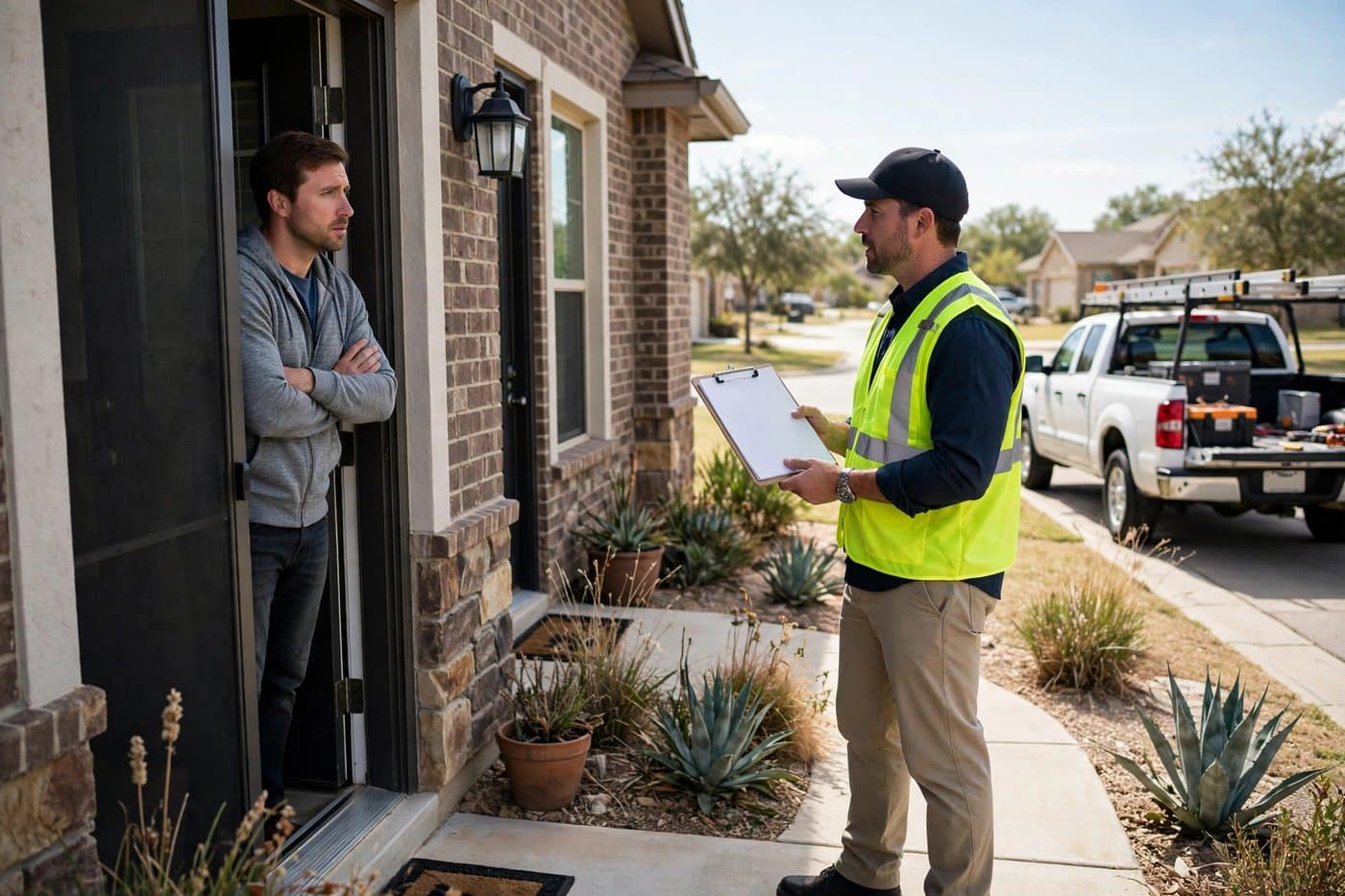
- Knocks on your door uninvited after a storm and offers a “free inspection” that ends with a contract in your hand. Legitimate DFW companies are busy enough after a storm that they do not need to canvass neighborhoods.
- Pressures you to sign today. “This price is only good if you sign now” is a sales tactic, not a roofing fact. A real bid is good for at least a week.
- Offers to “handle” your deductible. Under Texas Business and Commerce Code §27.02, a contractor may not waive, rebate, or absorb your insurance deductible — it is a Class B misdemeanor, with fines up to $2,000 and up to six months in jail.
- Offers to act as your public adjuster. Texas Insurance Code §4102.163 prohibits a contractor from acting as a public adjuster on a property where they provide roofing services.
- Asks you to sign a blank document or an assignment of benefits before you have a written, itemized bid. Never sign anything you have not read in full.
- Has out-of-state plates, no local address, and no local references. After the job, they are gone — and so is your warranty.
If your roof took hail damage and you are not sure what to do first, our storm damage checklist walks through documenting the damage and filing the claim before you call anyone. And when the job is done, give it one good rain — if anything drips or stains, call the company immediately and in writing. A pair of binoculars lets you check the ridge caps and flashing from the ground without climbing a ladder.
Who is the best roofing company in Dallas-Fort Worth?
There is no official ranking, because Texas does not license roofers. The best company for your home is the one that passes the vetting check: verified insurance, registration in your city, manufacturer certification confirmed on the manufacturer’s site, and three itemized bids for the same scope.
How much does a roof replacement cost in Dallas-Fort Worth?
For a typical DFW home in 2026, Class 3 architectural shingles run $8,000–$20,000 and Class 4 impact-resistant shingles run $10,000–$25,000, per local roofer pricing published in October 2026. The Dallas average for a full replacement is around $22,800 per Modernize’s Texas data.
Do roofers need a license in Texas?
No. Texas has no state roofing license — the Texas Department of Licensing and Regulation does not regulate roofing contractors. Some cities, including Dallas, require local contractor registration, and most DFW cities require a roofing permit. RCAT offers a voluntary licensing program for roofers who want to prove insurance, experience, and training.
How do I know if a roofing company is legit in Texas?
Verify their certificate of insurance by calling the insurer, confirm local registration and a real DFW address, look the company up on the manufacturer’s contractor finder, and check BBB and Google reviews for how they handle complaints. Walk away from anyone who pressures you to sign at the door or offers to waive your deductible.
Know what your roof should cost before you sign anything
Get a free estimate range for your DFW home in about a minute — pick your roof size and material and see the numbers before the first bid arrives.
Costs vary by region, roof complexity, and material — get local quotes. This article is educational, not a contractor recommendation; verify any company’s insurance, registration, and references yourself before hiring.
Disclosure: RoofAdviceHub is reader-supported. When you buy through links on our site we may earn an affiliate commission at no extra cost to you. As an Amazon Associate we earn from qualifying purchases.
Last updated: November 2026
Leave a Reply