
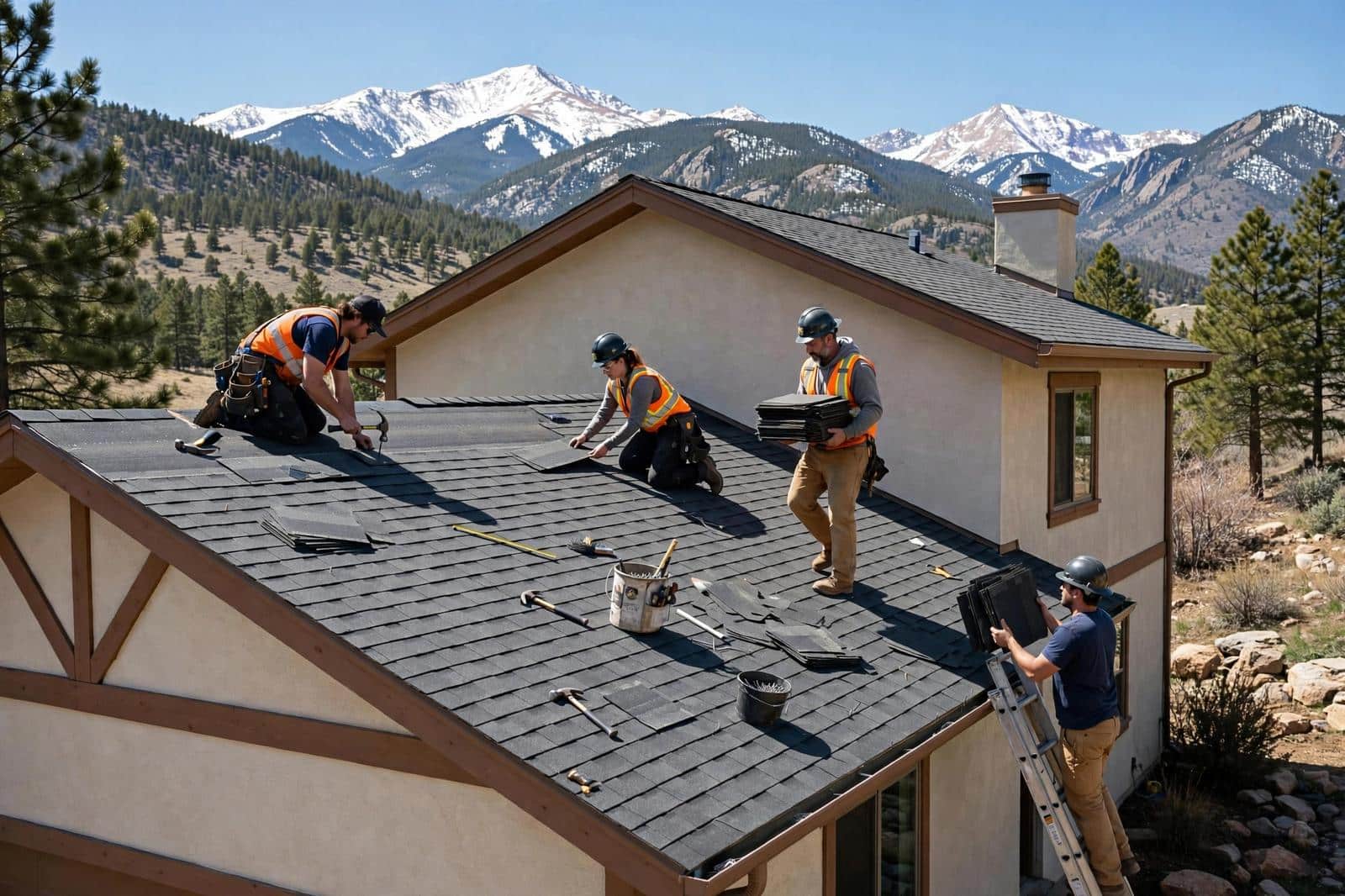
In Colorado, most homeowners pay about $8,300 to $16,100 for a full roof replacement with architectural asphalt shingles on a typical 2,000-square-foot roof surface in 2026 — roughly $4.15 to $8.05 per square foot installed, slightly below the national average. Class 4 impact-resistant shingles are close to standard along the Front Range, and hail in Denver–Colorado Springs, snow load in the high country, and thin-air UV at altitude mean the same house can price very differently across the state.
Colorado is one of the trickiest states to give a single roof price for. Hail batters the Front Range every spring and summer, mountain roofs fight snow load and ice dams all winter, and the sun at 5,280 feet ages shingles faster than the brochure admits. I ran a 15-person roofing crew for years: the honest Colorado answer is never a statewide average — it is your material, your roof shape, and what the weather does where you live.
Get your own number first: run your home through our free Roof Cost Calculator with Colorado preselected — it uses the same Colorado cost factor as the table below.
How much does a roof replacement cost in Colorado?
A Colorado roof replacement typically costs about 8% less than the national average for the same material — but Colorado adds line items most states never see: impact-resistant material for hail country and ice-barrier work required by the state building code. The table below starts with national installed ranges and applies the Colorado regional factor of 0.92. Totals assume a 2,000-square-foot roof surface — roofers price by roof surface, not living space, which usually runs 10–30% larger than your home’s floor area. Our national roof replacement cost guide explains that measurement in detail.
| Material | Colorado cost per sq ft (installed) | Typical total — 2,000 sq ft roof | Typical lifespan in Colorado |
|---|---|---|---|
| 3-tab asphalt shingles | $3.20–$6.00 | $6,400–$12,000 | 15–20 years |
| Architectural asphalt shingles | $4.15–$8.05 | $8,300–$16,100 | 20–30 years |
| Class 4 impact-resistant shingles | $4.35–$7.50 | $8,700–$15,000 | 25–30 years |
| Metal — exposed-fastener panels | $6.45–$11.05 | $12,900–$22,100 | 30–45 years |
| Metal — standing seam | $9.20–$14.70 | $18,400–$29,400 | 40–70 years |
| Clay or concrete tile | $9.20–$16.55 | $18,400–$33,100 | 50+ years |
Most Colorado homeowners choose architectural shingles: they cost only slightly more than 3-tab and handle wind better. If you are deciding between those two, our architectural shingles vs 3-tab shingles comparison breaks down the lifespan and warranty math. Along the Front Range, the Class 4 upgrade is near-standard — only modestly more installed, and it pays back through insurance discounts and fewer claims. Tile is far less common here than in the Southwest, and it is heavy — your structure may need reinforcement, which is not included above. Metal, especially standing seam, earns its keep in mountain towns, where a steep metal roof sheds snow instead of holding it.
What drives roof replacement cost in Colorado?
Hail, altitude, and snow drive Colorado roof costs more than labor does.
Hail country: the Front Range
The Denver–Colorado Springs corridor sits in one of the most hail-exposed metro areas in the country — the Front Range is sometimes called the “hail capital” of North America, and hail-risk studies have repeatedly placed Aurora, Colorado Springs, and Denver among the most hail-prone metro areas in the nation. Hail season runs roughly spring through late summer. That is why Class 4 impact-resistant shingles — the highest UL 2218 rating — are close to standard here: they cost only a few hundred to a bit over a thousand dollars more on a typical project, but Colorado law requires insurers to offer premium discounts for qualifying impact-resistant roofing, commonly reported at 15–30% on the dwelling portion. Keep the invoice and manufacturer paperwork: no documentation, no discount. Also read the fine print — some policies carry a cosmetic-damage exclusion, meaning dents that do not crack the shingle may not be paid later. Our storm damage roof checklist walks through what to check after hail.
High-altitude UV and freeze-thaw
The sun hits harder at 5,280 feet. High-altitude UV shortens shingle lifespan faster than at lower elevations, and rapid freeze-thaw cycling works seal strips and flashing loose. The honest field math: a Colorado architectural shingle roof rated for 25–30 years often delivers less when hail, UV, and poor ventilation stack up — one Denver-area contractor puts the real-world average closer to 11 years, and the gap is almost always installation and environment, not the shingle brand. Ventilation is the part most quotes undersell: an attic that traps heat bakes shingles from underneath.
Snow load and ice dams: the mountain towns
In the high country — Summit County, the Aspen area, and the other mountain towns — winter is the driving risk. Heavy snow loads stress ridge caps and flashing, and ice dams back water up under shingles at the eaves. Colorado’s building code answers that history: the state’s amendments require an ice barrier at the eaves on steep-slope roofs, extending at least 24 inches inside the exterior wall line, with wider coverage at valleys and where the roof meets walls. This is not an optional upcharge in mountain towns — it is code, and the permit inspector checks it.
The insurance squeeze
Colorado insurers have been losing money in the state in most of the past decade, largely on hail and wind — State Farm alone paid out $521 million in Colorado hail claims in 2024. Homeowners feel it three ways: rising premiums; roof age under a microscope (the Rocky Mountain Insurance Information Association has said 10 years can be a benchmark for asphalt roofs); and shifting terms, with separate higher wind/hail deductibles and some policies moving to actual cash value on older roofs. Know which kind you have before hail season.
Do you need a permit to replace a roof in Colorado?
In most Colorado jurisdictions, yes — a full roof replacement generally requires a building permit from your city or county. Denver requires permits, and inspectors check materials and workmanship, including the ice barrier, drip edge, and ventilation the code requires. Most Front Range cities operate the same way: permit, inspection, sign-off. Fees are set locally, so confirm with your city or county before work starts — and make sure a legitimate contractor pulls the permit in their own name.
The permit matters more than the paperwork: the new roof has to meet the code your city enforces today, not the code from when the house was built. Code upgrades — drip edge, ice barrier, ventilation, damaged decking — go on the job whether your old roof had them or not. Many homeowners policies include “ordinance or law” coverage for code-required work during a covered repair, so ask your adjuster before you assume the upgrade is out of pocket.
How to keep a Colorado roof replacement affordable
The cheapest Colorado roof is a properly installed architectural or Class 4 shingle roof bought on itemized quotes — not the lowest bid after a storm.
- Get three itemized quotes with the same scope: material, tear-off layers, decking rate per sheet, flashing, ventilation, ice barrier, and disposal spelled out.
- Price the Class 4 upgrade, then call your insurer: ask exactly what discount that specific roof earns on your policy — in hail country it can repay the upgrade in a few years.
- Budget a decking allowance: hail strikes and past leaks mean some decks have soft sheets that only show at tear-off; a fair contract states the per-sheet price in advance.
- Time it if you can: if your roof is not actively leaking, scheduling outside the post-storm rush gives you more contractor choice and calmer pricing.
- Check your number before you sign: compare any quote against the Colorado roof cost calculator — a bid far outside the range for your material needs an explanation, line by line.
Frequently asked questions
How much does a roof replacement cost in Colorado?
About $8,300 to $16,100 for architectural asphalt shingles on a typical 2,000-square-foot roof surface in 2026, or $4.15 to $8.05 per square foot installed. Class 4 impact-resistant shingles run $8,700 to $15,000, metal $12,900 to $29,400, and tile $18,400 to $33,100.
Do you need a permit to replace a roof in Colorado?
Usually yes: most Colorado cities and counties require a building permit for a full roof replacement, and your contractor should pull it. Denver and most Front Range cities inspect the work — including the code-required ice barrier, drip edge, and ventilation — before signing off.
Are Class 4 impact-resistant shingles worth it in Colorado?
For most Front Range homes, yes. Class 4 shingles cost only modestly more than standard architectural shingles and resist hail far better under the UL 2218 test, and Colorado law requires insurers to offer premium discounts for qualifying impact-resistant roofs — commonly reported at 15–30% on the dwelling portion. Confirm your carrier’s exact discount and any cosmetic-damage exclusion first.
How long does a roof last in Colorado?
An architectural asphalt roof is rated for 20–30 years, but Colorado’s hail, high-altitude UV, and freeze-thaw cycling mean real-world life here often runs shorter — especially with poor ventilation. Class 4 shingles hold up better against hail, metal roofs commonly last 40–70 years, and tile 50+ years.
Disclaimer: these are 2026 Colorado ranges based on national installed pricing adjusted by a Colorado regional factor (0.92) and current market reporting. Actual costs vary by city, roof size, pitch, complexity, and material availability — always get local written quotes.
Leave a Reply