
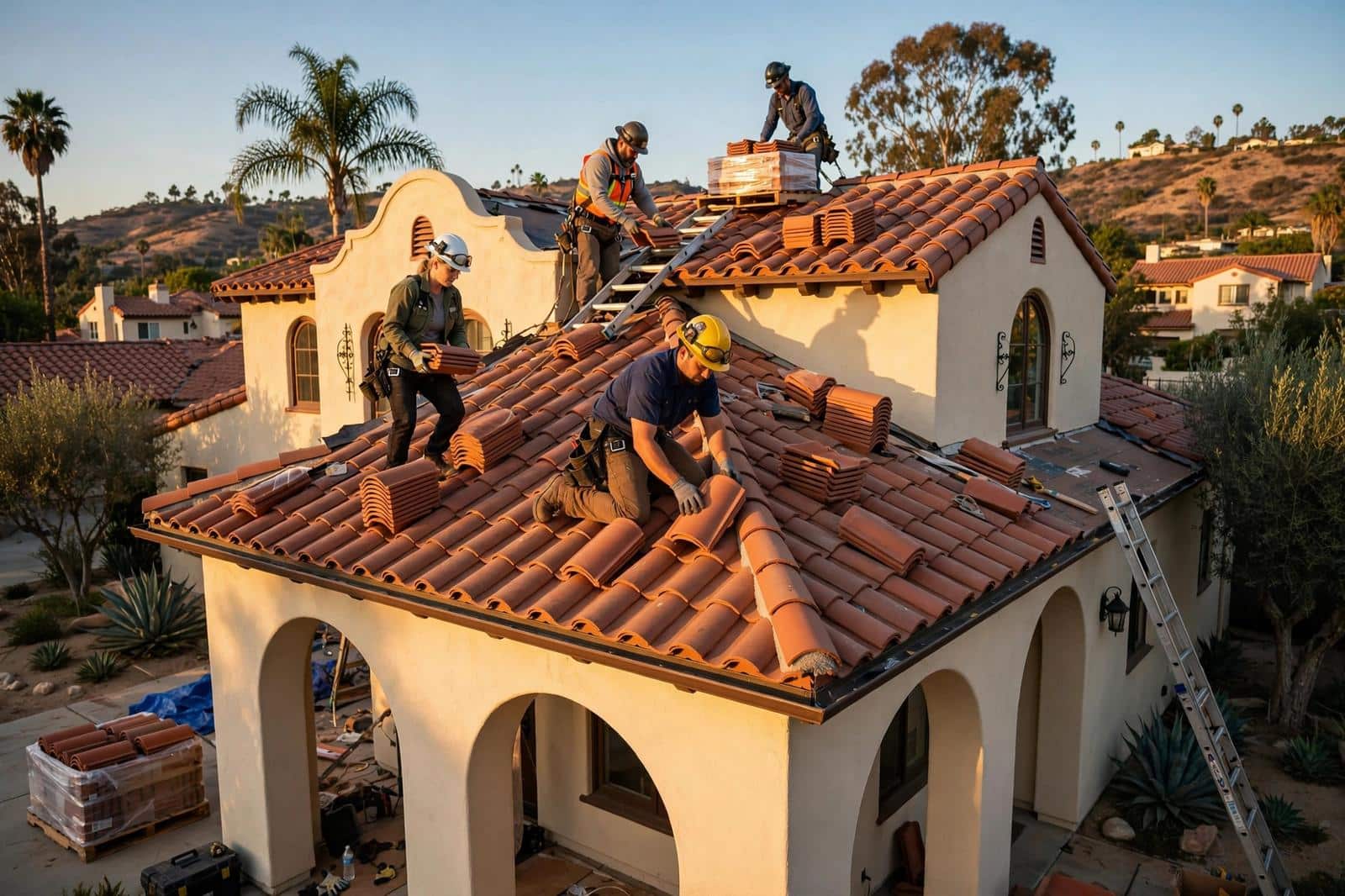
In California, most homeowners pay about $11,000 to $21,300 for a full roof replacement with architectural asphalt shingles on a typical 2,000-square-foot roof surface in 2026 — roughly $5.50 to $10.65 per square foot installed, about 22% above the national average. Metal, tile, and fire-rating upgrades push the total higher, and homes in the Bay Area, Los Angeles, and San Diego usually land at the top of the range.
California is the most expensive state in our pricing program to re-roof. Roofer wages here top the national range, every contractor must hold a state C-39 roofing license, and the job carries Title 24 cool-roof products, Class A fire-rated assemblies in fire zones, and city or county permits with real inspections. I ran a 15-person roofing crew for years, and the honest California answer is never a statewide average — it is your material, your roof shape, your climate zone, and your fire zone. Here is how the numbers actually break down.
Get your own number first: run your home through our free Roof Cost Calculator with California preselected — it uses the same California cost factor as the table below and takes about a minute.
How much does a roof replacement cost in California?
A California roof replacement typically costs about 22% more than the national average for the same material, because labor rates top our program and most California roofs carry compliance costs — cool-roof materials, permits, inspections — that cheaper states do not have. The table below starts with national installed ranges and applies the California regional factor of 1.22, rounded to clean ranges. Totals assume a 2,000-square-foot roof surface — roofers price by roof surface, not living space, and your roof surface is usually 10–30% larger than your home’s floor area once pitch and overhangs are counted. Our complete national roof replacement cost guide explains that measurement in detail.
| Material | California cost per sq ft (installed) | Typical total — 2,000 sq ft roof | Typical lifespan in California |
|---|---|---|---|
| 3-tab asphalt shingles | $4.25–$7.95 | $8,500–$15,900 | 15–20 years |
| Architectural asphalt shingles | $5.50–$10.65 | $11,000–$21,300 | 20–30 years |
| Class 4 impact-resistant shingles | $5.80–$9.95 | $11,600–$19,900 | 25–30 years |
| Metal — exposed-fastener panels | $8.55–$14.65 | $17,100–$29,300 | 30–45 years |
| Metal — standing seam | $12.20–$19.50 | $24,400–$39,000 | 40–70 years |
| Clay or concrete tile | $12.20–$21.95 | $24,400–$43,900 | 50+ years |
Most California homeowners choose architectural shingles: slightly more than 3-tab, better against UV and heat. Our architectural shingles vs 3-tab shingles comparison breaks down the lifespan and warranty math. Tile is California’s signature roof — barrel-profile clay and concrete tiles are everywhere in Spanish and Mediterranean-style neighborhoods — but it is heavy, so your structure may need reinforcement, which is not included above. See our roofing materials comparison for how tile, metal, and shingles compare on cost, weight, and lifespan.
What drives roof replacement cost in California?
Labor, energy code, and fire code drive California roof costs more than materials do — the same house prices very differently in San Diego, Sacramento, and a hillside community in a fire zone.
Labor, licensing, and the cost of doing it legally
California roofer wages top the national range, and the state adds overhead no cheaper state has. Any roofing job over $500 must be done by a contractor holding a C-39 roofing license from the Contractors State License Board — that credentialed pool, plus high workers’ comp and insurance costs, is baked into every legitimate bid.
Fire zones: Class A is the rule, not the upgrade
In designated Wildland-Urban Interface and Fire Hazard Severity Zones, the California Building Code (Chapter 7A) requires a Class A fire-rated roof assembly, tested to ASTM E108 or UL 790 — covering new construction in State Responsibility Areas and Very High Fire Hazard Severity Zones. Wood shake is off the table in those areas, and your roofer must document the assembly’s fire rating for inspection — tile and metal earn Class A naturally, and rated architectural shingle assemblies do too. Keep the manufacturer documentation with your permit file.
Title 24 cool roofs
Under Title 24, re-roofs on single-family homes must use products meeting minimum aged solar reflectance and thermal emittance values in many climate zones — for steep-slope roofs, an aged solar reflectance of at least 0.20 (SRI of at least 16) in zones 4 and 8 through 15, with stricter values for low-slope roofs. In much of inland and Southern California, your replacement shingles must be rated “cool” products. Heavy tile roofs are exempt, as are roof areas covered by solar panels. Most major shingle lines carry cool-rated colors now, so compliance usually means choosing from a specific palette rather than paying a premium.
What California roofs usually do NOT need
Unlike snow-belt states, California does not require ice-and-water shield along the eaves for ice dams — most of the state will never see one. Good roofers still use it in valleys and around penetrations, but if a quote charges you a big line item for full eave ice barrier in Fresno, ask why. Class 4 impact-resistant shingles are worth pricing mainly if your insurer offers a hail or wind discount; hail is not the statewide driver here that it is in Texas or Colorado.
Do you need a permit to replace a roof in California?
In most California cities and counties, yes — a full roof replacement requires a building permit, and the inspection is real.
Permit rules and fees vary by city and county, but the pattern holds: your contractor submits the roofing plans, material specifications, and their C-39 license information, and the jurisdiction schedules inspections — many counties require an in-progress inspection plus a final one. Your roofer should pull the permit in their own name; one who asks you to pull it yourself is telling you something. Since January 2020, Title 24 has required rooftop solar on most newly built homes, so new builds design the roof and the array together — and even on a re-roof, tell your roofer if panels are coming so mounts land on fresh flashing.
How to keep a California roof replacement affordable
The cheapest California roof is a properly installed, code-compliant architectural shingle roof bought on itemized quotes from C-39 licensed contractors — not the lowest bid with the license number missing.
- Get three itemized quotes with the same scope: material line, tear-off layers, decking rate per sheet, flashing, ventilation, and disposal spelled out — each bid should name the cool-roof rating and fire rating for your address.
- Match the upgrades to your zone: in a designated fire zone, the Class A assembly is mandatory — do not pay extra for what the code already requires. Outside one, do not buy ratings your address does not need.
- Budget a decking allowance: sun-baked and leak-damaged decks hide soft sheets that only appear at tear-off; a fair contract states the per-sheet replacement price in advance (commonly around $70–$100 per sheet installed nationally).
- If solar is in your future, say so now: a re-roof is the cheapest moment to add flashed standoffs for a future array, avoiding penetrations through a brand-new roof later.
- Check your number before you sign: compare any quote against the California roof cost calculator — a bid far outside the range for your material needs an explanation, line by line.
Frequently asked questions
How much does a roof replacement cost in California?
Most California homeowners pay about $11,000 to $21,300 for architectural asphalt shingles on a typical 2,000-square-foot roof surface in 2026 — roughly $5.50 to $10.65 per square foot installed, about 22% above the national average. Metal runs $17,100 to $39,000 by system, and tile $24,400 to $43,900. Steep, complex, or fire-zone roofs cost more.
Do you need a permit to replace a roof in California?
Usually yes: most cities and counties require a building permit for a full roof replacement — often with an in-progress inspection and a final one — and your C-39 licensed contractor should pull it in their name. Minor repairs typically do not need one, but confirm locally.
Does California require a cool roof on a re-roof?
In many climate zones, yes. Under Title 24, steep-slope re-roofs in zones 4 and 8 through 15 must use products with an aged solar reflectance of at least 0.20 (SRI of at least 16); low-slope roofs face stricter values. Heavy tile roofs and areas covered by solar panels are exempt.
How long does a roof last in California?
An architectural asphalt roof typically lasts about 20–30 years in California, often toward the lower end inland, because UV and heat age shingles from above. Metal roofs commonly last 40–70 years and clay or concrete tile 50+ years — one reason tile dominates the state’s Spanish and Mediterranean-style neighborhoods. Good attic ventilation remains the cheapest way to protect whatever roof you buy.
Disclaimer: these are 2026 California ranges based on national installed pricing adjusted by a California regional factor (1.22) and current market reporting. Actual costs vary by city, roof size, pitch, complexity, fire zone, and material availability — always get local written quotes before making a decision.
Leave a Reply