
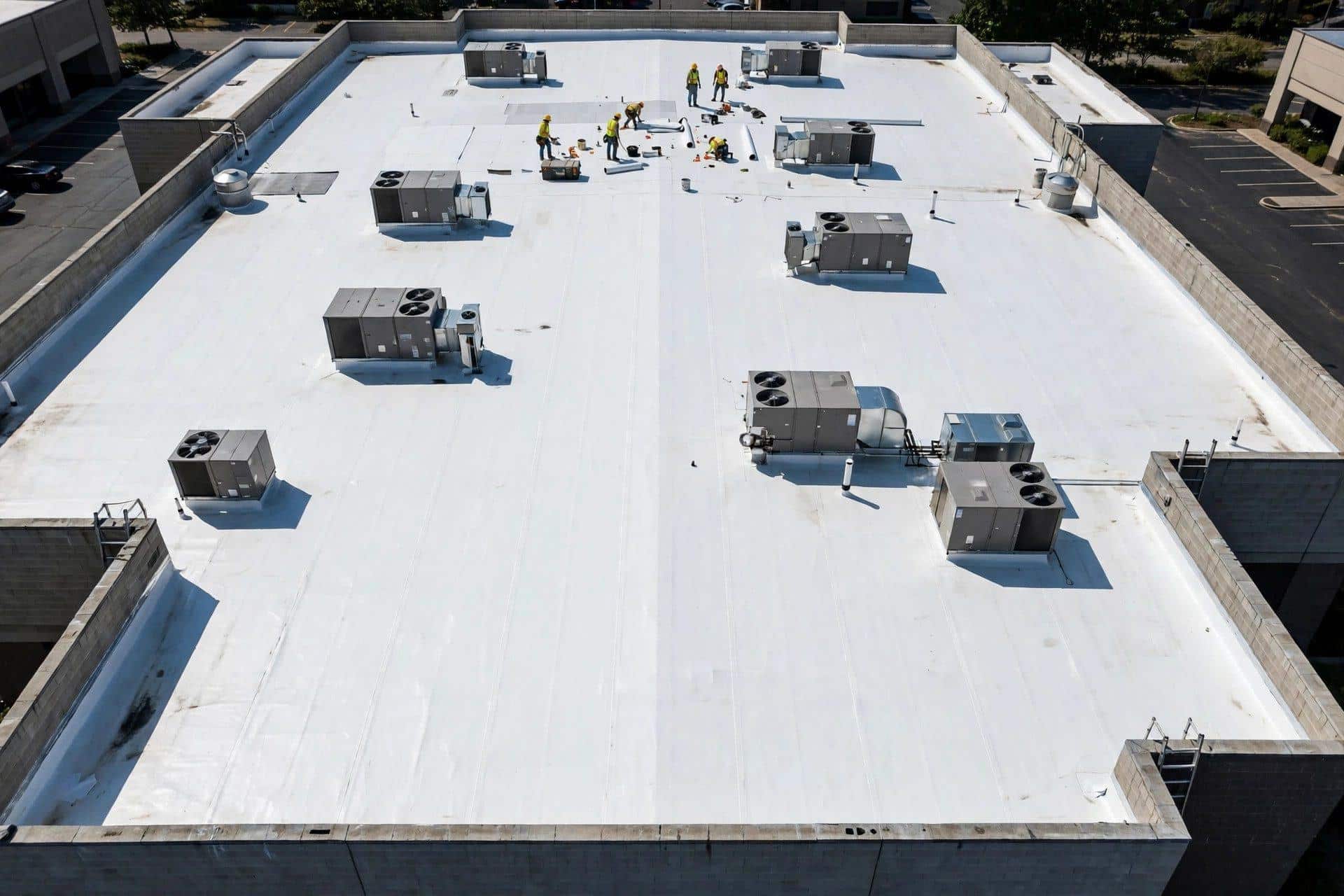
Key takeaways
- Replacing a 10,000 sq ft commercial roof in 2026 typically costs $55,000–$120,000 for a standard single-ply membrane system, installed.
- Per square foot, expect $5.50–$12 for most membrane replacements.
How much does it cost to replace a 10,000 sq ft commercial roof? In 2026, a standard single-ply membrane replacement typically runs $55,000–$120,000 installed.The cheapest bid is often the one that left something out — tear-off, insulation to code, and drainage work are where low bids hide the real cost.
A recover (new roof over the old one) can save $1–$3 per square foot in tear-off, but only when the existing roof is dry and code allows a second layer.
If you own or manage a building this size — a small warehouse, a retail strip unit, a light manufacturing shop — this is probably the largest maintenance check you will write in a decade. It deserves better than a single number from a single bidder. This guide breaks down what a 10,000 sq ft replacement actually costs by system, what moves your price up or down, and how to compare bids so you are comparing the same roof, not three different scopes with the same headline number.
One note before the numbers: 10,000 sq ft of roof is not always 10,000 sq ft of billable work. Parapets, curbs, drains, and penetrations add flashing labor that a flat per-square-foot figure does not capture. Treat every range below as a planning budget, then get a measured estimate for your actual roof. For a quick
planning figure on your own building, the Commercial Roof Cost Calculator lets you run your size and system before you call anyone.
The cheapest bid is often the one that left something out — tear-off, insulation to code, and drainage work are where low bids hide the real cost.
How much does it cost to replace a 10,000 sq ft commercial roof by system?
The system is the single biggest cost driver, and the spread is wide. The table below converts published 2026 per-square-foot ranges into totals for a 10,000 sq ft roof, so you can decide in dollars rather than in rates.
| System | Installed cost per sq ft (2026) | Total for 10,000 sq ft | Typical lifespan |
|---|---|---|---|
| TPO, 60-mil mechanically attached | $5.50–$9.00 | $55,000–$90,000 | 20–30 years |
| EPDM, 60-mil | $4.50–$8.50 | $45,000–$85,000 | 20–35 years |
| PVC, 60-mil fully adhered | $6.50–$15.00 | $65,000–$150,000 | 25–35 years |
| Modified bitumen, two-ply | $5.00–$12.00 | $50,000–$120,000 | 15–25 years |
| Standing seam metal | $9.00–$20.00 | $90,000–$200,000 | 40+ years |
| Roof coating / restoration | $2.50–$8.00 | $25,000–$80,000 | 10–20 years (system-dependent) |
These ranges line up across independent 2026 sources. According to The Roofing Brief’s 2026 cost ranges, most warehouse and manufacturing replacements land at $7–$12 per square foot installed including tear-off of one layer, R-25 polyiso insulation, cover board, membrane, and flashings. Federal Estimating’s 2026 guide puts a full TPO replacement with new insulation and a 20-year warranty on a 10,000 sq ft building at roughly $55,000–$100,000. And SquareDash’s 2026 commercial cost data puts most projects in the $5.50–$8.00 per square foot band, or $55,000–$80,000 for a 10,000 sq ft roof. When sources built from different data land in the same band, you can budget with some confidence — and treat any bid far outside it as a difference, not a bargain.
For most owners, a realistic shortlist is TPO or EPDM. TPO is the default for a reason: white, reflective, heat-welded seams, and the best cooling-load story in warm climates. EPDM usually costs a little less and has the longest track record of any single-ply membrane, but its black surface absorbs heat unless it is coated. PVC earns its premium only where grease, chemicals, or animal fats attack other membranes — restaurants, food processing, factories. Paying PVC prices on a
dry warehouse buys you nothing. Our earlier breakdown of commercial roof replacement cost per square foot goes deeper on each system if you are still choosing between them.
What moves your 10,000 sq ft roof to the top or bottom of the range?
Two buildings with identical footprints can get bids $40,000 apart, and both bids can be honest. Here is what actually moves the number.
Tear-off vs. recover
Removing the old roof and disposing of it commonly adds $1–$3 per square foot — $10,000–$30,000 on a 10,000 sq ft roof — and more when there are multiple layers or wet insulation that must come off. A recover skips that cost, but it is not always legal or wise: most codes allow only two roofing layers, and a recover over wet insulation traps the moisture and voids most manufacturer warranties. Before you assume a recover, read can you put a new commercial roof over the old one — the moisture survey and code check decide this, not the bid price.
Insulation to current code
If your building was roofed 20 years ago, its insulation almost certainly does not meet today’s energy code. Bringing a 10,000 sq ft roof up to R-25 or higher with polyiso can add $2–$4 per square foot on tapered or sloped areas, and it is the line item most likely to appear as a surprise change order later. Ask for the R-value and thickness in writing. If one bid includes it and another does not, they are not comparable.
Deck, drainage, and flashing scope
Once the old roof is off, the contractor will find the deck, and what they find matters. Replacing rotted steel deck, adding crickets to move water to drains, raising curbs, and reflashing every penetration are the extras that separate a $65,000 job from a $95,000 job on the same building. A complete bid lists deck replacement by the square foot, as a unit price, not as a lump sum — so you can see exactly what triggers the extra cost.
Labor, access, and phasing
A clear, single-story warehouse with crane access costs less to roof than a building that must stay open, with work phased around tenants, limited staging, and night or weekend hours. If your building cannot shut down, expect phasing, protection, and coordination to add 5–15% to the total. That is not padding. It is the cost of keeping your business running while the roof comes off above it.
Warranties and who stands behind them
A manufacturer’s system warranty — 15, 20, or 30 years — is only as good as the installation that earns it. A 20-year warranty on a TPO system requires specific seam, flashing, and inspection steps. A cheaper bid that skips the manufacturer’s inspection or uses a non-approved detail may leave you with a material-only warranty that is worth far less than the system warranty you thought you bought. Ask which warranty, from whom, and what inspection is required to activate it.
Total installed cost — what a real 10,000 sq ft bid looks like
A headline price tells you almost nothing. A complete bid breaks out every scope item. Below is what a mid-range TPO replacement on a 10,000 sq ft roof typically includes.
| Scope item | Typical range for 10,000 sq ft |
|---|---|
| Tear-off and disposal (one layer) | $10,000–$30,000 |
| Polyiso insulation to code, tapered where needed | $20,000–$40,000 |
| Cover board | $5,000–$10,000 |
| TPO membrane, 60-mil, mechanically attached | $15,000–$25,000 |
| Flashing, curbs, drains, and penetrations | $5,000–$15,000 |
| Labor, warranty, and manufacturer inspection | Included in totals above |
| Total, typical TPO replacement | $55,000–$90,000 |
Use this table as a checklist. If a bid is missing a row, that work is either excluded or will arrive later as a change order. The only bids you can compare fairly are the ones that include the same rows.
What should a 10,000 sq ft commercial roof cost per square foot?
The short answer: $5.50–$12 per square foot for most full membrane replacements in 2026, before deck repair, drainage changes, or phasing premiums. TPO and EPDM sit in that band. PVC and metal sit above it. Coatings sit well below it, but a coating is not a replacement — it extends the life of a roof that is still sound.
If a bid comes in under $5 per square foot for a full replacement, ask what is missing. It is almost always one of three things: tear-off, insulation to code, or flashing scope. If a bid comes in over $15 per square foot for a standard single-ply job, ask what is driving it. It should be a clear, named item — multiple layers to remove, extensive deck repair, or a complex flashing and drainage scope — not a round number with no breakdown.

How to compare bids on the same scope
Do not compare headline prices. Compare scope, line by line, and make every bidder price the same roof.
- Same system, same thickness. Specify the membrane, thickness, and attachment method in writing — for example, 60-mil TPO, mechanically attached. Otherwise one bidder prices 45-mil and another prices 80-mil, and the comparison is meaningless.
- Same insulation. State the R-value, thickness, and whether tapered insulation is included. This is the largest hidden difference between bids.
- Same tear-off. State how many layers come off, and whether disposal is included.
- Same flashing and drainage scope. List curbs, drains, scuppers, and penetrations. Ask for deck replacement as a unit price per square foot, so you can compare the trigger, not just the allowance.
- Same warranty. Name the warranty type, length, and manufacturer, and confirm the inspection required to activate it.
- Same exclusions, in writing. Ask each bidder to list what is not included. The shortest exclusion list is usually the most honest bid, even if its headline price is higher.
Once the scopes match, the lowest price is usually the best price. Until they match, the lowest price is usually just the smallest scope.
When a coating or restoration beats a full replacement
Not every aging roof needs to come off. If the membrane is sound, the insulation is dry, and the deck is solid, a coating or restoration system at $2.50–$8 per square foot — $25,000–$80,000 on a 10,000 sq ft roof — can add 10–20 years of life for a fraction of replacement cost. It is the right call when the roof has no active leaks, no wet insulation, and no structural issues.
It is the wrong call when the roof is already leaking through, when insulation is saturated, or when the deck is compromised. Coating over wet insulation seals the problem in and guarantees a larger replacement later. A moisture survey — core cuts or infrared scanning — is the test that separates a good coating candidate from a roof that needs to come off.
Bottom line: budget, then verify
For planning, budget $55,000–$120,000 for a standard single-ply replacement on a 10,000 sq ft commercial roof in 2026, with $55,000–$90,000 as the typical TPO range. Budget more if you need full tear-off of multiple layers, insulation to current code, extensive drainage work, or a metal system. Budget less only if a moisture survey confirms a coating or a recover is genuinely appropriate.
Then verify. Get at least three bids on the same written scope, compare them line by line, and treat any bid far outside the range above as a question, not an answer. The cheapest roof is rarely the cheapest bid — it is the bid that includes everything the roof actually needs, installed to the manufacturer’s standard, with a warranty you can enforce.
Frequently asked questions
How much does it cost to replace a 10,000 sq ft commercial roof?
In 2026, a standard single-ply membrane replacement typically costs $55,000–$120,000 installed, or $5.50–$12 per square foot. TPO is the most common choice at $55,000–$90,000 for a 10,000 sq ft roof.
What is the cheapest commercial roofing system for a 10,000 sq ft roof?
EPDM is usually the cheapest full replacement, at $45,000–$85,000 for 10,000 sq ft. A coating or restoration is cheaper still at $25,000–$80,000, but only when the existing roof and insulation are dry and sound.
Can you put a new commercial roof over the old one?
Often yes, if code allows a second layer and a moisture survey shows the existing roof and insulation are dry. A recover saves $1–$3 per square foot in tear-off, but it is not appropriate over wet insulation or when two layers already exist.
How long does a commercial roof replacement take?
Most 10,000 sq ft replacements take one to three weeks, depending on tear-off, weather, deck repair, and whether the building stays open during the work.
Leave a Reply