
Key takeaways
- Yes, you can put a new commercial roof over the old one — but only if the existing roof is dry, sound, and is the only layer on the deck.
- Code bars a recover over a water-soaked roof or over two or more existing roof coverings.
- A recover typically saves $1–$3 per square foot in tear-off and disposal — $20,000–$60,000 on a 20,000 sq ft roof.
- Skipping the moisture survey is the expensive mistake: trapped water rots the assembly from inside and can void the new warranty.
Yes, you can put a new commercial roof over the old one — but only when the old roof passes three tests: it is dry, it is structurally sound, and it is the only roof layer on the deck. If it fails any one of those, code and common sense both point to a tear-off. That is the whole decision in one paragraph; the rest of this article is how to prove which side your building falls on before you sign a contract.
Owners ask this for a good reason. A recover skips the messiest part of the job: tearing the old system off down to the deck, hauling it away, and leaving the building open to weather while the crew works. For a warehouse or retail building that has to stay open, that matters. But a recover also hides whatever is wrong underneath. The savings are real only when the roof underneath is worth keeping.
What a roof recover actually is
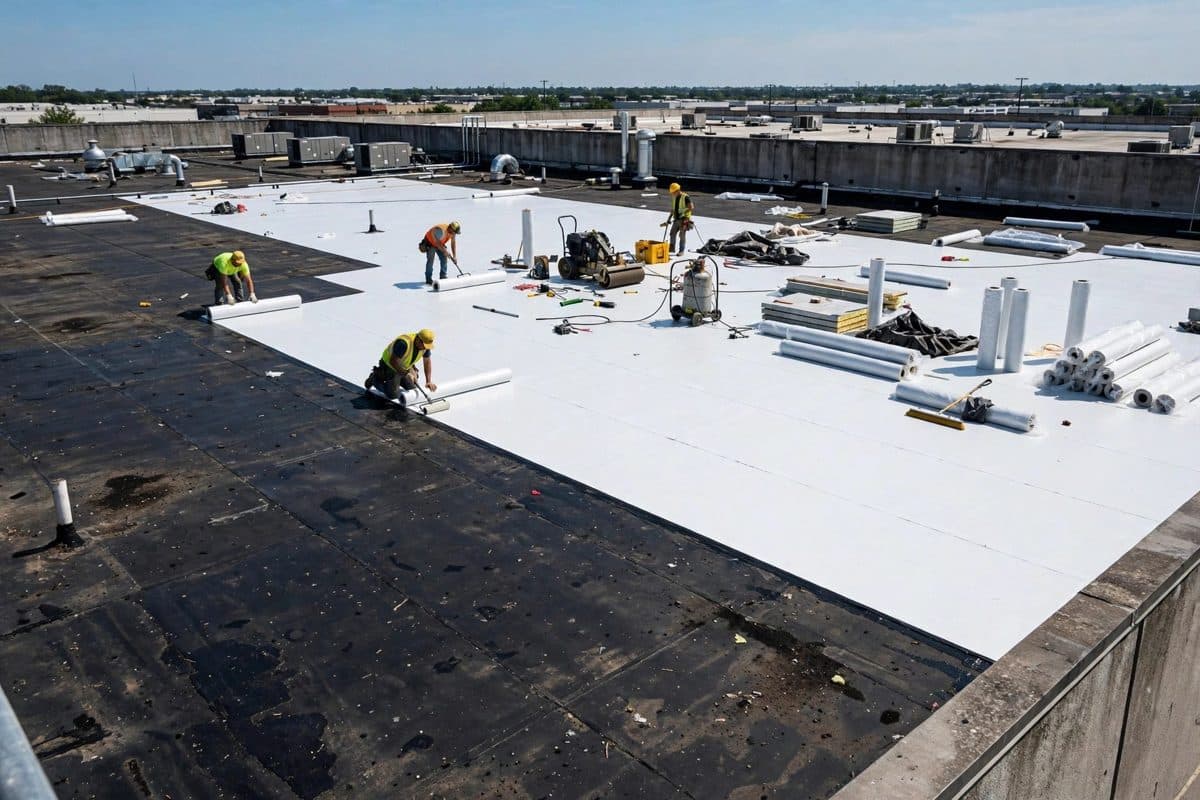
A recover — also called a roof-over or overlay — installs a new roof covering over the existing one, usually with a separation layer or new insulation board between them. The old membrane stays in place and becomes part of the base. It is not a coating: coatings are a different, lighter-touch option, covered in our comparison of roof coatings vs roof replacement for building owners.
A recover works best on a single-ply or built-up roof that is aging but dry: the membrane is worn and seams are starting to go, but the insulation below is still dry and the deck is solid. When the old roof is already a recover itself, or water has been sitting in the insulation for years, that shortcut stops being a shortcut.
When code says no: the three hard stops
The International Building Code (IBC) sets the rules most cities adopt, and its recover section is blunt. According to the 2018 IBC Section 1511.3, a new roof covering may not be installed over an existing covering when the existing roof is water-soaked or has deteriorated to the point that it is inadequate as a base, or when the building already has two or more roof coverings. In plain terms: two layers is the ceiling, and a wet roof is a tear-off no matter how many layers it has.
A recover also fails when the deck itself is damaged — rotted wood, rusted steel, or cracked concrete — because the new fasteners have nothing solid to bite into. And every added layer adds dead load: most roofs were designed with allowance for one reroofing, not two. If your building is older or already carries heavy rooftop equipment, get a structural check before assuming the deck can carry another system for 20 more years. Confirm the layer-count rule with your local building department before budgeting — a contractor who offers to add a third layer is selling you a permit problem, not a bargain.
The moisture survey: the step you must not skip
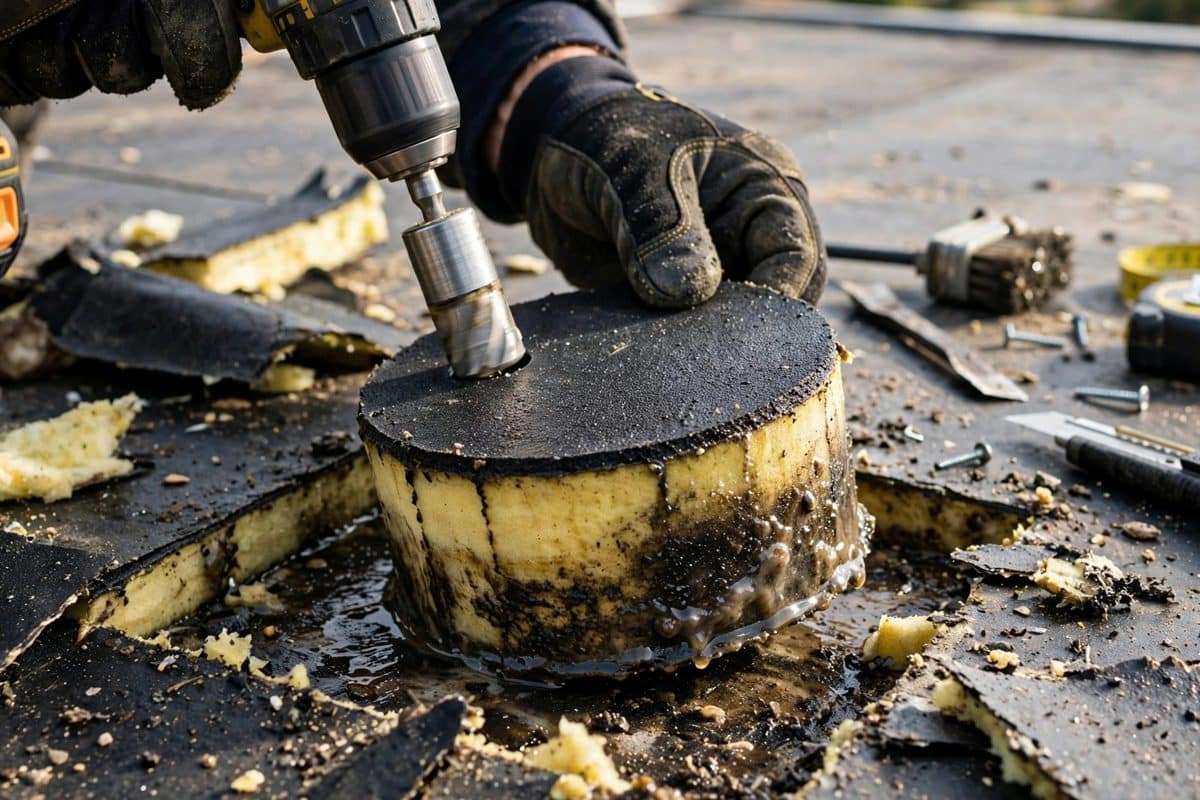
The moisture survey is what separates a legitimate recover from a gamble. Before any recover, a qualified contractor should run an infrared, nuclear, or capacitance moisture scan of the whole roof, then confirm suspicious areas with core cuts — small plugs cut through the assembly and measured to prove how much water is actually in the insulation. As FacilitiesNet’s roofing guidance notes, manufacturers will require a moisture survey before warranting a recover, because encapsulating moisture is, in the words of one design principal quoted there, “something you absolutely do not do.”
Trapped water does not sit quietly. Water in an old roof turns acidic and attacks fasteners, so a new roof that looks perfect can lose its attachment and fail in high wind for no visible reason. That finding comes from longtime roofing consultant Dick Fricklas, quoted in Buildings magazine, and it matches what crews see in the field: the membrane looks fine, the screws underneath are gone.
How much wet insulation kills a recover? Pattern matters more than percentage. A small, contained wet area — say 5% of the roof in one section — can be cut out down to the deck, replaced with dry insulation, and recovered over. But wet spots scattered across the whole roof, even at a similar total percentage, usually mean tear-off: patching dozens of scattered areas costs as much in labor as removing everything. If a contractor quotes a recover without a survey or core cuts, that quote is a guess, not a plan.
What a recover costs vs a tear-off in 2026
Full commercial roof replacement in 2026 typically runs $7–$12 per square foot for most single-ply projects, with the broader range running $5.50–$16 per square foot, according to 2026 contractor pricing compiled by Federal Estimating. Tear-off and disposal commonly adds $1–$3 per square foot. A recover eliminates most of that line item — which is where the headline savings come from.
On a 20,000 sq ft roof, tear-off alone is $20,000–$60,000 in labor, dumpsters, and landfill fees. Our breakdown of how much a commercial roof replacement costs per square foot in 2026 walks through the full range by system, so you can compare a recover quote against a tear-off quote line by line instead of by headline price.
The catch is the second cycle. A recover uses up your one allowed extra layer. The next time that roof needs work, it will almost certainly be a tear-off — of two systems instead of one. Price the recover honestly: cheaper now, plus a more expensive tear-off later, versus a tear-off now with a clean single layer and the longest warranty. For a building you plan to hold for 20-plus years, that lifecycle math often favors tear-off even when the recover quote looks tempting.
Warranty: what you give up with a recover
Recover jobs can be warranted, but coverage is usually shorter and more conditional than a full replacement. As our guide to commercial roofing NDL warranties explains, a No Dollar Limit warranty covers labor and materials without a cap — and manufacturers reserve their best NDL terms for systems installed over a sound, dry, inspected base. A recover over a questionable base may qualify only for a limited warranty, or one that excludes pre-existing conditions — exactly the part of the roof most likely to fail. Ask for the warranty in writing before you decide: how many years, does it cover material and labor, and what voids it?
How to decide: a five-step checklist
First, count the layers — core cuts will tell you. Two layers or more means tear-off, full stop. Second, get the moisture survey and core-cut report in writing, with a map of wet areas, not a verbal “looks dry.” Third, check the deck for soft spots, rust, or deflection. Fourth, compare lifecycle cost, not just first cost: recover price plus the eventual two-layer tear-off, against tear-off price plus the longer warranty. Fifth, confirm the permit with the building department.
If all five steps point to recover, take it — it is a legitimate, code-approved way to extend a building’s roof at lower cost and disruption. If any step fails, tear it off. One warning that fits the current climate: a recover pitched door-to-door after a storm, with no survey and pressure to sign the same day, is a red flag, not a deal. The legitimate version of this job starts with core cuts and paperwork, not a clipboard at your door.
For a quick budget check on either path, run your building’s size and system through the Commercial Roof Cost Calculator before the contractor’s estimate arrives. And for the full building-owner hub, start at RoofAdviceHub Commercial.
Costs vary by region, roof complexity, and material — get local quotes before budgeting a project.
Last updated: October 2026
Frequently asked questions
Can you put a new commercial roof over the old one?
Yes, if the existing roof is dry, structurally sound, and the only layer on the deck — and if the new system is installed per the manufacturer’s instructions and local code. A water-soaked roof or a roof with two or more existing coverings must be torn off.
How much does a commercial roof recover save vs tear-off?
Typically $1–$3 per square foot in avoided tear-off and disposal costs — $20,000–$60,000 on a 20,000 sq ft roof in 2026 pricing. The saving only holds if the recover lasts its full warranty life; a failed recover costs more than the tear-off it skipped.
Do you need a moisture survey before a commercial roof recover?
Yes. Manufacturers generally require one before warranting a recover, and code bars recovering over a water-soaked roof. A survey plus core cuts is how you prove the roof is dry — a visual walkthrough cannot.
Leave a Reply