
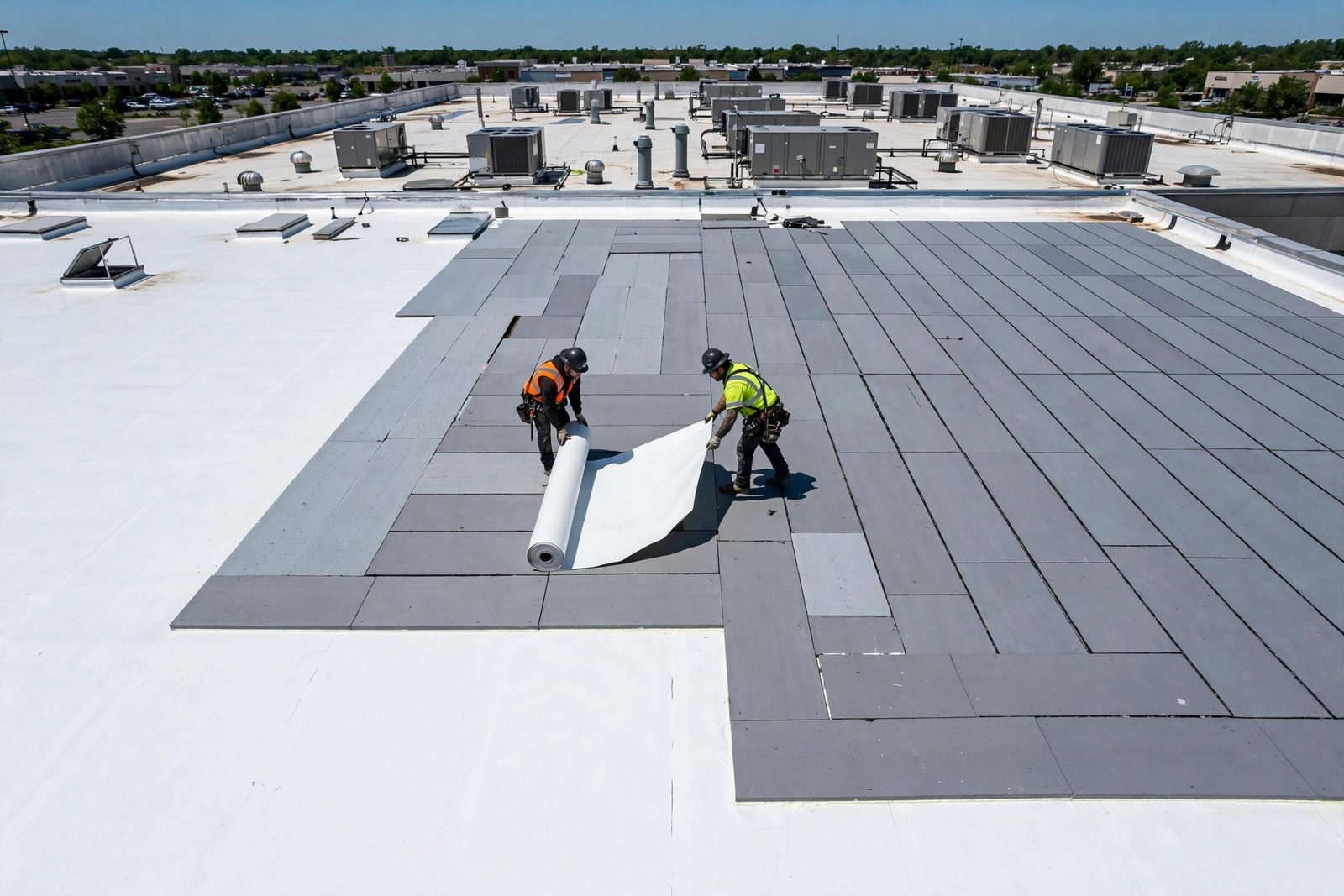
Key takeaways
- Commercial roof replacement costs $4–$20 per square foot installed in 2026; single-ply systems like TPO and EPDM typically land at $4.50–$9.
- Tear-off adds $1–$3/sq ft, and most building codes cap a building at two roof layers — no stacking membranes forever.
- Over 20 years on a 10,000 sq ft building, metal often costs less per year of service than membranes despite the highest upfront price.
- Compare bids on scope, not the bottom line: demand per-square-foot unit prices for wet insulation and deck replacement.
Commercial roof replacement costs $4 to $20 per square foot installed in 2026, depending on the system. Most flat-roof buildings end up between $5 and $12 per square foot for single-ply membranes like TPO, EPDM, or PVC — materials, labor, and standard insulation included, before tear-off and deck repairs. That’s the honest answer. The rest of this guide is about making sure you don’t overpay, don’t get under-spec’d, and don’t buy the cheapest system only to replace it a decade early.
I’ll be straight with you: I spent years supervising a roofing crew, and commercial roofs are a different animal from residential. Nobody talks in total job dollars the way homeowners do — everything is priced per square foot, and small spec changes (a thicker membrane, one more inch of insulation, a different warranty) swing five-figure amounts on a 20,000 sq ft building. The numbers below are 2026 ranges drawn from contractor-published cost guides, and 2026 pricing reflects the 4–8% manufacturer price increases rolled out in spring 2026. Use them to sanity-check your bids, not to replace them — local labor markets move these numbers more than anything else.
Commercial roof replacement cost per square foot by system (2026)
These ranges are installed cost — membrane, labor, and standard insulation. They come from 2026 contractor surveys, notably Linta Roofing’s published 2026 breakdown, cross-checked against several other guides. Tear-off of the old roof ($1–$3/sq ft) and deck repairs are typically quoted separately, so confirm what’s in the number before you compare.
| Roof system | Installed cost per sq ft | Typical lifespan |
|---|---|---|
| Roof coatings / restoration | $2–$8 | 10–20 years |
| EPDM (rubber membrane) | $4–$8 | 20–35 years |
| TPO (single-ply) | $4.50–$9 | 20–30 years |
| Modified bitumen | $4–$9 | 15–25 years |
| Built-up roofing (BUR) | $5.50–$9.50 | 20–30 years |
| PVC membrane | $6–$12 | 25–35 years |
| Spray polyurethane foam (SPF) | $4.50–$7.50 | 15–25 years |
| Standing seam metal | $8–$20 | 40–60 years |
If you’re weighing the two most common membranes, our TPO vs EPDM comparison breaks down where each one actually wins. For a 10,000 sq ft building, 2026 totals typically run $45,000–$75,000 for TPO, $40,000–$65,000 for EPDM, $55,000–$85,000 for PVC, and $75,000–$120,000 for metal, according to RoofVista’s 2026 cost survey.
What the per-square-foot price actually includes
The per-square-foot number is a bundle, and you should know what’s in the bundle before you treat two bids as comparable. On a typical commercial replacement, the membrane itself is roughly a third to half of the installed cost — the rest is labor, insulation, and the work around it. Labor typically doubles or triples the materials-only cost, per contractor cost breakdowns published in 2026.
The add-ons that get quoted separately are where owners get surprised. Tear-off and disposal of the old roofing adds $1–$3 per square foot, according to RoofVista’s 2026 survey. Insulation upgrades to current energy code — and most codes now require R-20 to R-30 on commercial re-roofs — add $1–$4 per square foot. Permits usually run $500 to $2,000 or more depending on the municipality. And deck repairs are the wildcard: you can’t see them until the old roof comes off, which is exactly why the best practice is to have unit prices for deck replacement written into the contract before the tear-off starts.
For a sense of how different the math is on the residential side, our complete 2026 roof replacement cost guide covers the homeowner version — same price-inflation pressures, very different cost structure.
The five cost drivers that move your bid
Why does one 20,000 sq ft building get $7/sq ft and a similar one get $11? In my experience, it’s almost always one of these five:
1. Size and access. Larger buildings get lower per-square-foot pricing — mobilization, equipment staging, and bulk material pricing spread over more area. A tight downtown building with no staging area and crane access costs more than a suburban warehouse with an empty lot next door.
2. Tear-off vs. recover. Laying the new system over a sound existing roof skips the $1–$3/sq ft tear-off and the landfill dumpsters. But recover is only an option when the existing roof is dry and there’s just one layer — more on that below.
3. Insulation code upgrades. Current energy codes usually require bringing insulation up to R-20 or R-30 on a re-roof, even if the old building predates those rules. That’s real money — $1–$4/sq ft — and it’s not optional, so treat bids that don’t mention it as incomplete, not cheap.
4. Penetrations and complexity. Every HVAC unit, vent, skylight, and drain is flashing labor. A wide-open warehouse roof with four penetrations installs fast. A restaurant with grease vents, rooftop units, and a maze of curbs does not. Contractors price this in, and it’s the biggest reason two same-size buildings differ.
5. Region and timing. Labor markets and permit regimes move the number 15–25% between metro areas — coastal California runs that much above inland, for example. And Florida’s January 2026 Roof Observations tables show the real spread: from about $4.10/sq ft for ballasted TPO with no added insulation up to $17.20/sq ft for a three-ply SBS system with R-25, with a 60-mil mechanically attached TPO full replacement averaging $11.60. Same market, same year, huge range — because spec and scope drive everything.
Tear-off vs. recover: the decision that changes your cost
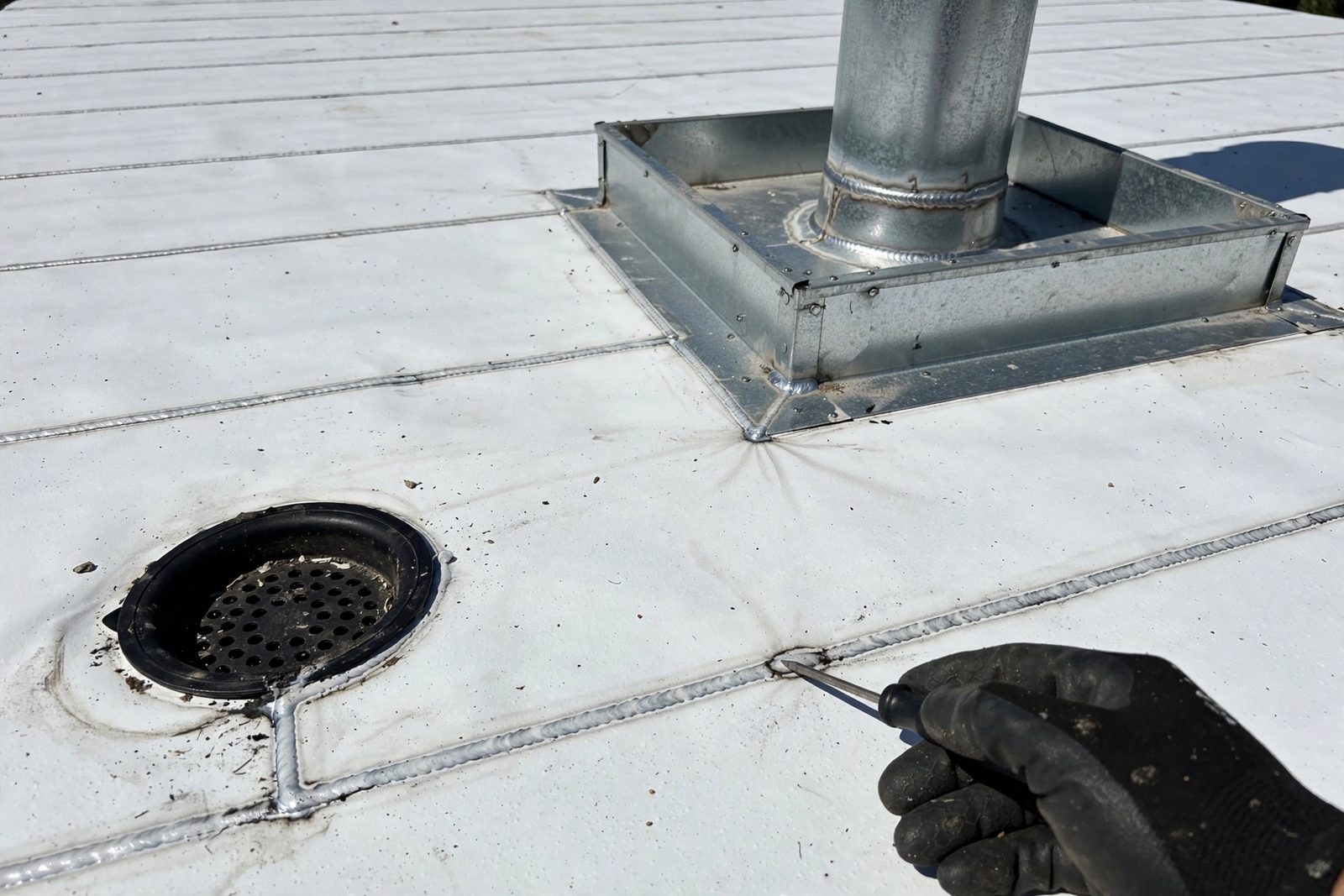
A recover — installing the new system over the old one — saves the $1–$3/sq ft tear-off and weeks of dumpster logistics. It’s the cheapest path to a new warranty, and it’s legal in most cases. But it’s not always the right call, and the code draws a hard line: per NRCA’s reroofing guidance, nearly all model building codes cap a building at two roof system layers. If there are already two roofs on the building, the next one is a tear-off, full stop.
The second gate is moisture. You cannot recover over wet insulation — it rots the deck, kills the new membrane’s warranty, and traps moisture that will blister the new system within a year. Any honest contractor will cut core samples or run a moisture survey before proposing a recover. If a bid proposes covering the old roof without mentioning either, that’s not a deal — it’s a gamble with your building.
A couple of practical notes: a protective coating is not counted as an additional roof layer under current code, so a coating restoration usually stays legal even on a two-layer building. And local rules add quirks — Florida’s building code, for instance, caps repairs at 25% of a roof section in any 12-month period before the full system must be replaced to current code, so in Florida a “recover” decision also runs through the permit history.
Lifecycle cost: the bid price isn’t the real price
This is where building owners should spend their thinking, because the cheapest system on bid day is rarely the cheapest over the roof’s life. A 2026 lifecycle comparison modeled on a 10,000 sq ft roof over 20 years tells the story:
- Modified bitumen: $6/sq ft installed + $0.15/sq ft/year maintenance = ~$90,000 over 20 years
- EPDM: $5.50/sq ft + $0.10/year maintenance = ~$75,000
- TPO: $6.75/sq ft + $0.10/year maintenance = ~$87,500
- Metal: $10.50/sq ft + $0.05/year maintenance = ~$115,000
That’s per a lifecycle model published by New England Metal Roof in 2026. Now extend the frame: TPO, EPDM, and modified bitumen are all looking at replacement somewhere in years 20–30. Metal at 40–60 years means in year 25 you’re writing a second check for the membrane building — and that second replacement lands at future prices, not today’s. On a per-year-of-service basis, metal often undercuts membranes even though it’s the most expensive line item at signing.
None of this means every building should get metal. A building you’re selling in five years doesn’t need a 50-year roof. A warehouse with a tight maintenance budget and a 15-year lease horizon is exactly where TPO earns its reputation. But run the horizon math honestly: how long do you actually plan to own the building? The system should match that number, not the lowest bid.
One more option belongs in this section: coating restoration at $2–$8/sq ft. If the existing membrane is sound and the insulation underneath is dry, a fluid-applied coating can buy 10–20 more years for a fraction of replacement cost. It’s the best ROI on the table for aging-but-healthy roofs — and the worst money you’ll ever spend on a roof that’s already saturated.
How to compare commercial bids without getting burned
Commercial bids are scope documents, and scopes are where the games get played. Three practices separate a professional procurement from a coin flip.
Get one written scope first. Have a roof consultant or engineer write a single specification — the assembly, the insulation target, the attachment method, the product approval numbers — so every contractor is pricing the same roof. Comparing a $7/sq ft 45-mil mechanically attached bid against a $9/sq ft 80-mil fully adhered bid is meaningless; they’re different roofs.
Require unit prices for the unknowns. As Advanced Roofing’s 2026 commercial budget guide advises owners: require per-square-foot unit prices for wet insulation replacement and deck repair in every bid, before the tear-off starts. Without them, change orders are negotiated at your most vulnerable moment — with your building open to the sky.
Read the warranty, not just the price. A 20-year manufacturer NDL (no dollar limit) warranty is priced into the top of the range, not the bottom – it requires specific details, inspections, and sometimes a manufacturer-approved contractor. If one bid is dramatically cheaper, check whether it carries the same warranty class. A warranty that isn’t backed by the manufacturer is a piece of paper. Most manufacturer warranties also require documented twice-yearly inspections to stay valid — see our commercial roof maintenance checklist for what those inspections should cover.
And one habit that pays for itself: run the numbers through our free commercial roof cost calculator before you collect bids. It won’t replace a quote, but it tells you whether a bid is in the right county — and which line items deserve questions. Our commercial roofing hub has the rest of our building-owner guides.
Frequently asked questions
How much does a commercial roof replacement cost on a 10,000 square foot building?
Budget $40,000 to $120,000 in 2026 depending on the system. Typical totals: EPDM $40,000–$65,000, TPO $45,000–$75,000, PVC $55,000–$85,000, and standing seam metal $75,000–$120,000, per RoofVista’s 2026 survey. These include tear-off of one existing layer and standard insulation; buildings with heavy penetrations, deck repairs, or insulation upgrades land higher.
What is the cheapest commercial roofing material?
Upfront, it’s EPDM at $4–$8/sq ft installed, or a coating restoration at $2–$8/sq ft if the existing roof is sound and dry underneath. But cheapest on bid day isn’t cheapest over 20 years — factor in maintenance and the replacement cycle before you decide on price alone.
Can you install a new commercial roof over the old one?
Yes, if there’s only one existing layer, the roof is dry, and the new system is installed to the manufacturer’s specs — but nearly all model codes cap a building at two roof layers, per NRCA guidance, so two existing roofs means a mandatory tear-off. Never recover over wet insulation.
How long does a commercial roof replacement take?
Anywhere from a few days to a few weeks depending on size, system, tear-off, and weather. A 10,000 sq ft single-ply replacement typically takes one to two weeks of work days; metal retrofits and complex buildings with many penetrations take longer.
How long do commercial roofs last?
It depends on the system: TPO 20–30 years, EPDM 20–35, PVC 25–35, modified bitumen 15–25, built-up roofing 20–30, spray foam 15–25, coatings 10–20, and standing seam metal 40–60. Real-world life tracks maintenance closely — neglected membranes die early, inspected ones often beat the published ranges.
Cost estimates vary by region, roof complexity, material prices, and contractor — get local quotes before budgeting. The ranges above reflect 2026 contractor-published data and are meant for planning, not as a bid substitute.
Last updated: October 2026
Leave a Reply