
Key takeaways
- TPO (thermoplastic polyolefin) typically costs $5–$10 per square foot installed and lasts 20–30 years on a well-maintained commercial roof. Its white reflective surface bounces back most solar heat, which can cut summer cooling costs by 20–30% in hot climates — savings that compound into tens of thousands of dollars over the roof’s life.
- EPDM (ethylene propylene diene monomer) runs $4–$12 per square foot installed and routinely lasts 25–30+ years, the longest proven track record of any single-ply membrane. The black rubber shrugs off hail impacts, stays flexible well below freezing, and installs with simple adhesives — making it the durability pick for cold climates and hail-prone regions.
- Compare membranes by lifecycle cost per year of service, not installed sticker price. A $75,000 TPO roof lasting 25 years costs $3,000 per year before energy savings, while a lower-priced EPDM bid lasting 30 years can cost less annually. Honest per-year math reveals which system is actually the better deal.
- The warranty that actually protects your investment is the manufacturer’s no-dollar-limit (NDL) system warranty — it covers the whole installed assembly, including labor, for the full term. A material-only warranty merely replaces defective sheet, which is almost never what fails. Always confirm which warranty your bid includes before you sign.
If you own or manage a commercial building with a flat roof, the TPO vs EPDM question is really a money question: TPO typically costs $5–$10 per square foot installed, lasts 20–30 years, and cuts cooling costs with a reflective white surface; EPDM runs $4–$12 per square foot installed, lasts 25–30+ years, and survives hail, UV, and freezing temperatures better. The better membrane is the one that matches your climate, your hold period, and your energy bill — not the one your contractor happens to install.
Flat roofs are the most expensive building component nobody thinks about until they fail. A warehouse, office, retail strip, or apartment building with a 10,000-square-foot roof is looking at $50,000–$120,000 for a full replacement. That number buys more than a membrane: tear-off, deck repairs, insulation, drainage work, and the warranty that actually protects you. When I supervised a 15-person roofing crew, I watched building owners sign quotes based on one number — the price per square foot — and then pay twice: once for the cheap install, and again for the repairs the warranty wouldn’t cover. This guide breaks down the real TPO vs EPDM comparison the way an owner should see it: lifecycle cost, lifespan, warranties, energy, and the install details that decide whether either membrane reaches its advertised life.
TPO vs EPDM: what these two membranes actually are
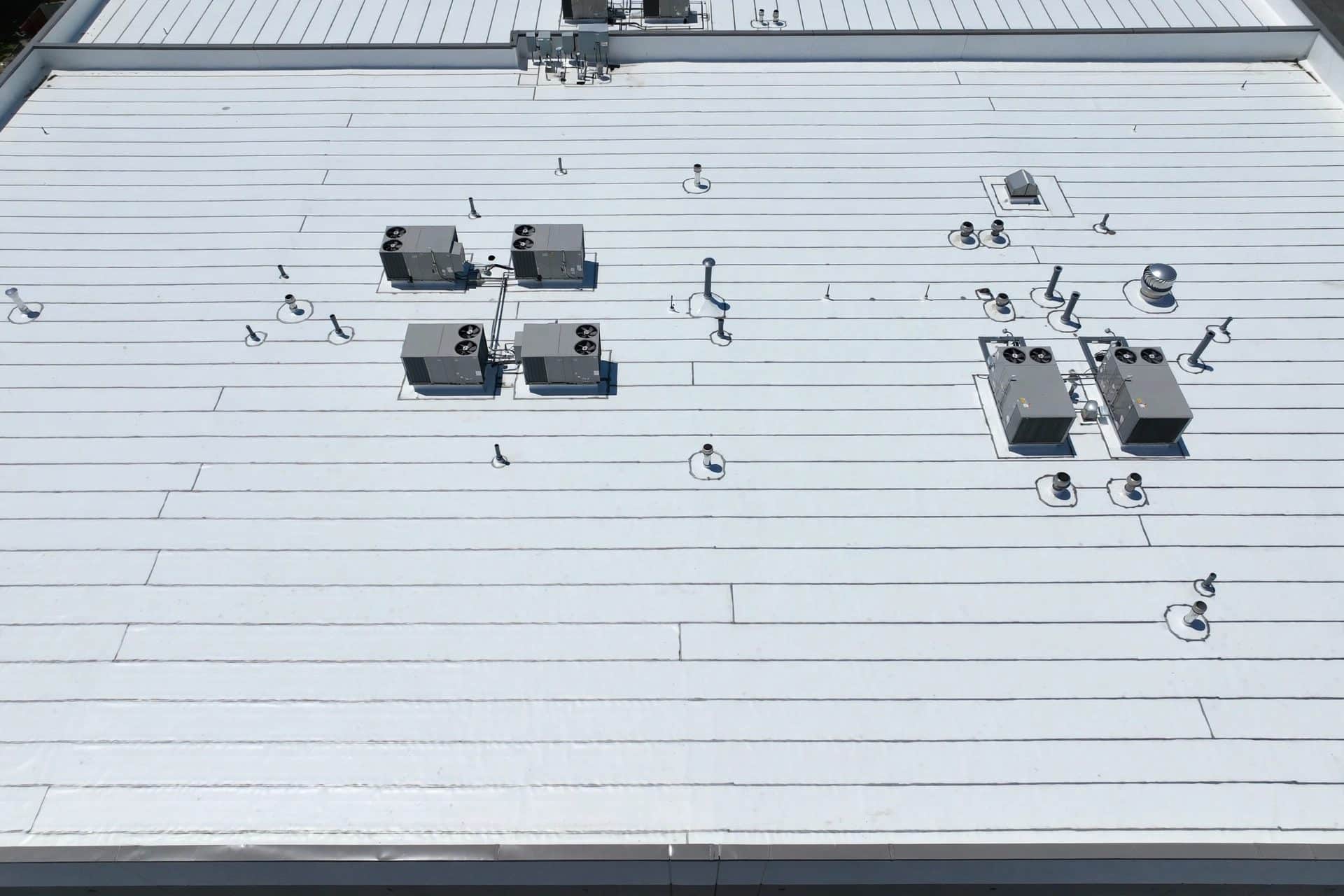
TPO (thermoplastic polyolefin) is a single-ply membrane, usually white or light gray, whose seams are heat-welded with hot air into one continuous sheet. It entered the commercial market in the 1990s and now dominates new commercial flat roofs in the US, largely because the reflective surface meets cool-roof requirements (Title 24 in California, LEED credits, and many local energy codes) and because hot-air welding produces seams as strong as the sheet itself — when the crew knows what it’s doing.
EPDM (ethylene propylene diene monomer) is a synthetic rubber membrane, usually black, with a track record going back to the 1960s. It’s glued at the seams with adhesive (or mechanically fastened or ballasted), stays flexible at −40°F and below, and has the longest proven field history of any single-ply system. It doesn’t reflect heat — a black EPDM roof absorbs it — but white-coated EPDM versions exist for buildings that need reflectivity without switching systems.
Both membranes are installed in thicknesses from 45 mil to 80–90 mil (a “mil” is one-thousandth of an inch). Sixty-mil is the commercial standard; 80-mil costs more and buys puncture resistance and longer warranty terms. Everything below this paragraph assumes a 60-mil, code-compliant installation on a commercial building — because the membrane choice matters less than the assembly under it. If you’re weighing broader flat-roof questions, our commercial roofing hub collects every building-owner guide in one place.
TPO vs EPDM cost: what a roof actually costs to install
Installed cost is where owners start, and the ranges are wider than most quotes admit. For 2026 commercial projects in the US, planning figures look like this. For the full breakdown across every commercial system, see our guide to commercial roof replacement cost per square foot in 2026.
| Membrane | Typical installed cost per sq ft | 10,000 sq ft replacement | Advertised lifespan |
|---|---|---|---|
| TPO (60 mil) | $5–$10 | $50,000–$100,000 | 20–30 years |
| EPDM (60 mil) | $4–$12 | $40,000–$120,000 | 25–30+ years |
These ranges come from contractor-published 2026 pricing data and industry cost surveys — sources disagree at the edges, which is exactly why you should treat any single “average” with suspicion. What moves a quote inside (or outside) those ranges: tear-off of the old roof (and how many layers are up there), deck repairs, insulation thickness and R-value, tapered insulation for drainage, cover board, parapet height, building access, and the number of penetrations — every HVAC unit, vent, and skylight is a detail someone has to flash by hand.
A more honest way to compare cost is per year of service. A $75,000 TPO roof that lasts 25 years costs about $3,000 per year of service. A $60,000 EPDM roof that lasts 22 years costs about $2,700 per year — but add a white coating at $1.50–$3.00 per square foot if you need reflectivity, and that edge narrows. This is the math our commercial roof cost calculator runs for you: plug in your building’s square footage, system, and state, and it builds the estimate from the same pricing model we track across the industry.
Lifespan and warranties: the fine print that moves the money
How long does a TPO roof last? Twenty to thirty years is the realistic planning number for a well-installed 60-mil TPO roof with twice-yearly maintenance. Early-generation TPO (1990s–2000s) had real problems with seam failures and UV degradation — that’s where the horror stories come from. Modern formulations with thicker UV weathering layers perform dramatically better, and manufacturers now back them with warranties to match. See how long each commercial roof system lasts for the full lifespan comparison.
How long does an EPDM roof last? Twenty-five to thirty-plus years. EPDM’s chemistry is inherently UV-stable — the rubber doesn’t break down in sunlight the way older plastics did — and there are documented EPDM roofs still watertight at 40+ years. The weak points are the glued seams and adhesive-flashed penetrations, which age faster than the sheet itself.
Now the warranty part, because this is where owners lose money. A membrane has a material warranty (the manufacturer replaces defective sheet — almost never what fails) and a system or no-dollar-limit (NDL) warranty (the manufacturer covers the whole installed assembly, including labor, for the term — this is the one that protects your building). NDL terms from major manufacturers run 20–30 years for both membranes, and 30-year NDL coverage typically requires 80-mil membrane, two layers of insulation, an adhered cover board, and installation by a manufacturer-certified contractor. Read every quote twice: a 25-year “warranty” that only covers material defects is worth a fraction of a 20-year NDL warranty. The system warranty — not the membrane brand — is what you actually buy.
Energy bills: the white-roof advantage nobody budgets
This is TPO’s strongest card and the least appreciated line item in a building owner’s spreadsheet. A white TPO membrane reflects most of the sun’s energy; a black EPDM roof absorbs it. On a 10,000-square-foot building running commercial air conditioning through a hot-climate summer, industry analyses put the cooling-cost difference at roughly 20–30% — on the order of $1,500–$3,000 per year depending on electricity rates, insulation, and how hard the HVAC system works.
Run that over a 25-year roof life and TPO’s reflectivity can be worth $30,000–$60,000 in avoided energy costs in hot climates like Texas, Florida, Arizona, and the Gulf Coast. In some cases the energy savings pay for the price difference between the membranes within two to four years. Two caveats from the field: (1) a dirty TPO roof loses reflectivity — dirt and biological growth cut reflectance measurably, which is why periodic washing is a maintenance line item, not cosmetic vanity; and (2) in cold climates, the heating penalty of a white roof in winter partially offsets the summer savings. Energy Star’s cool-roof guidance and NRCA technical bulletins both confirm the same principle: reflectivity pays where cooling dominates, and matters least where heating dominates.
When EPDM wins: hail, cold, and simple roofs
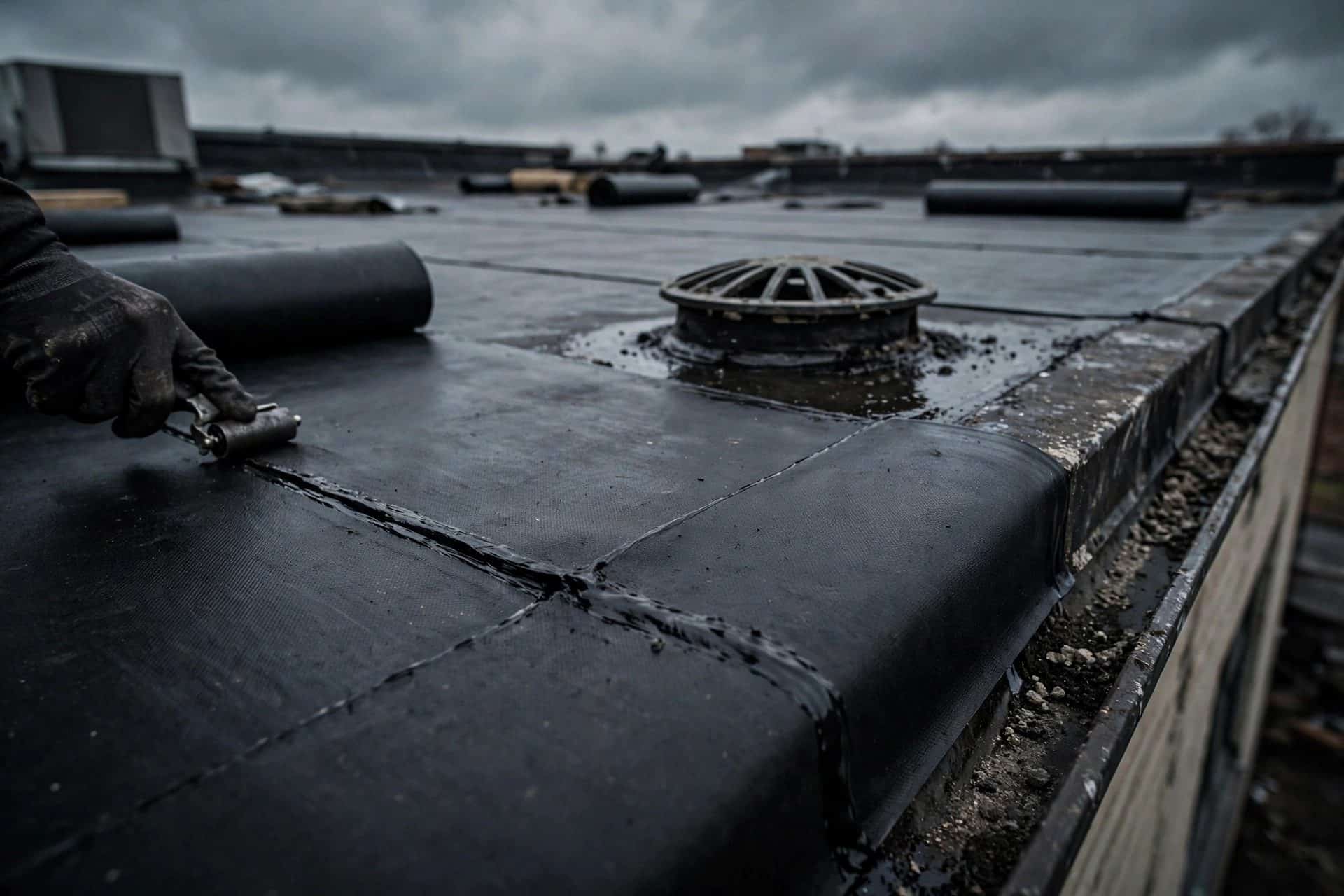
EPDM is the durability champion for buildings in tough environments, and three properties explain why. First, impact resistance: rubber absorbs hail strikes that can puncture or crack heat-aged membranes, which is why EPDM remains popular across the Texas–Oklahoma–Kansas hail belt. Second, cold flexibility: EPDM stays pliable below −40°F; TPO stiffens in deep cold and is more vulnerable to cracking if walked on or impacted in freezing weather — and TPO installation itself generally requires ambient temperatures above roughly 50°F for proper welding, which shortens the install season in the snow belt. Third, simplicity: EPDM’s adhesive systems need no welding equipment, the sheets come in very large widths (fewer seams), and repairs are straightforward — a puncture patches with primer and tape, a repair any competent crew can do.
EPDM also wins the proven-history argument. No other single-ply membrane has as many 30-year-old roofs still in service. If your building is in Minnesota, the Dakotas, or anywhere roofs take a beating from hail and freeze-thaw cycles — and your energy bill is heating-dominated anyway — EPDM is very hard to beat.
Installation differences your contractor should explain
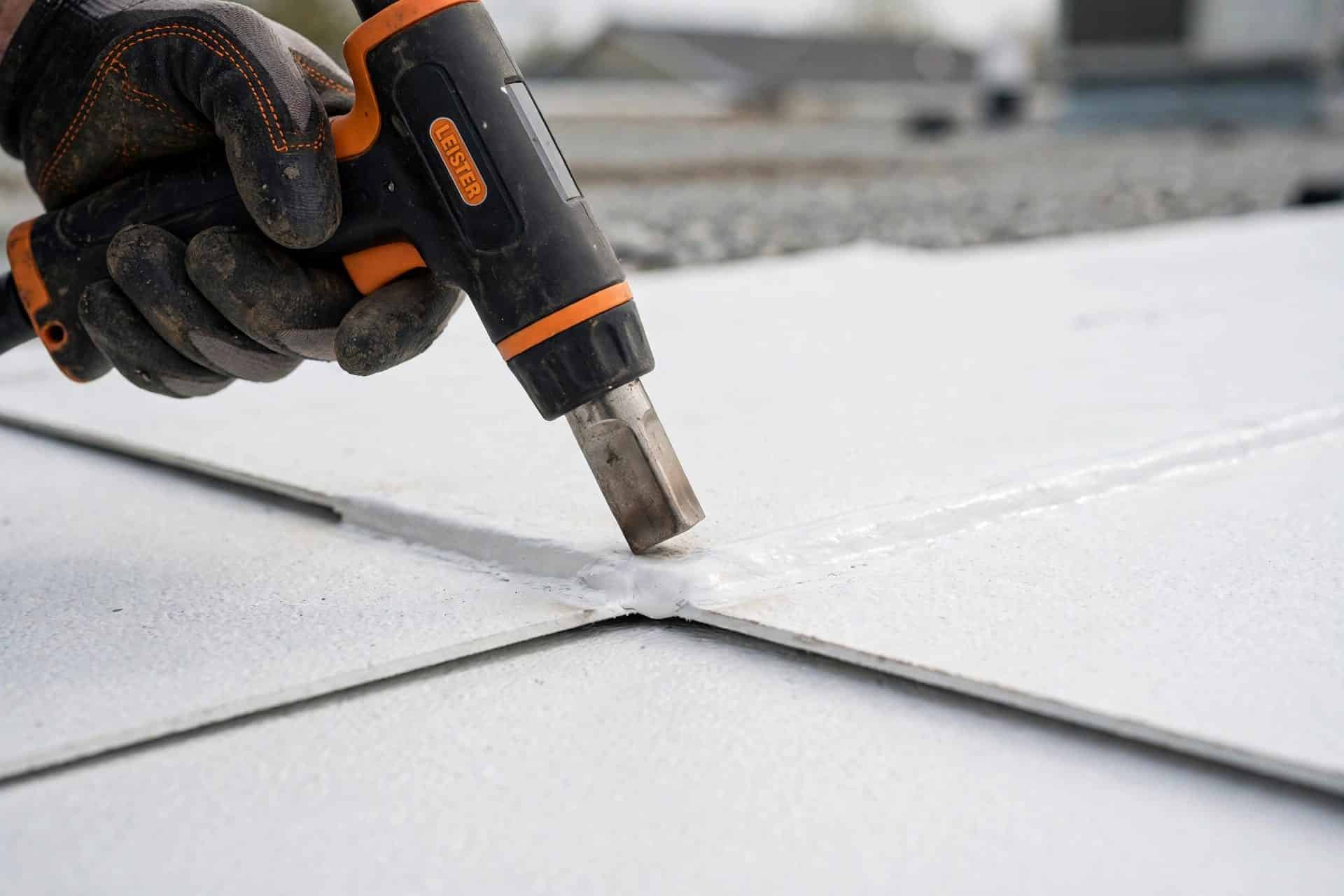
Both membranes live or die at the seams and the details, but they fail differently. TPO seams are heat-welded — the installer runs a hot-air welder (robotic on open field, hand welder at details) that melts the membrane layers into a fused bond, then probes every seam to verify it. A properly welded TPO seam is stronger than the sheet. The risk is installer skill: a cold weld looks fine and fails in year three. For the full technique, see our guide on how to heat-weld a TPO seam. Ask whether the crew is certified by the membrane manufacturer — NDL warranties require it.
EPDM seams are glued — adhesive applied to both surfaces, rolled together, with seam tape at details. The materials are simpler and more forgiving of installer inexperience, but adhesive seams don’t last as long as the sheet, and adhesive has a shelf life and temperature window. EPDM’s large sheets mean fewer seams overall, which partially offsets the glued-seam weakness.
One more install reality that matters for owners: cover board and insulation. The single biggest cause of premature flat-roof failure I’ve seen in the field isn’t the membrane — it’s water trapped under it, punctures from foot traffic, and standing water at clogged drains. A high-density cover board over the insulation adds puncture resistance and hail resistance for roughly $0.50–$1.50 per square foot, and it pays for itself on any roof that gets walked on for HVAC maintenance. If a quote skips cover board on a commercial building, ask why.
The owner decision: pick by holding period, climate, and energy bill
Here’s how I’d frame it if you were standing on my old job site asking which membrane to spec:
- Hot climate + large roof + big AC bills → TPO. The energy savings are real money, the install season is year-round, and cool-roof codes may require reflectivity anyway. Spec 60- or 80-mil from a certified contractor with a 20–25-year NDL warranty, and budget for periodic washing to keep the reflectivity working.
- Hail belt + cold climate + heating-dominated building → EPDM. The rubber shrugs off hail and deep cold, the proven track record is unmatched, and there’s no cooling bill to justify the white membrane. Spec 60-mil (90-mil if the roof gets heavy foot traffic), demand adhesive seam tape at all details, and consider a white coating only if a code or utility program requires reflectivity.
- Short hold period (selling within 5–10 years) → the cheaper total bid with a transferable warranty. Your buyer cares about a warranty they can transfer and a roof that passes inspection — not which membrane family you chose.
- Long hold period (20+ years) → run the per-year math. A roof is a 25-year asset; compare lifecycle cost per year of service, not installed price. The membrane is typically 20–30% of a full replacement project’s cost — the rest is tear-off, insulation, drainage, and details, which cost the same regardless of membrane.
- Grease or chemical exhaust (restaurants, factories): choose PVC. Neither of these membranes holds up to kitchen grease or process chemicals, so PVC for grease and chemical exposure is the right call there.
Whatever you choose, get the estimate right before you sign anything — run your building through the commercial roof cost calculator and bring the number to your bid meetings. An owner who walks in knowing the cost range negotiates from a completely different position than one who doesn’t.
Frequently asked questions
Is TPO better than EPDM?
Neither is universally better. TPO wins on energy savings and installed cost in hot climates; EPDM wins on hail resistance, cold-weather flexibility, and proven long-term
durability. Compare them by lifecycle cost per year of service for your building, not by sticker price.
How much does a TPO roof cost per square foot in 2026?
Typical installed costs run $5–$10 per square foot for a 60-mil TPO commercial roof, or roughly $50,000–$100,000 for a 10,000-square-foot building. Tear-off, insulation, drainage work, and warranty terms move quotes within that range.
How long does a commercial TPO roof last?
Twenty to thirty years with proper installation and twice-yearly maintenance. Major manufacturers now offer 20–30-year no-dollar-limit (NDL) system warranties on TPO when installed by certified contractors with the required membrane thickness and cover board.
Does a white TPO roof really lower energy bills?
Yes, in cooling-dominated climates. White TPO reflects most solar energy, and industry analyses estimate 20–30% cooling-cost reductions versus a black membrane — roughly $1,500–$3,000 per year on a 10,000-square-foot building in a hot climate. The benefit shrinks in cold climates where winter heating dominates.
Can EPDM be installed in cold weather?
EPDM installs in colder temperatures than TPO (which needs roughly 50°F+ ambient for proper heat welding), but adhesive has its own temperature limits — most manufacturers require temperatures above freezing for seam adhesive. EPDM’s real cold-weather advantage is the installed roof: the rubber stays flexible below −40°F.
Which membrane handles hail better, TPO or EPDM?
EPDM. The rubber absorbs hail impacts that can puncture stiffer membranes, and rubber hail performance is one reason EPDM remains popular across the Texas–Oklahoma–Kansas hail belt. On either membrane, a high-density cover board adds meaningful puncture resistance.
Last updated: October 2026.
Disclaimer: costs vary by region, roof complexity, insulation requirements, and local labor rates. Figures above are 2026 planning ranges from industry sources — get multiple local quotes from manufacturer-certified commercial contractors before committing to a project.
Leave a Reply