
Key takeaways
- For grease and chemical exhaust, specify PVC-KEE — the version engineered for animal fats and oils.
- Installed PVC runs about $6–$12 per square foot, with a 20–30-year service life.
- Grease damage is typically excluded from warranties, so exhaust containment matters as much as the membrane.
If your roof sits under kitchen exhaust, a grease vent, or a chemical process vent, PVC roofing is usually the right membrane — but only the right kind of PVC. For a restaurant, food plant, or factory, PVC-KEE is the membrane that holds up to grease and animal fats that break down other single-ply roofs. Standard single-ply choices can look fine on bid day and fail years early once grease starts working on them.
This is a building-owner decision, not a roofer preference. The wrong membrane means a second roof in ten years, a kitchen shut down for repairs, and a warranty claim that goes nowhere. The right one costs more up front and quietly does its job for decades. For the wider commercial picture, our commercial roofing hub covers lifecycle cost, not just bid price.
When grease and chemicals actually demand PVC
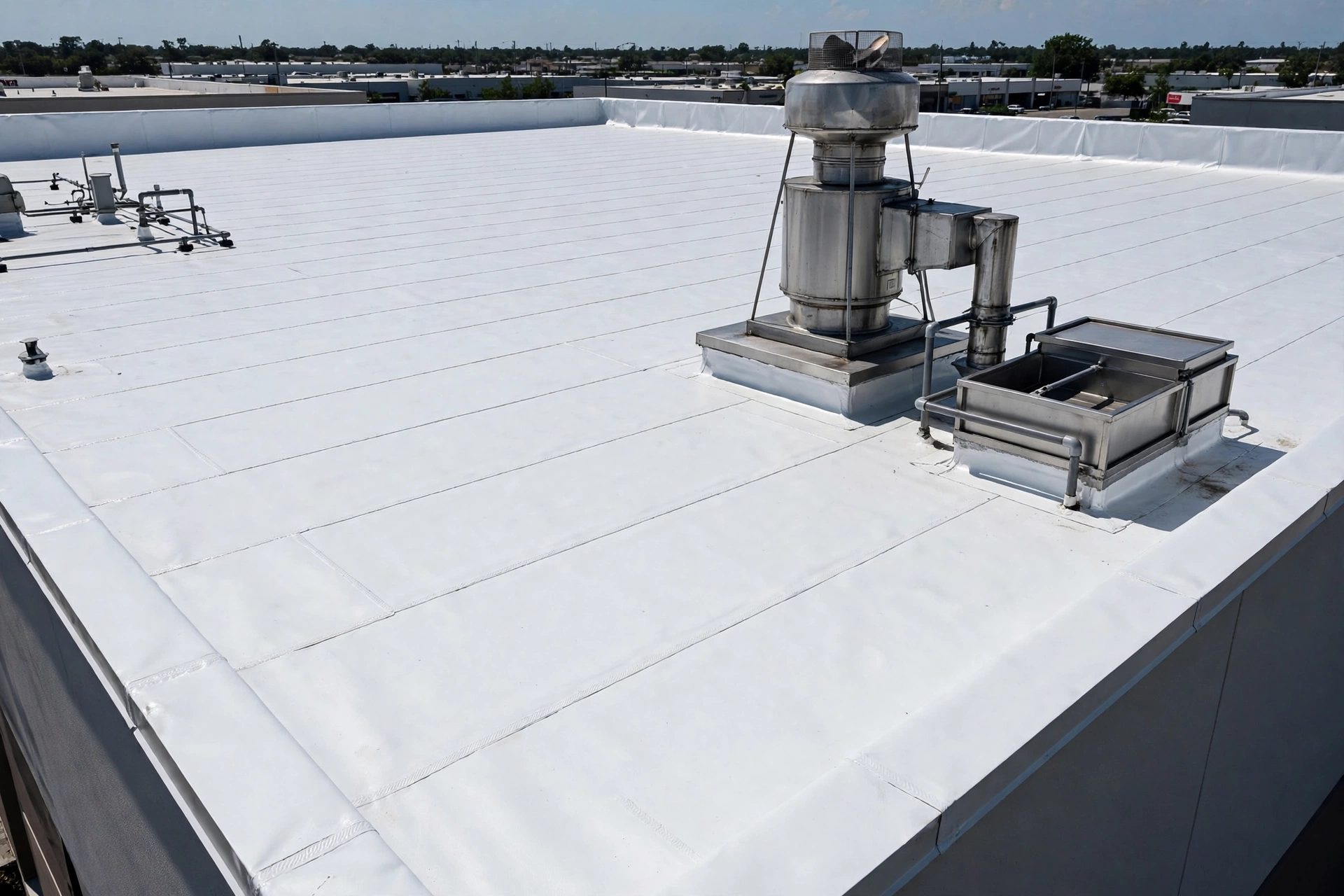
Grease demand starts at the exhaust vent. Restaurant kitchen hoods push grease-laden vapor onto the roof around the vent, day after day. That film does not just sit there. On TPO and EPDM it softens the membrane, and over time the surface blisters, seams weaken, and the roof starts leaking in exactly the area that is hardest to keep dry during service hours.
PVC was built for this fight. According to GAF’s food-service guide for EverGuard PVC KEE, the membrane is “chemically engineered specifically to stand up to that kind of organic chemical exposure” from grease and oil, while also carrying a Class A fire rating under ASTM E108 — a real consideration over a commercial kitchen.
The trigger is simple: if your building vents grease, animal fats, oils, or process chemicals onto the roof, you are in PVC territory. If it does not, you probably are not, and paying the PVC premium buys you little.
PVC vs TPO vs EPDM at a glance
All three are single-ply membranes with heat-welded or adhered seams, but they bet on different strengths. Our full TPO vs EPDM comparison covers the two cheaper options in depth; here is how PVC changes the math when chemicals enter the picture.
| Membrane | Installed cost (2026) | Typical lifespan | Grease and chemical resistance |
|---|---|---|---|
| TPO | $5–$10 per sq ft | 20–30 years | Fair — grease softens it over time |
| EPDM | $4–$7 per sq ft | 25–30+ years | Poor against grease and oils |
| PVC (incl. PVC-KEE) | $6–$12 per sq ft | 20–30 years | Strong — KEE is the grease-rated version |
Those cost ranges come from 2026 commercial cost guides, and they move with thickness, insulation, and roof complexity. A 60-mil membrane is the common commercial minimum; 80-mil buys more puncture and foot-traffic tolerance. If you want a project-specific number before talking to bidders, run your building through the commercial roof cost calculator to bracket the job first.
The KEE distinction most quotes skip
Here is the detail that separates a good bid from a costly one: not all PVC is equal against grease. KEE stands for a ketone ethylene ester copolymer used as the membrane’s plasticizer. Unlike the liquid plasticizers in traditional PVC, KEE is a solid, so it does not migrate out of the membrane over time — which is exactly what keeps the grease resistance working years down the road. GAF’s guide notes that PVC KEE offers enhanced resistance to grease and oil on top of standard PVC’s UV, mold, and seam strength, with guarantees up to 30+ years available for qualified systems.
So when a bidder writes “PVC” on the quote, ask one question: “Is this PVC or PVC-KEE?” For a restaurant or food plant, the answer should be KEE, in writing, with the product data sheet attached.
What PVC will not fix
No membrane handles every chemical: GAF’s chemical guidance rates strong acids as not recommended for TPO, PVC, and PVC-KEE alike. If your process vents strong acids or oxidizers, get a manufacturer compatibility review before anyone welds a seam.
Second, and more important for owners: grease damage is typically excluded from the warranty. GAF states plainly that its warranties and guarantees do not provide coverage against chemical exposure or exposure to grease, animal fats, and jet fuel. That does not make PVC a bad choice — it makes containment part of the roof system. Grease containment units, regular cleaning around vents, and keeping grease off the field of the roof protect both the membrane and any warranty claim you might ever need for an unrelated defect. Our guide to how long commercial roofs last by system makes the same point across materials: maintenance, not just material, decides whether a roof reaches its rated life.
Third, PVC still needs the basics done right: positive drainage, protected seams at curbs and penetrations, and a twice-yearly inspection. Grease makes ponding water worse, not better, because contaminated standing water attacks seams and hides damage.
What to ask before you sign
Keep the bid conversation to five checks. One, membrane and thickness in writing: PVC-KEE, 60-mil minimum, 80-mil where kitchen staff or service crews walk the roof. Two, the grease plan: containment at every kitchen exhaust, not just a membrane and a prayer. Three, seam and flashing details at vents, curbs, and grease traps — that is where grease roofs fail first. Four, the warranty in full: what it covers, what it excludes (expect grease to be excluded), and what maintenance it requires to stay valid. Five, a maintenance schedule with twice-yearly inspections and vent-area cleaning, priced or at least specified, so the roof is not orphaned the day the crew leaves.
Get those five in writing and the premium for PVC stops being a gamble. It becomes what it should be: the cost of a roof that survives the hardest thing your building puts on it — its own exhaust.
When is PVC roofing required instead of TPO?
PVC is the right call when the roof is exposed to grease, animal fats, oils, or process chemicals — most commonly restaurant kitchen exhaust, food processing vents, and chemical plants. For a standard warehouse or office with no chemical exhaust, TPO usually delivers the same waterproofing for less money.
How much does a PVC roof cost in 2026?
Installed PVC typically runs $6–$12 per square foot in 2026, depending on membrane thickness, insulation, and roof complexity. That is a premium over TPO, but on a grease-exposed roof it is usually cheaper than replacing a failed TPO roof years early. Costs vary by region, roof complexity, and material — get local quotes.
Does a PVC roof warranty cover grease damage?
Generally, no. Manufacturers including GAF explicitly exclude chemical exposure and grease, animal fats, and jet fuel from warranty coverage. That is why grease containment and regular vent-area cleaning matter as much as the membrane itself — they protect the roof in the ways the warranty does not.
Disclaimer: costs vary by region, roof complexity, and material — get local quotes. This article is educational, not a substitute for a manufacturer compatibility review on chemical-exposed roofs.
Last updated: October 2026
Leave a Reply