
Key takeaways
- A commercial roof coating costs $2–$5 per square foot installed and buys 10–20 more years on a sound roof — roughly half the cost of a full replacement at $5–$12/sq ft.
- A coating is a restoration, not a repair: it only works when the membrane is intact and the insulation underneath is dry.
- Never approve a coating without a moisture survey or core cuts — coating over wet insulation locks in the damage and voids most warranties.
- On a cost-per-year-of-service basis, a coating on the right roof beats every replacement system — on the wrong roof, it is the worst money you can spend.
For a 10,000 sq ft commercial building, a coating restoration costs $20,000–$50,000 installed and typically extends the roof’s life 10–20 years — while a full tear-off replacement costs $50,000–$120,000. A coating wins the math every time the existing roof is sound underneath; it loses badly when it isn’t. This guide shows you how to tell which roof you have before you sign.
I’ll be straight with you: this is the cheapest way to buy roof life in commercial roofing — and also the easiest line item to waste five figures on. I’ve seen coatings save building owners $60,000 and I’ve seen coatings peeled off a saturated roof two years later like wallpaper. The difference was never the product. It was the survey. If you take one thing from this article, make it this: the bid that includes a moisture survey is the only bid worth comparing. The rest of our building-owner guides live in our commercial roofing hub.
What a roof coating actually buys you
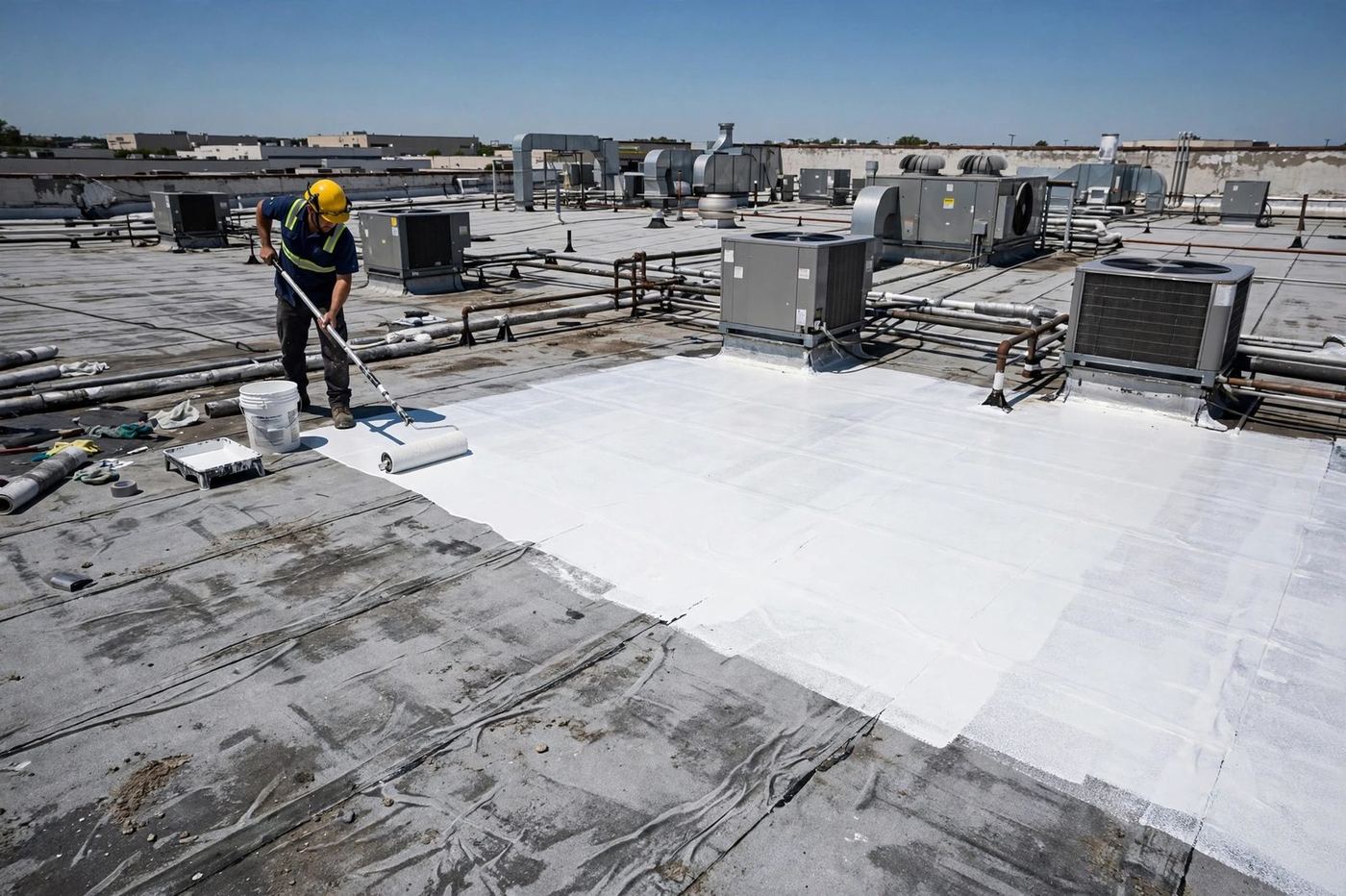
The first sentence of every honest coating pitch should answer one question: a coating is a fluid-applied membrane — acrylic, silicone, or polyurethane — rolled or sprayed over your existing roof, where it cures into a seamless, waterproof layer that bonds to what’s already there. It seals seams, fasteners, and penetrations, and a white coating reflects sunlight off the roof, which is where the energy savings come from.
Two chemistries dominate the commercial market, and they price differently. Acrylic coatings run $1.50–$3.50 per square foot installed, hold their reflectivity well, and typically carry 10–20 year warranties — but most manufacturer warranties exclude ponded areas, because acrylic breaks down in standing water. Silicone runs $2.00–$5.00 per square foot installed, tolerates ponding water without degrading, and carries 15–20 year warranties (a few products even advertise limited material warranties out to 50 years, though those are material-only and read the fine print). Those ranges come from a 2026 coating chemistry guide published by US Made Supply that benchmarks installed costs and warranties against each chemistry’s ASTM minimums — D6083 for acrylic, D6694 for silicone. Note the ASTM floors are minimums, not what good products deliver; real products clear them by wide margins.
On energy: contractor-published guides credit white coatings with cutting roof surface temperatures dramatically, and some coastal contractors claim cooling-energy reductions of up to 30% on dark-roofed buildings (Ridgeline Construction’s 2026 Pensacola guide). Treat that as a ceiling, not a promise — savings depend on your climate, building use, and how dark the old roof was. But reflective coatings are real enough that California’s Title 24 and ASHRAE 90.1 give cool-roof credit to qualifying white assemblies, which matters if your building is subject to either.
The honest math: cost per year of service
Building owners think in cost per year, not bid price — so run the math on a 10,000 sq ft building over one service cycle:
- Coating restoration: $20,000–$50,000 installed ÷ 15 years of average service = $1,300–$3,300/year
- TPO replacement: $45,000–$75,000 installed ÷ 25 years of average service = $1,800–$3,000/year
- EPDM replacement: $40,000–$65,000 installed ÷ 27 years = $1,500–$2,400/year
The replacement ranges are the per-square-foot ranges we published for 2026 — TPO at $4.50–$9/sq ft, EPDM at $4–$8 — and they include standard insulation before tear-off and deck repairs. What the table doesn’t show is the part owners care about most: a coating buys you 10–20 years without tearing anything off. No dumpster logistics, no building opened to the sky, no weeks of disrupted tenants. A 10,000 sq ft coating job typically finishes in 3–5 days; a full replacement runs one to three weeks.
There’s one more math term most bids skip: a coating is not counted as an additional roof layer under current building codes, per the same NRCA reroofing guidance that caps buildings at two roof layers. So on a two-layer building — where any new membrane means a mandatory tear-off — a coating can stay legal where a recover can’t. That alone has saved owners the $1–$3/sq ft tear-off adder.
And if the answer turns out to be replacement after all, the membrane choice matters: our TPO vs EPDM comparison breaks down where each one actually wins. Run both scenarios through our free commercial roof cost calculator before you collect bids — it tells you whether a quote is in the right county.
When a coating is the wrong call
Here’s the other half of the honest math, and contractors who make their money on coatings don’t volunteer it: a coating is designed to work with a roof that still has a serviceable system underneath it. That’s not my phrasing — it’s how Jules Albert III, owner of Jaymar Roofing in Slidell, Louisiana, put it in an August 2026 statement: coating “is designed to work with a roof that still has a serviceable system underneath it,” and “if moisture has entered the insulation, the membrane has widespread deterioration or the roof has structural problems, covering the surface does not correct those underlying conditions” (EINPresswire, August 20, 2026).
Walk the roof with these three disqualifiers in mind:
- Wet insulation. Moisture is the cancer of any roof system. Studies by the Army Corps of Engineers’ Cold Regions Research and Engineering Laboratory and the National Bureau of Standards — cited by NRCA’s moisture guidance — found that common rigid-board insulation can lose up to 80% of its thermal resistance when saturated, and trapped moisture rots the deck and corrodes fasteners from the inside. Coating over wet insulation doesn’t fix it; it puts a lid on it. If core cuts or an infrared survey show widespread saturation, the honest bid is a replacement.
- Widespread membrane failure. A coating seals seams and minor cracks — it is not a new membrane. If the existing membrane is blistered, split, or pulling away across large areas, coating is cosmetic surgery on a failing structure.
- Structural sag holding water. Silicone tolerates ponding water; acrylic doesn’t — most acrylic warranties exclude ponded areas. But even silicone can’t fix a deck that’s sagged into a permanent pond. Drainage has to actually move water, or the new surface fails for the same reason the old one did.
The screening step most bids skip
The step that separates a professional coating bid from a sales pitch is a moisture survey — core cuts or an infrared scan — before anyone prices the work. This is the one thing to demand in writing. A bid that proposes spraying a roof without mentioning the survey is a gamble with your building, because the bid price assumes dry insulation underneath and you have no way to know that from the surface.
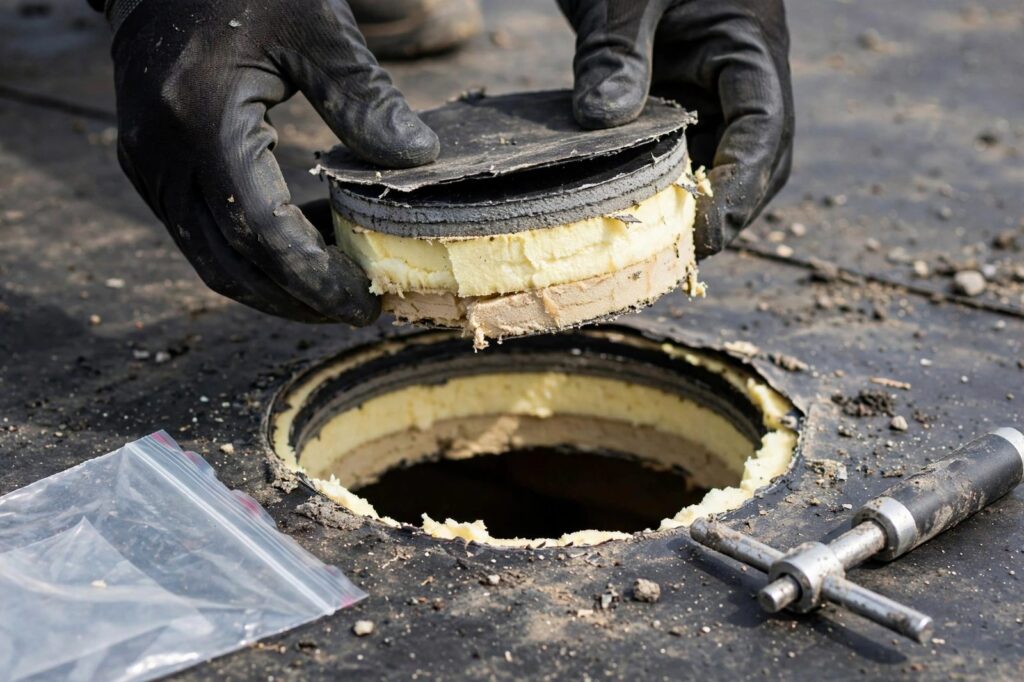
The survey also sets your warranty class. Most manufacturer warranties on coatings are tiered by dry-film thickness — a 10-year tier vs. a 20-year tier is mostly about how many mils go down, which is a materials decision, not a chemistry mystery. Get the product’s data sheet, confirm the mils, and confirm who backs the warranty: the manufacturer, or just the installer on a piece of paper.
One practical note from the field: if you’re shopping products yourself — say you’re a smaller building owner comparing what’s on the shelf before a contractor meeting — look at silicone roof coating and elastomeric roof coating options to learn the price spread between acrylic and silicone chemistries at retail. You’re not buying the roof there — labor, prep, and the survey are the real project — but knowing what the buckets cost keeps a bid honest.
Run your building’s numbers before you sign
A coating looks cheap until it’s the wrong call. Punch your square footage and system into our free Commercial Roof Cost Calculator — it gives you the 2026 installed range for coatings and full replacements side by side, so you can walk into every bid meeting with the math already done.
Frequently asked questions
Can you coat over a commercial roof that already has two layers?
Yes — and this is one of the coating’s biggest advantages. A fluid-applied coating is not counted as an additional roof layer under current building codes, per NRCA reroofing guidance. On a two-layer building, where any new membrane system would trigger a mandatory tear-off, a coating usually stays code-legal. Confirm with your local building department, since permit quirks vary by jurisdiction.
How long does a commercial roof coating last?
Expect 10–20 years from a professional coating system in 2026 pricing guides, with silicone systems at the top of that range and acrylic at the bottom. Real-world life tracks the survey and the mils: a dry substrate at the right dry-film thickness with the seams and flashings repaired first will reach warranty terms; a coating sprayed over wet insulation can fail within a couple of years regardless of the warranty on paper.
How much does a roof coating cost for a 10,000 sq ft commercial building?
Typically $20,000–$50,000 installed in 2026, based on $2–$5/sq ft for silicone and $1.50–$3.50/sq ft for acrylic, before surface prep and seam repairs. Buildings with heavy prep — rust treatment, seam work, ponding corrections — land at the top. Compare that against $50,000–$120,000 for a full replacement on the same building, and require a moisture survey in the bid before you decide.
Cost estimates vary by region, roof complexity, material prices, and contractor — get local quotes before budgeting. The ranges above reflect 2026 contractor-published data and are meant for planning, not as a bid substitute.
Disclosure: RoofAdviceHub is reader-supported. When you buy through links on our site we may earn an affiliate commission at no extra cost to you. As an Amazon Associate we earn from qualifying purchases.
Last updated: October 2026
Leave a Reply