
Key takeaways
- The NRCA recommends inspecting commercial roofs twice a year — spring and fall — plus after any severe storm. Mid-October is the fall window.
- Regular inspection and repair can extend a commercial roof’s useful life by five to ten years, per NRCA maintenance guidance cited by EMC Insurance.
- GAF’s Diamond Pledge NDL guarantee requires owners to “perform regular inspections and maintenance and keep records” — skip the paperwork and a denied claim can cost you six figures on a large roof.
- Ponding is water still standing 48 hours after rain ends. Water weighs roughly 5 pounds per square foot per inch of depth — a ponding area is a structural load, not just a puddle.
Inspect your commercial roof twice a year — once in spring, once in fall — and write down everything you find. Per NRCA guidance, that habit alone can add five to ten years to the service life of a commercial roof system, and most manufacturer warranties require it to stay valid.
It’s mid-October, which makes this the right week for the fall half of that checklist. Your roof just took the full summer — thermal expansion, UV, storm season — and winter is coming. On a flat commercial roof, small problems don’t stay small; they hide. A seam that was 90 percent intact in April can be a ceiling stain by January. This checklist is what a proper commercial roof maintenance program looks like, written for the person who signs the checks, not the person holding the heat gun.
What the twice-yearly inspection actually covers
A real inspection is not a walk-around with a clipboard and a prayer. It covers every point where commercial roofs actually fail. Here is what the inspector — or your facilities person — should check every spring and every fall.
1. Drains, scuppers, and gutters
Clogged drainage is the number one cause of ponding, and ponding is the number one killer of flat roofs. Clear every drain, scupper, and gutter of leaves, gravel, and debris. Check that drain strainers are in place and seated. If water has nowhere to go, it stays — and water weighs roughly 5 pounds per square foot for every inch of depth, according to roofing industry guidance.
2. Ponding water — the 48-hour test
Walk the roof a day or two after rain. If water is still standing 48 hours after the rain ended, that is ponding by definition — GAF’s technical bulletin TAB-C-44 uses the same 48-hour threshold for its TPO and PVC membranes. Mark the spots on a roof plan. Shallow, persistent ponds indicate low spots or deck deflection; both get worse over time, because standing water adds load, and added load deepens the sag.
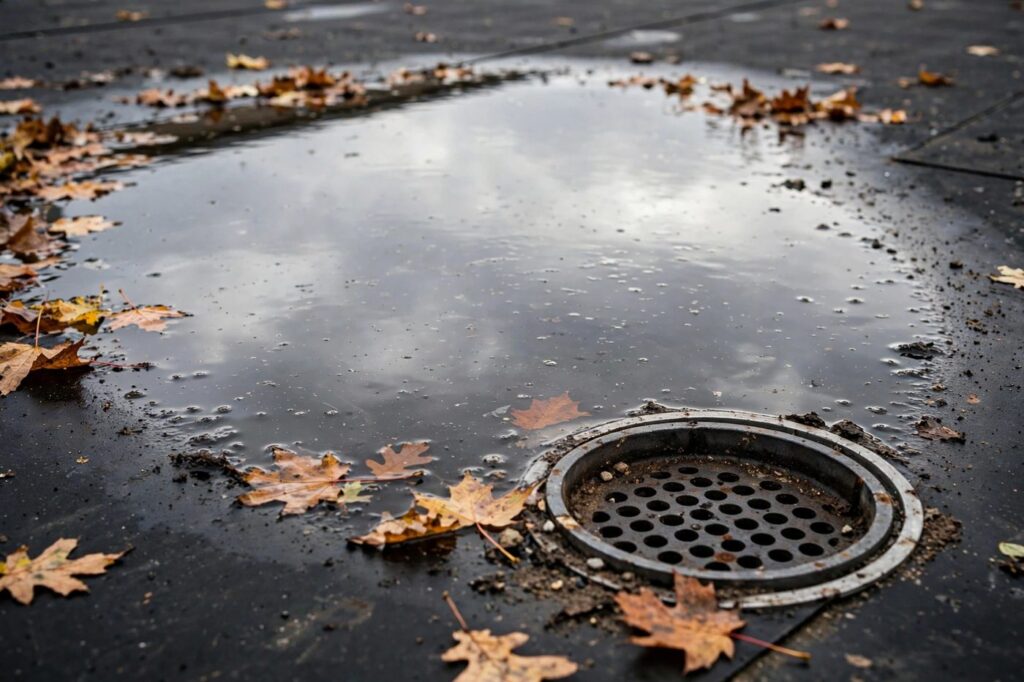
Water around a clogged drain is the classic ponding scene: leaves block the strainer, the drain backs up, and the membrane sits submerged. Every fall inspection should start at the drains.
3. Seams, flashings, and penetrations
Seams, flashings, and roof penetrations are where commercial roofs leak — not in the middle of the field. Check every seam for lifting or open edges, every flashing at parapets and curbs for gaps or cracked sealant, and every penetration (HVAC curbs, vents, pipes, skylights) for deteriorated boots and loose fasteners. Pay special attention to anything installed since the last inspection: new rooftop equipment means new penetrations, and new penetrations mean new leak paths.
4. Membrane damage and debris
Look for punctures, cuts, blisters, and alligatoring in the membrane. Clear any debris — branches, trash, abandoned equipment — that can puncture the surface or block drainage. Check walkway pads on high-traffic routes to and from rooftop equipment; worn-through pads expose the membrane to daily foot traffic damage.
5. Vegetation and rooftop conditions
Weeds growing in gravel or debris piles mean dirt has been sitting long enough to become soil — and roots find membrane seams. Pull it, clean it, and note where it was. Also check for unauthorized rooftop access: a door left unlocked to the roof is an open invitation for damage nobody reports.
Your warranty almost certainly requires this
Here is the part owners miss: the warranty is not a substitute for maintenance — it depends on it. GAF’s Diamond Pledge NDL Roof Guarantee, one of the industry’s strongest commercial roofing NDL warranties, states under “Owner Responsibilities” that you “must perform regular inspections and maintenance and keep records of this work.” It also requires leaks to be reported to GAF in writing within 30 days — notice to your contractor does not count. Keep the inspection logs. When a warranty claim is denied, the first question is always what your maintenance records show.
What maintenance costs versus what it saves
A professional commercial roof inspection typically runs a few hundred dollars to a few thousand depending on roof size and complexity; a standing twice-yearly maintenance contract costs more but includes minor repairs as they’re found. Compare that to replacement: a full commercial roof replacement can run several dollars per square foot installed, which puts a 10,000-square-foot roof well into the tens of thousands of dollars. And systems that get inspected last longer — lifespans vary widely by system, but maintenance is what moves a roof from the short end of its range to the long end.
If a replacement is on the horizon and you’re budgeting for it, run the numbers with the commercial roof cost calculator so the capital plan is based on real ranges, not guesses. Costs vary by region, roof size, access, and system — get local quotes before budgeting.
Frequently asked questions
How often should a commercial roof be inspected?
At least twice a year, in spring and fall, per NRCA guidance — plus after any severe weather event such as hail or high winds, and before and after any rooftop work. Document every inspection with photos and a written report; the log is what protects your warranty coverage.
Can skipping maintenance void a commercial roof warranty?
Yes. Major manufacturer warranties, including GAF’s Diamond Pledge NDL guarantee, require owners to perform regular inspections and maintenance and keep records. Most also exclude damage from ponding water — defined as water standing 48 hours after rain — when it goes unaddressed. Neglect is the most common reason warranty claims get denied.
What causes most commercial roof leaks?
Failed flashing and penetrations cause the majority of commercial leaks, followed by clogged drains leading to ponding, and open or lifted seams. The membrane field itself rarely fails first — the edges, seams, and penetrations do. That is why every inspection should start there.
Last updated: October 2026
Leave a Reply