
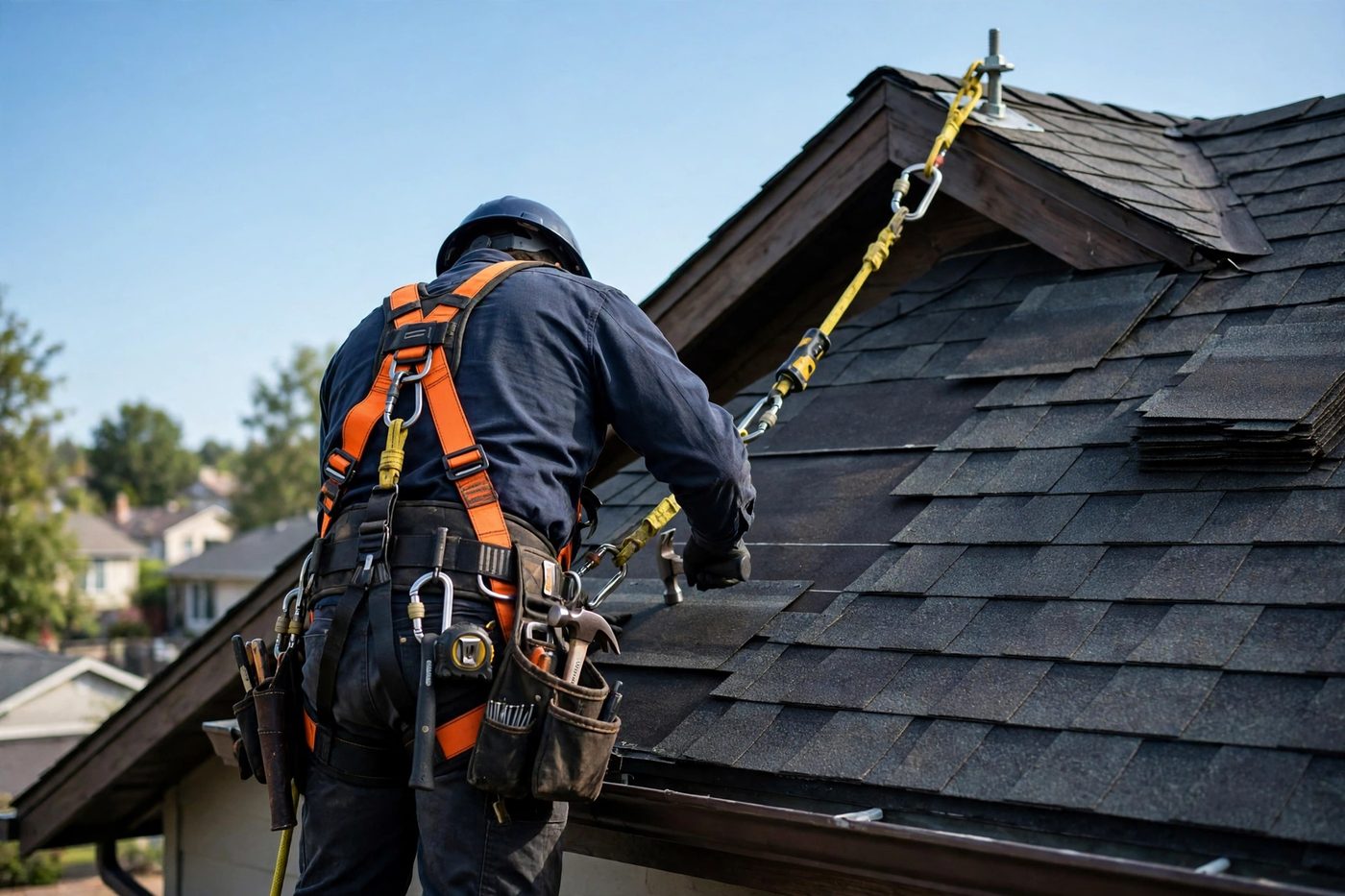
Key takeaways
- Under OSHA 1926.501, any worker 6 feet or more above a lower level must be protected against falling — guardrails, safety nets, or a personal fall arrest system. Residential roofs are included.
- Steep roofs (over 4:12 pitch) require guardrails with toeboards, safety nets, or a harness system; low-slope roofs may also use warning lines or a safety monitor.
- Anchors must hold 5,000 pounds per attached worker; body belts have been banned for fall arrest since 1998.
- Fall protection is OSHA’s most-cited construction standard every year — and falls, slips, and trips killed 96 of the 120 roofing workers who died in 2024, per BLS.
OSHA’s 6-foot rule means this: on any roof 6 feet or more above the ground or a lower level, paid workers must be protected against falling — no exceptions, no “I’ll just be careful for a minute.” The protection has to be a guardrail system, a safety net, or a full-body harness clipped to an anchor rated for 5,000 pounds per worker.
I supervised a 15-person roofing crew. Fall protection is the one thing I drilled into every new laborer on day one, because it’s the thing that kills roofers. The Bureau of Labor Statistics counted 96 of 120 roofing-contractor deaths in 2024 from falls, slips, and trips. And if you’ve ever watched an OSHA inspection from across the street, you know the inspector walks straight past everything else and looks at the edge first. This article lays out what the rule actually requires, in the terms you’ll hear on a real job site.
What the 6-foot rule actually covers
The trigger is 6 feet above a lower level — not 6 feet above the ground. A lower level can be the ground, a deck, a lower roof section, or anything you’d land on. On a single-story house with a low eave, the ridge can easily be 15–20 feet up. On a two-story, you’re at 20–25 feet off the eave alone. There is no residential exemption: OSHA 1926.501(b)(1) applies to all construction work, including residential roofing done by paid workers.
More on our field guides for working roofers is in our For Roofers hub.
Your three compliant options
OSHA doesn’t care which system you pick. It cares that one of them is in place whenever anyone is 6 feet or more above a lower level:
- Guardrail systems — top rail at 42 inches, plus or minus 3, with a midrail, able to take 200 pounds of force at the top edge (OSHA 1926.502(b)). Simple, passive, and the inspector’s favorite.
- Safety net systems — installed as close as possible under the work surface, drop-tested. Rare on residential roofing, common on commercial.
- Personal fall arrest systems (PFAS) — full-body harness, lanyard or lifeline, anchor. What most residential crews actually use.
The slope of the roof changes what’s allowed. On steep roofs — over 4:12 pitch — your options are guardrails with toeboards, safety nets, or PFAS, per OSHA 1926.501(b)(11). On low-slope roofs (4:12 or less), you get two more tools: a warning-line system set at least 6 feet back from the edge combined with another system, or a safety monitor alone — but only on roofs 50 feet wide or less, per 1926.501(b)(10).
What a compliant PFAS looks like on a real crew
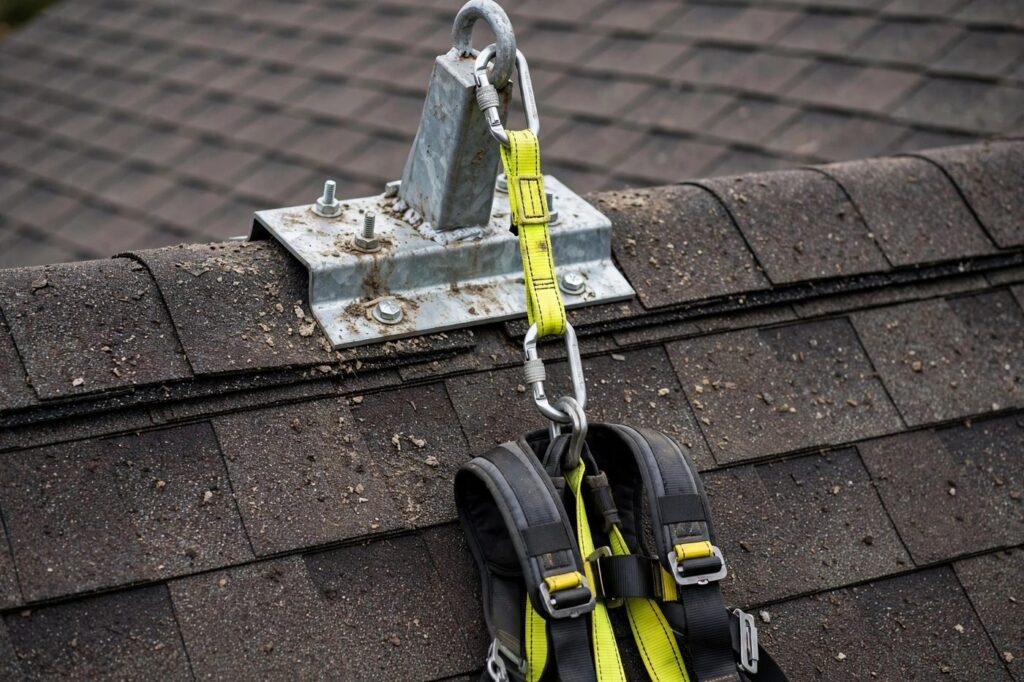
A compliant setup has three parts, and all three have specs: the harness must be a full-body harness (ANSI Z359.11) — body belts have been prohibited as part of a fall arrest system since January 1, 1998, and inspectors still catch crews with them. The connector is an energy-absorbing lanyard (ANSI Z359.13) or a self-retracting device, and the anchor must be rated for 5,000 pounds per attached worker, per OSHA 1926.502(d)(15).
Two details crews get wrong: the free fall can’t exceed 6 feet — a lanyard that’s too long for the anchor position blows the rule before anything happens — and the maximum arresting force on the worker is 1,800 pounds. If you buy a roof safety harness kit, check that it includes a shock-absorbing lanyard, not just rope; the absorber is what keeps the force on your body under that 1,800-pound limit.
The one piece nobody plans for is the rescue. OSHA expects prompt rescue of anyone left hanging in a harness — suspension trauma is real. Figure out before the job starts who pulls the roofer back up, with what, and in how long. “We’ll figure it out” is not a plan.
The mistakes inspectors cite most
Fall protection (1926.501) has been OSHA’s most-cited construction standard every year for over a decade, and the citations cluster around the same short list: no fall protection at all on a steep residential tear-off; a body belt instead of a harness; tying off to whatever was handy — a vent pipe, a gutter, an unrated anchor; guardrails pulled for material handling with nothing covering the gap; a safety monitor trying to watch a whole crew alone; and no documented training from a competent person.
The fines are not symbolic. OSHA’s maximum penalties for violations assessed after January 15, 2026 run to $16,550 per serious violation and $165,514 per willful or repeated violation. But the math that mattered to me as a supervisor was simpler: a harness and a rated anchor cost less than one day of a crew’s wages. Train it every morning like you test your nailer depth every morning — make it a habit, not a debate. And remember that everything holding the roof together depends on the fundamentals: a correct shingle nailing pattern and a compliant tie-off are the same discipline — do it right every square, every time. The Spanish version of this guide covers the same requirements in Spanish.
FAQ
Does OSHA fall protection apply to residential roofing jobs?
Yes. The 6-foot rule in OSHA 1926.501 covers all construction work, including residential roofing done by paid workers. There is no residential exemption — steep roofs over 4:12 pitch need guardrails with toeboards, safety nets, or a personal fall arrest system.
Can I use a body belt instead of a full-body harness?
No. Body belts have been prohibited as part of a personal fall arrest system since January 1, 1998. Only a full-body harness (ANSI Z359.11) is permitted for fall arrest.
Does the 6-foot rule apply if I’m working on my own house?
OSHA regulates employers and their paid workers, not homeowners doing their own roof work. But the same 6-foot line is the practical standard any professional roofer would hold you to — a fall from a single-story eave can be fatal, and a harness with a rated anchor costs less than an ER visit.
Disclosure: RoofAdviceHub is reader-supported. When you buy through links on our site we may earn an affiliate commission at no extra cost to you. As an Amazon Associate we earn from qualifying purchases.
Last updated: October 2026
Disclaimer: this article summarizes OSHA 29 CFR 1926 Subpart M for general educational purposes. It is not legal advice — check the current standard text and consult a qualified safety professional for your specific jobsite.
Leave a Reply