
Key takeaways
- Every nail head should sit flat and flush with the shingle — not sunk in, not sticking up.
- Test-fire five nails into scrap shingle and decking every morning before the first course goes down.
- Most pneumatic coil nailers run best at 80–95 psi, per Owens Corning’s technical bulletin — then fine-tune with the depth wheel.
- An overdriven nail is a damaged shingle: replace it, or seal it with roofing cement plus a new fastener within 1 inch.
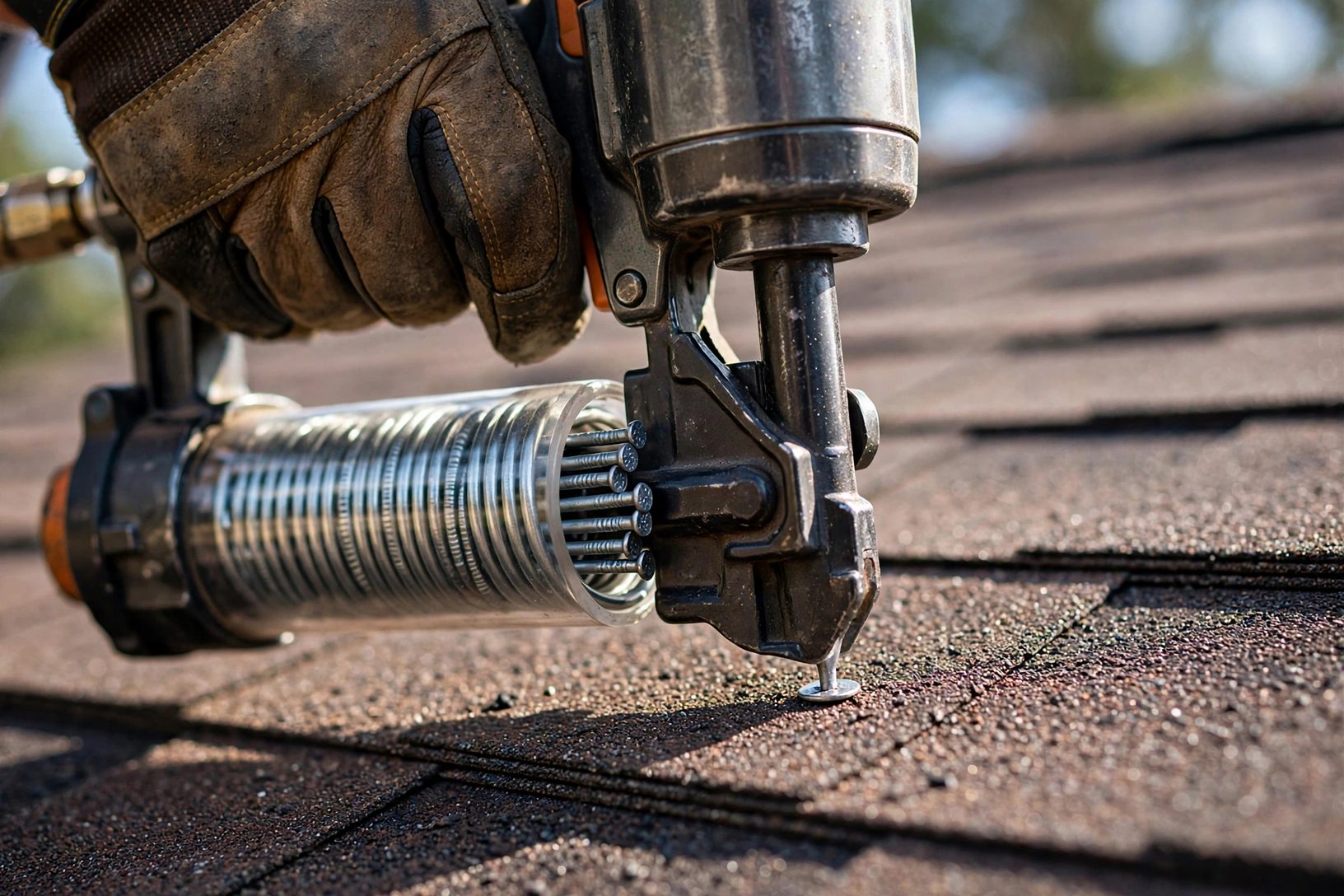
A correctly set roofing nailer drives every nail head flat and flush with the shingle surface — no dimple, no proud head, no torn mat. Getting there takes five test nails into scrap material every morning, then small adjustments to the depth wheel and air pressure as the day changes.
I watched a crew burn half a day re-nailing a slope because one gun ran hot after a compressor swap. Depth moves with pressure, temperature, decking, and shingle thickness. For more field guides like this one, see the For Roofers hub.
What a correct nail looks like
The nail head sits flat and flush, the shingle lies flat against the course below, and the sealant strip can bond. That’s the standard in every manufacturer’s install guide. Overdriven means the head crushes into the shingle and tears the fiberglass mat — lost holding power and a leak path. Underdriven means the head stands proud, the shingle above can’t lie flat, and the sealant strip never fully bonds. CertainTeed’s applicator’s manual adds the depth rule: on decks 3/4 inch or thicker, nails need at least 3/4 inch of penetration into the deck.
The morning test: five nails into scrap
Before the first bundle gets opened, set up a test station: scrap decking with a scrap shingle on top, same thickness as what you’re installing that day.
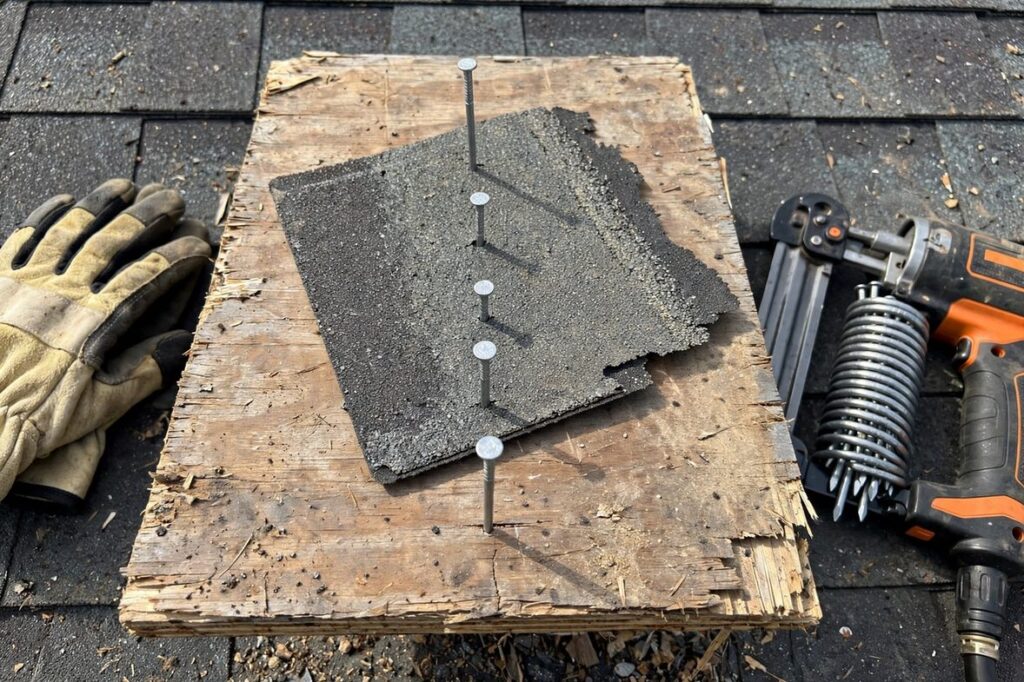
- Set starting pressure. Owens Corning’s bulletin puts most coil nailers at 80–95 psi. Start at 85 — use the lowest pressure that drives nails flush.
- Fire five nails into the scrap, holding the gun square and firm, the way you’ll hold it on the roof.
- Read them. Run a fingertip across each head. Flush means you feel the head but no edge and no crater. Buried means you’re hot. Proud means you’re cold.
- Adjust one thing at a time. Depth wheel first, pressure second. One click or quarter-turn, then five more test nails.
- Confirm on the real deck. Check the first five nails on the actual roof the same way — scrap is close, but the first course is the real test.
Depth wheel vs. pressure
Two controls, two jobs. The depth adjustment wheel (usually a thumbwheel near the nose or trigger) changes how far the driver blade travels. Air pressure sets how hard the blade hits. On most guns, turning the wheel one way drives deeper, the other shallower; check your manual, because direction varies by brand.
Pressure does the coarse work, the wheel does the fine work. Heads buried deep — drop pressure first. A hair proud — nudge the wheel. Owens Corning’s bulletin warns against running more pressure than the job needs: excess pressure wears the tool and blows through shingles.
Watch for what moves your setting mid-day: a second gun on the same compressor (Owens Corning flags this directly — shared air drops penetration), a longer hose run, a compressor cycling low, cold mornings, or switching from 3-tab to architectural shingles. Architectural shingles are thicker, so a setting that was flush on 3-tab comes up proud on laminates.
What to do with a bad nail
- Slightly proud: one firm hammer tap to seat it flush. If the shingle isn’t torn, that’s a good repair.
- Overdriven (head crushed into the mat): per Owens Corning’s bulletin, repair it — replace the shingle, or cover the fastener with asphalt roofing cement and add a fastener within 1 inch.
- Crooked or angled: pull it and re-drive straight. An angled nail holds less and can push the next course out of line. For where each nail goes — and why 6 nails beat 4 in high wind — see our shingle nailing pattern guide.
The rule on a crew: the guy who fires a bad nail fixes it on the spot. Pair it with the crew’s other daily discipline: OSHA fall protection basics — harnesses on, anchors rated, lanyard checked before anyone steps onto the roof.
Gun and nail basics
Most steep-slope crews run a pneumatic coil roofing nailer — 15-degree, 1-1/4 to 1-3/4 inch nails for standard shingles. Cordless coil nailers are fine for repair work and small jobs, but on a full tear-off day the pneumatic gun still wins on weight, speed, and consistency.
Nails matter as much as the gun. Owens Corning specifies corrosion-resistant 11- or 12-gauge nails with minimum 3/8-inch diameter heads, meeting ASTM F1667. Electro-galvanized nails corrode faster — hot-dipped galvanized or stainless is the standard on a roof you want to last.
FAQ
What PSI should a roofing nailer be set to?
80–95 psi for most pneumatic coil nailers, per Owens Corning’s technical bulletin. Start around 85 and adjust to the lowest pressure that drives nails flush. Hose length, compressor capacity, and a second gun sharing the line all shift effective pressure — verify with test nails.
How do I know if my roofing nailer is driving nails too deep?
Run a fingertip across the nail head. A crater, or a head sunk into the mat with torn fiberglass around it, means overdriving. Turn the depth wheel toward shallow (or drop pressure a few PSI), fire five test nails into scrap, and re-check.
Should I test my nailer every day or just once?
Every morning, and again after anything changes: new compressor or hose, a second gun on the line, a switch in shingle thickness, or a big temperature swing. Five test nails takes less time than re-nailing one course.
Disclosure: RoofAdviceHub is reader-supported. When you buy through links on our site we may earn an affiliate commission at no extra cost to you. As an Amazon Associate we earn from qualifying purchases.
Last updated: October 2026
Leave a Reply