
Key takeaways
- Torch-down roofing safety starts before the flame: clear combustibles within 35 feet and name a trained fire watch.
- NRCA’s CERTA program calls for two 4A60BC extinguishers within 10 feet of torch work and a 2-hour fire watch after the last torch goes out.
- Never torch directly into corners, flashings, or deck voids — use self-adhered or cold-applied material in those spots.
- OSHA’s 30-minute fire watch is a floor, not a finish line: smoldering fires can hide for hours.
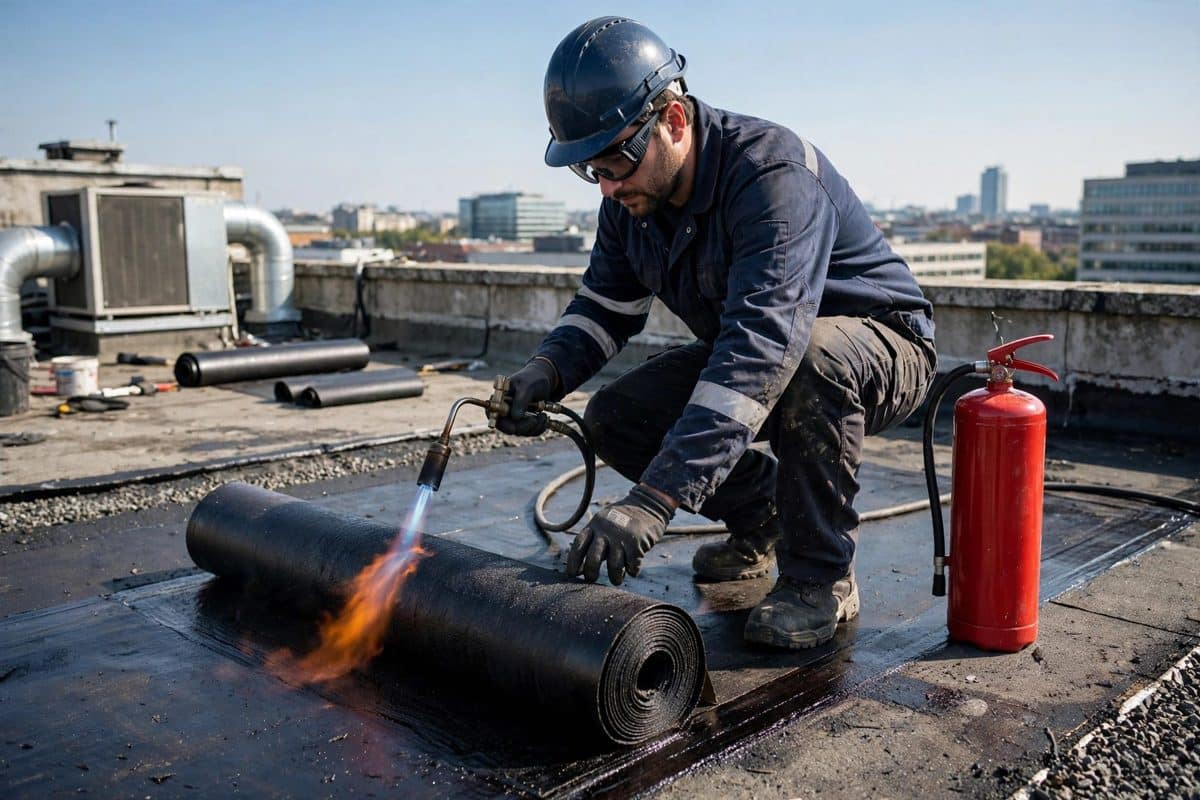
Torch-down roofing safety comes down to one rule: the job is not over when the torch goes out. Before you light up, clear combustibles within 35 feet, put two 4A60BC extinguishers within 10 feet of the work, and assign a trained fire watch who stays long after the last seam is sealed.
Torch-down looks fast: a torch, a roll of modified bitumen, a steady walk backward. The risk hides underneath — wood decking, a gap at a wall, a vent full of lint, a seam that keeps smoldering after everyone has packed up. Most torch fires do not start while the flame is visible. They start later, in a spot nobody checked. That is why this checklist covers before, during, and after, in that order.
Before you light up: walk the roof like a fire inspector
Start with a pre-job walk, not the propane valve. Look for fire traps first: plywood or OSB decking, wood plank, wood fiberboard, and open gaps or voids in the deck. According to NRCA’s CERTA torch-safety practices, the foreman should review daily with the building owner any conditions that could present a hazard during torching — and address them before work starts, not after the first roll is down.
Clear or protect everything combustible within 35 feet of the work. That is the hot-work distance in OSHA’s fire-prevention rules, and it covers more than loose debris: sweep the roof, remove scrap and rags, and keep piles at least 10 feet from the building. Check every penetration inside and out. Exhaust vents with lint or grease, intake vents, skylights, and vent pipes need cleaning before torching, and air conditioning units, exhaust fans, and air intakes in the work area should be shut down at the roof control with the building owner or maintenance staff, so a fan does not pull heat or a spark inside.
Check what is under the membrane you are about to heat. If the substrate is plywood, OSB, or cannot be confirmed as non-combustible, it needs a thermal barrier first — perlite board, fiberglass or mineral wool insulation, or gypsum board. If you cannot see what is below a detail, do not guess: pull the material away, heat it, then apply it to the surface. Torch into a blind spot and you are heating something you cannot watch.
Gear that must be on the roof before the first seam
Two 4A60BC fire extinguishers within 10 feet of torch operations is the CERTA standard, deliberately far above the OSHA minimum. As Professional Roofing’s summary of CERTA notes, that rating carries more than 10 times the firefighting capability OSHA’s rules require. Keep at least one extinguisher per torch operator, within reach but not so close to propane equipment that a fire blocks access to it. Every person on the roof should be trained to use one, and a 4A60BC fire extinguisher whose seal has been broken, even for a small use, must be recharged before the next job.
PPE is simple and non-negotiable: work boots, long pants, a long-sleeved shirt, and gloves. Everyone except the torch operator should stay at least 3 feet from the flame. Add two items crews forget: a phone or other means of reaching 911, and an infrared thermometer for the fire watch. You cannot find a hot spot by looking at a finished seam — you find it by scanning upstands, wall transitions, penetrations, and cants after the flame is gone.
Fall protection belongs here too. Torch work does not suspend the 6-foot rule: at 6 feet or higher, fall protection is required, with a plan in place before the torches come out. See OSHA fall protection for roofers and what the 6-foot rule actually requires for the options in plain terms.
While you work: torch rules that prevent most fires
Never torch directly at flashings, corners, or voids in the roof deck. That is the most repeated warning in the modified-bitumen application guides, because those are exactly the places where flame slips through a gap into something combustible. Use self-adhered or cold-applied material at fire-sensitive locations, and torch the membrane first, then adhere it to the corner or joint — never the other way around.
Treat the torch as if it is always burning. On a bright day the flame can be hard to see, and near mechanical equipment it can be hard to hear. Never leave a lighted torch unattended, never lay an operating torch over the edge of a roof, and never rest one on a propane tank — if there is a gas leak, that is how a small problem becomes a tank fire. Ignite with a flint or electronic lighter, not matches or a disposable lighter, and check hoses, regulators, and connections first: no worn hoses, no regulator rated above its torch, no damaged equipment. Work with the same steady attention heat-welding a TPO seam demands — and if a lap is unbonded, lift it and re-torch it properly instead of torching the top surface. For the full pro library, see the For Roofers hub.
The fire watch: the part crews skip, and the part that matters most
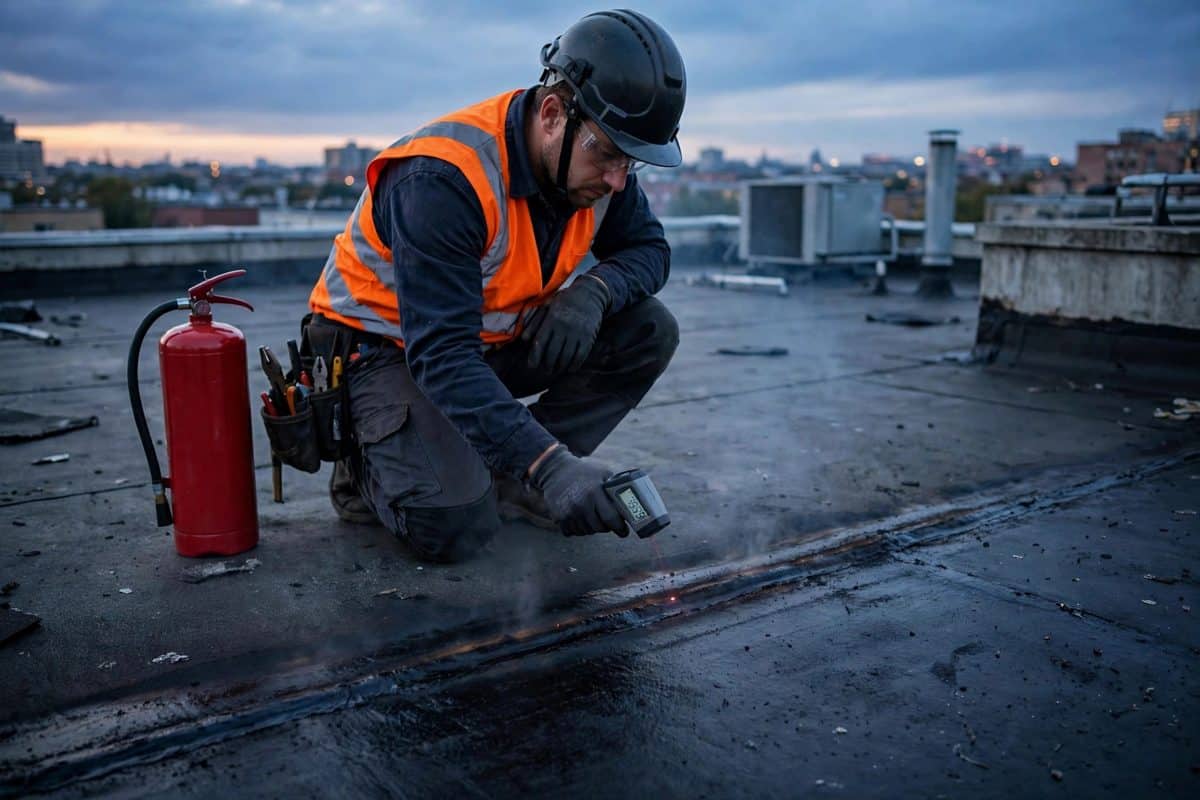
The fire watch is a named, trained person whose only job during and after torching is watching for fire — not a crew member who is also rolling membrane. That person has extinguishing equipment immediately available, knows how to sound the alarm, and stops work when conditions turn hazardous.
How long? OSHA’s general-industry hot-work rule requires at least 30 minutes after hot work ends. NFPA 51B’s 2024 edition sets a 60-minute baseline, plus up to 3 additional hours of monitoring as the permit authorizer directs. NRCA’s CERTA program requires a 2-hour fire watch after the last torch is extinguished. As Roofing Magazine’s summary of OSHA’s rules puts it, the OSHA figures are minimums. On a torch-down job, plan for the CERTA 2 hours, longer if the building has combustible construction or concealed cavities.
During the watch, scan for hot spots with the infrared thermometer — especially at upstands, wall transitions, and around penetrations — and, wherever access allows, inspect the underside of the deck or walk the building interior before closing out. A smolder behind a wall will not announce itself from the roof. If a propane tank itself catches fire and you cannot shut off the cylinder valve safely, do not fight it: get clear and call the fire department. Never use water on a kettle or asphalt fire. Sign off the daily checklist only after the watch period is complete and the area is confirmed safe.
FAQ
How long should fire watch last after torch-down roofing?
Plan for 2 hours after the last torch is extinguished, per NRCA’s CERTA program. OSHA requires at least 30 minutes and NFPA 51B’s 2024 edition requires 60 minutes plus up to 3 hours of additional monitoring — treat those as minimums, not targets.
Can you torch directly over wood decking?
No, not without a thermal barrier. Plywood, OSB, wood plank, and other combustible substrates need perlite board, fiberglass or mineral wool insulation, or gypsum board first. Never torch directly into corners, flashings, or deck voids — use self-adhered or cold-applied material there.
What fire extinguisher do you need for torch-down roofing?
CERTA calls for a minimum of two 4A60BC extinguishers within 10 feet of torch operations, at least one per torch operator, with every person on the roof trained to use them. Keep them reachable but not so close to propane equipment that a fire blocks access.
Disclosure: RoofAdviceHub is reader-supported. When you buy through links on our site we may earn an affiliate commission at no extra cost to you. As an Amazon Associate we earn from qualifying purchases.
Last updated: October 2026
Disclaimer: This article is general trade guidance, not a substitute for NRCA CERTA training, your employer’s hot-work program, or local fire-code requirements. Always follow the membrane manufacturer’s installation instructions and the permit conditions for your job.
Leave a Reply