
Key takeaways
- Never pay a roofer in full up front. The FTC warns against it, and deposits on a typical job run 15–25%.
- Texas has no state roofing license — in Texas, “licensed” on a truck means nothing at the state level, so insurance and references do the filtering.
- Get three written quotes and compare them line by line: the lowest bid often leaves out decking, flashing, or haul-away.
- A manufacturer warranty covers the shingles. Only a written workmanship warranty — or a GAF-backed one like Golden Pledge — covers the installation.
- In November 2026, a Michigan veteran paid $15,000 up front and went 539 days without a roof — a milestone payment schedule would have stopped it.
The short answer: a good roofing contractor has a permanent local address, proof of general liability and workers’ compensation insurance, three recent references you actually call, a written line-item quote, and a payment schedule that never asks for the full amount up front. If any one of those is missing, keep looking — the cheapest bid is rarely the cheapest roof.
Picking a roofer is the most expensive decision most homeowners make about their house, and it comes with the least help from the state. In Texas, there is no roofing license to look up, no exam, and no board to revoke anything when the work is bad. The vetting falls on you — and it takes about an afternoon.
I spent years running a 15-person roofing crew. The homeowners who got burned almost never got burned by a bad roof — they got burned by a bad hire. The ten questions below separate a real roofing company from a truck, a ladder, and a promise.
Start with the paperwork before you ask anything else
Before the first question, check three things that take ten minutes. First, the company has a permanent place of business — a real address, a real phone number, and a tax ID — not just a cell phone and a P.O. box. The National Roofing Contractors Association (NRCA) puts this at the top of its checklist for selecting a roofing contractor, and it is there for a reason: a workmanship warranty is a promise from a company, and it is only worth as much as that company’s chance of still being around.
Second, ask for certificates of general liability and workers’ compensation insurance, and check that the coverage dates run through your install window. NRCA’s guidance is blunt: if a contractor is not properly insured, you may be liable for accidents on your property. Call the insurer named on the certificate to confirm it is real — a certificate is a summary, not proof.
Third, check the Better Business Bureau for complaints and read reviews with a critical eye. One bad review means little; a pattern — late starts, leaks after install, no warranty callbacks — means everything.
The 10 questions to ask before you sign
Ask these in person or on the phone, and write the answers down. A legitimate contractor answers all ten without hesitation. A contractor who dodges more than one is telling you something.
1. Are you licensed and insured — and can I see the certificates? Licensing depends on your state, so check with your state or county government for what applies where you live. In Texas, there is no state roofing license at all — lawmakers have tried to create one at least five times since 2013, most recently HB 3344 in 2025, and every bill died before a vote. So a “licensed roofer” claim has no state meaning there, and insurance and references matter even more. Some Texas cities do require local registration to pull a permit.
2. How long have you been in business under this name? Longevity is not a guarantee, but a company that has survived five or ten storm seasons in your area has a track record you can check. Be wary of a company whose name is younger than the last hailstorm — storm chasers open, close, and reopen under new names.
3. Can I call three of your recent customers? Not names on a flyer — three people you can phone today, with roofs installed in the last year or two, in your own county if possible. Ask them: did the crew show up when promised, did the price change, and did anyone come back when there was a problem? If the contractor cannot produce three, stop there.
4. Will you give me a written, line-item quote? NRCA tells homeowners to insist on a written proposal with a complete description of the work, specifications, start and completion dates, and payment procedures. The quote should name the exact shingle brand and line, the underlayment, where ice-and-water shield goes, drip edge, step and counter flashing, pipe boots, ventilation, the per-sheet price for replacing rotten decking, debris haul-away, and who pulls the permit. A one-line price — “$12,000 for a new roof” — cannot be compared to anything.
5. What does your warranty cover — the shingles, the work, or both? These are two different warranties, and confusing them is the most common expensive mistake in roofing. The manufacturer’s warranty covers defects in the shingles themselves — GAF’s standard warranty, for example, is non-prorated for the first 10 years and never covers workmanship. The contractor’s workmanship warranty covers installation errors, and per NRCA guidance most contractors offer one or two years, with no industry standard. The exception is a manufacturer-backed workmanship warranty: GAF’s Golden Pledge, available only through GAF Master Elite contractors, adds 25 years of factory-backed workmanship coverage on Timberline HDZ (30 years on UHDZ and designer shingles), backed by GAF itself — so it survives even if the roofer goes out of business. Whatever warranty you are offered, get it in writing and read the provisions that would void it.
6. Who will be on my roof, and who is in charge? Ask for the name of the person supervising your job, how many workers will be on site, and whether the crew are employees or day laborers picked up that morning. On a crew I ran, the foreman was the difference between a roof that lasted 25 years and one that leaked in year two. You are hiring the crew, not the salesperson.
7. How do you handle decking that turns out to be rotten? Nobody knows what is under your old shingles until they come off. The quote should state a per-sheet price for replacing damaged plywood or OSB before the tear-off starts — not a surprise number mid-job. This is the line item that turns into a fight more than any other, because a low bid that assumes perfect decking and a real bid that budgets for some replacement are not the same price. If your roof is older, it is worth knowing what repair versus replacement actually involves before you sign.
8. What is the payment schedule? The Federal Trade Commission’s advice is plain: do not pay the full amount up front, and never make the final payment until the work is done and you are satisfied with it. The Consumer Federation of America notes that deposits typically run 15–25% of the job, and some states limit by law how much a contractor can ask for in advance. A fair schedule looks like a modest deposit, a payment when materials arrive, and the balance on completion after your final walk-through. Cash-only and “pay everything today for a discount” are both red flags the FTC names by name.
9. Will you pull the permit, and will the work be inspected? The contractor should pull the permit, not you. One who asks you to get it may be unlicensed locally or reluctant to deal with the building inspector. Confirm the permit is in the quote, and do not make the final payment until inspections are passed.
10. What happens if something leaks after you leave? Get the answer in writing: who do you call, how fast do they come back, and what is covered. A company that stands behind its work answers this in one sentence. A company that does not will change the subject to the shingle warranty — which, as question 5 showed, covers the shingles, not the installation.
How to compare the quotes (the part most people skip)
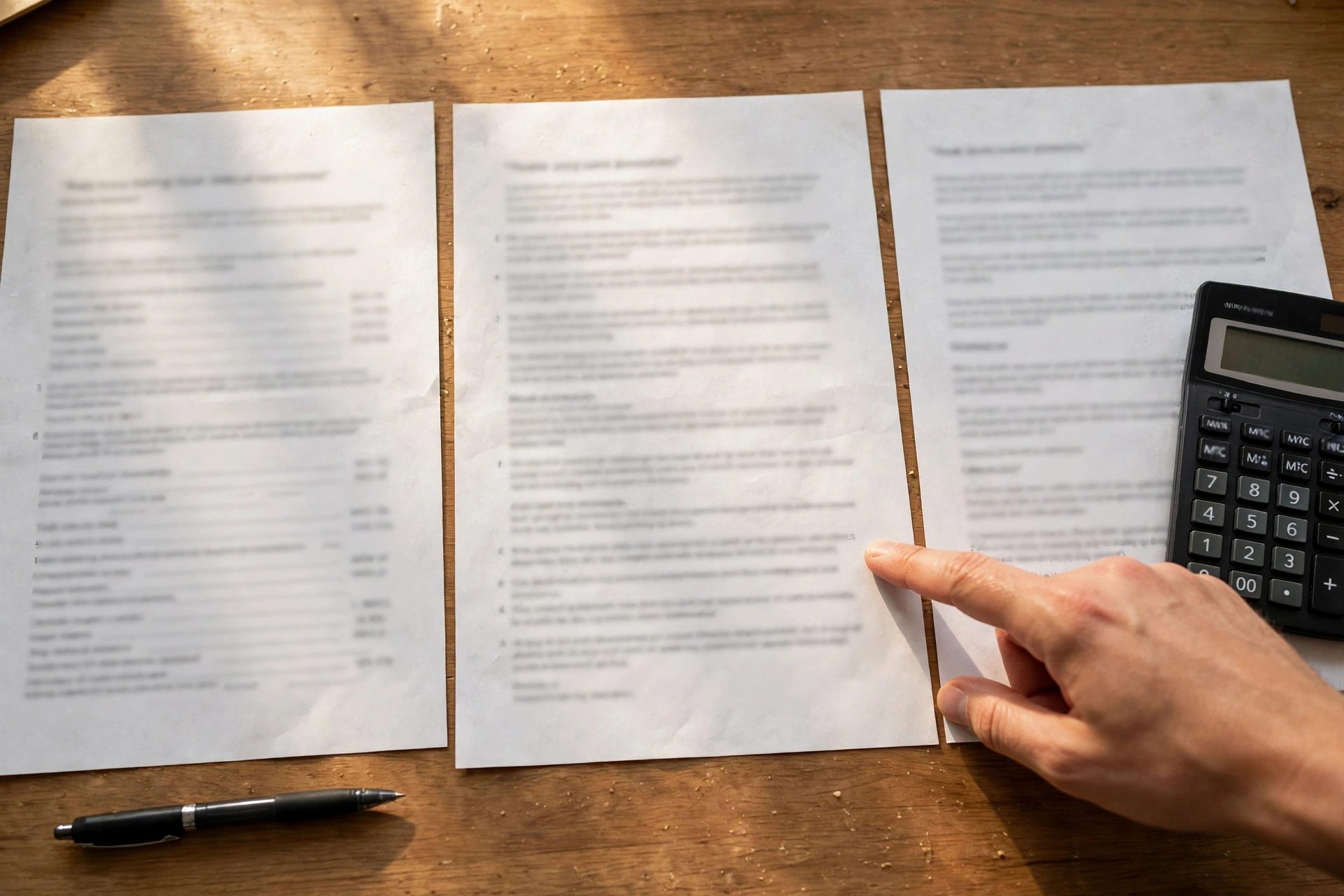
Get three written quotes. Then do not compare the big numbers — compare the line items. A comparison making the rounds in November 2026 shows a $9,600 bid plus $1,350 in mandatory extras coming out $400 more expensive than a $10,400 bid with only $150 in extras. The “cheap” bid lost. The difference was scope: tear-off versus layover, ice-and-water shield on the eaves or only in the valleys, how many sheets of decking were included, new pipe boots and drip edge or reused ones, ventilation specs, dump fees, cleanup, and the length of the workmanship warranty in writing.
Put the three quotes side by side and look only at the rows where one column is empty. That empty row is where the money hides. If one bid is thousands lower than the others for the same shingles, it is not a bargain — something was left out, and you will pay for it later, either as a change order or as a leak.
Before you accept any quote, it also helps to know what a roof should cost in the first place. Angi’s 2026 data, based on more than 32,000 verified projects, puts the national average at $9,611, with a typical range of $5,903–$13,380 — but your roof’s size, pitch, and material move that number a lot. Our complete 2026 roof replacement cost guide breaks it down by material and roof size, and the roof cost calculator gives you a ballpark for your own house before you sit down with any contractor.
Red flags that mean walk away
Any one of these on its own might have an innocent explanation. Three of them together do not.
- Knocking on your door after a storm, offering to handle your insurance paperwork. Legitimate roofers do not need to canvas neighborhoods.
- “Leftover materials from another job” at a discount. There is no such thing as a truck full of matching shingles looking for a home.
- Pressure to decide today. A roof is a five-figure purchase. A contractor who will not let you sleep on it is not protecting your interests.
- Full payment up front, or cash only. The FTC lists both as warning signs. In November 2026, Local 4 in Detroit reported a Michigan veteran who paid $15,000 up front to a roofer who tore off his old roof in spring 2023 and never came back — 539 days later, he still has no roof.
- No written contract, or a contract with blank spaces. If you signed in your home rather than at the contractor’s office, the FTC’s cooling-off rule gives you three business days to cancel in writing — but only if the contract says so. Read it before you sign, not after.
- “We don’t need a permit for this.” If your city requires one and the contractor skips it, the unpermitted work is your problem when you sell the house.
One more thing worth doing before you call anyone: look at your own roof from the ground first. A pair of binoculars will show you missing shingles, curled edges, and damaged flashing without a ladder — and knowing what is actually wrong keeps you from paying for a full replacement when a repair would do. Our 9 signs you need a new roof guide walks through what to look for.
How many quotes should I get for a new roof?
Three written, line-item quotes — two is the minimum. Three gives you a real range and makes the odd one out obvious. Compare the line items, not the bottom-line prices.
What is a fair deposit for a roofing job?
Deposits typically run 15–25% of the total, according to the Consumer Federation of America, and some states cap the amount by law. Never pay the full amount up front, and hold the final payment until the work is complete, inspected, and you have walked the roof with the foreman.
Do roofers need a license in Texas?
No. Texas has no state roofing license, no exam, and no state board — bills to create one have failed in at least five legislative sessions since 2013, most recently HB 3344 in 2025. Some Texas cities require local registration to pull a permit, and the Roofing Contractors Association of Texas runs a voluntary licensing program. In Texas, verify insurance certificates, business registration, and manufacturer certifications instead of a license number.
How do I know if a roofing contractor is legit?
Check four things: a permanent local address and phone number, general liability and workers’ compensation certificates confirmed with the insurer, three recent references you call yourself, and a written line-item quote with a separate workmanship warranty — plus a clean Better Business Bureau record. If all four check out, you are dealing with a real company.
What should a roofing contract include?
The contractor’s name, address, phone number and license number (where one exists), a detailed description of the work and materials including the exact shingle brand and line, start and completion dates, the total price, the payment schedule, both warranties in writing, who pulls the permit, and the per-sheet price for decking replacement. No blank spaces, and a written statement of your right to cancel within three business days if you signed at home.
Should I choose the lowest roofing bid?
Not automatically. The FTC and NRCA both warn against it. A low bid usually means something was left out of the scope — decking, flashing, ventilation, haul-away — and that cost shows up later as a change order or a leak. Compare scope first, price second.
Costs vary by region, roof complexity, and material — get local quotes. This article is educational, not legal or financial advice; check your state and local rules before signing a contract.
Disclosure: RoofAdviceHub is reader-supported. When you buy through links on our site we may earn an affiliate commission at no extra cost to you. As an Amazon Associate we earn from qualifying purchases.
Last updated: November 2026
Leave a Reply