
Key takeaways
- Judge every channel by cost per booked job, not cost per lead: shared leads run $15–$120 each but close at 8–15% (3–5 contractors buy the same request).
- 97% of homeowners say response speed sways who they hire (Housecall Pro, 2025); contact within 5 minutes and you’re 21× more likely to qualify the lead (Harvard Business Review).
- A complete Google Business Profile gets 7× more clicks; 88% of consumers read reviews before choosing a contractor. The best lead system is free.
More roofing leads don’t come from one magic channel. The companies that stay booked in 2026 run several repeatable systems at once — speed-to-lead, reviews, Local Services Ads, a website that converts, referrals, local content, and paid platforms used as a supplement, never the whole plan. Here’s how each one actually works, what it costs, and where most owners go wrong.
One rule before anything else: the number that decides every marketing decision is cost per booked job, not cost per lead. A $50 lead you close 10% of the time costs $500 per signed job. A $110 lead you close 35% of the time costs $314 per signed job. The cheap lead is more expensive. Internalize that and half of these systems make instant sense.
Budget anchor: most planning guidance for service companies lands around 5–10% of revenue for marketing — a mature referral-heavy shop can run leaner, while a company adding crews or entering a market spends above it temporarily. We’ve organized all of our business-side guidance for owners in our roofing company owners hub.
How to get more roofing leads: do the acquisition math first
Before you spend a dollar, set your ceiling. Take your gross profit per average job — say $4,000 on a replacement — and decide the maximum share you’ll spend to acquire it, once you price every job to protect your margin. If 15% is your ceiling, that’s $600 per booked job. Now every channel gets judged the same way: lead cost ÷ close rate = cost per job. Run that division on your current channels this week. Most owners are surprised — some for good reasons, some not. Everything below is ordered from highest-ROI to most expensive.
1. Call every lead back in under 5 minutes
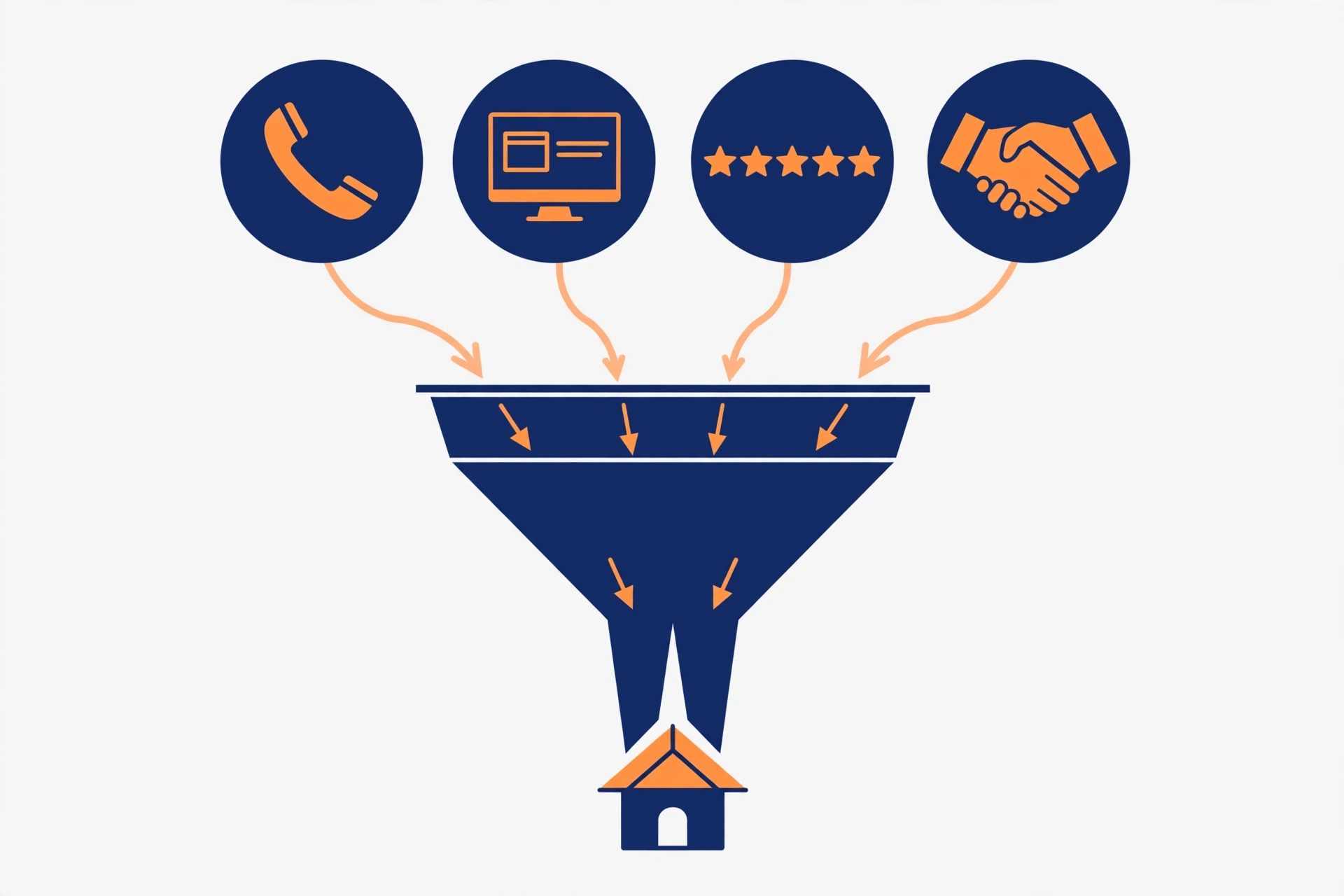
This is not a marketing channel. It is a multiplier on every other channel, and it is the one most roofing companies fail at.
The numbers are brutal. A Harvard Business Review study found that contacting a lead within 5 minutes makes you 100 times more likely to reach them and 21 times more likely to qualify them compared to waiting 30 minutes (per Improve & Grow’s 2026 lead-management guide). An October 2025 survey of 1,040 homeowners by Housecall Pro found that 97% say response speed influences which home service pro they hire. And 78% of buyers ultimately choose the first company to respond. Yet a Jobber 2026 survey found only 20% of home service owners say they reply to leads within the hour (via UseCarly’s 2026 missed-call roundup).
That gap is your opening. A homeowner who submits a form at 9:40 PM and hears back at 9:44 PM is your customer. The same homeowner, called back at 9 AM the next morning, has already booked with the company that answered at night.
The system: every inquiry — form, call, chat, text — hits one place. After hours, an auto-response goes out immediately with a real name and a promise (“This is Mike, I’ll call you at 7 AM”). The first human call happens the next morning, same hour, every time. No system, no speed, no point buying leads.
What it costs: the right roofing CRM or call-tracking setup, typically $50-150/month. It pays for itself the first week it works. When a hailstorm hits, run our 72-hour storm damage marketing playbook.
2. Win the Google Business Profile before you win anything else
When a homeowner searches “roofing contractor near me,” your Google Business Profile is your website’s front door — and it’s free. The companies that get the calls are the ones with plenty of recent reviews, photos of actual jobs, and answered questions on the profile.
Reviews do double duty: they rank you higher and they close the sale. Per Google’s own figures, businesses with complete profiles get 7× more clicks, and 88% of consumers read reviews before choosing a local business (per Shapo’s 2025 review statistics roundup). Recency matters too — 73% of consumers only trust reviews from the last 30 days. Trust is what “appears trustworthy” means in practice: recent reviews, real photos, answered questions.
The system: ask for a review on every completed job, while you’re still on-site and the homeowner is happy. Text them the direct review link before you leave the driveway. Respond to every review, including the bad ones, with specifics. Post 2–3 job photos a week to the profile. Companies that do this consistently pull leads that never touched a paid channel — and close them at 40% or better because the homeowner pre-sold themselves. For the full routine, see how to get more Google reviews for your roofing company.
3. Turn on Google Local Services Ads
If you buy one paid channel, make it this one. Local Services Ads put you at the very top of Google with a “Google Verified” badge, and you pay per lead — an actual phone call or message — not per click.
The numbers for roofing: contractor-reported data puts roofing leads on Local Services Ads at an average of about $101 in Q2 2026, with typical ranges of $75–$150 per qualified call across industry benchmarks (per 2026 contractor-channel reporting; WebTonic’s Q1 2026 roofing benchmarks put LSA in the same $75–$150 band). That sounds expensive until you do the acquisition math: at a 25% close rate, a $100 lead becomes a $400 booked job. On an $8,000–$15,000 replacement, that’s a 20–38x revenue multiple on the lead cost.
Two warnings. First, LSA can’t distinguish a $400 repair from a $15,000 replacement — both arrive at the same per-lead price, so make sure your job mix supports it. Second, tight job-type and service-area settings matter: Google’s lead credits only recover a single-digit share of bad-lead spend, so prevention beats disputes.
4. Build a website that sells estimates while you sleep
Your website is not a brochure. It is a salesperson that works nights, weekends, and holidays — and plenty of home-service inquiries arrive after hours, when your office is dark. The companies converting search traffic into leads all do three things:
- Show real numbers. Homeowners comparison-shop price first — it’s the single biggest trust gap in roofing. You don’t need exact quotes: ranges by material with an honest “what moves the price” section are enough. Our own 2026 roof replacement cost guide ranks because it answers the price question plainly.
- Answer the questions homeowners actually search. Every “how much,” “how long,” and “what is” article is a lead that found you instead of a competitor. Publishing one helpful piece regularly compounds — contractor benchmarks put SEO leads at $5–$30 each on mature programs, and organic search leads close far better than shared platform leads (per ProWeb365’s 2026 channel comparison).
- Give something worth exchanging contact info for. A free estimate tool on your site turns anonymous visitors into named leads with a phone number and a zip code. We run a free roof cost calculator for exactly this reason: the homeowner gets an honest range, you get a qualified inquiry to call back in five minutes (see system 1).
5. Run a referral engine on every single job
The cheapest lead in roofing is the one you already paid to create: a happy customer standing on a new roof. Yet most companies leave referrals to chance.
The system: before you leave the job site, ask directly — “We’re trying to help two more families on this street. Who do you know with an older roof?” — and leave five business cards or a referral card. Then follow up by text a week later when they’ve had time to enjoy the work. Referral leads close at the highest rate of any channel and cost you nearly nothing; the only real expense is the ask and the follow-through.
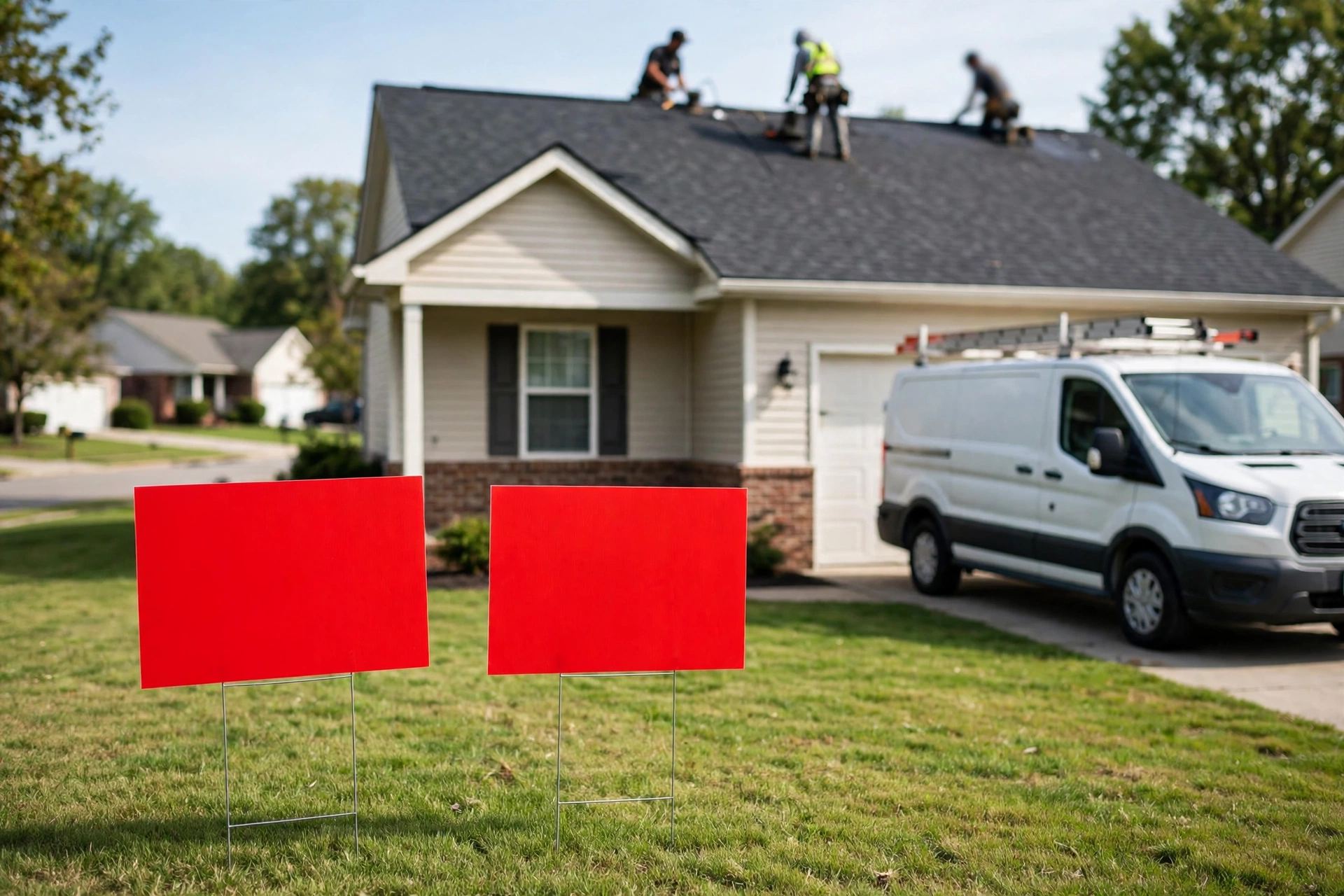
Multiply it with visibility. Two yard signs at every job site — one facing each direction of traffic — turn each project into weeks of free advertising on the street where your ideal next customer lives. A box of corrugated blank yard signs on Amazon costs less than one shared platform lead and advertises for months. The same goes for a door-hanger pass on the 20 houses nearest each job: “We’re the crew doing the roof at 412 — free inspections this week.”
6. Own your local search pages — one per market
National advice doesn’t win “roof replacement cost in Dallas” — local pages do. Homeowners searching with a city or state in the query are further along the buying journey than almost any other searcher. Build one genuinely local page per market you serve: real pricing ranges for that market, the local cost drivers (hail zones, permit rules, storm history), and a clear path to an estimate.
Our state cost pages do exactly this — for example, our Texas roof replacement cost guide breaks down pricing by material with state-specific drivers like the hail belt and Class 4 shingle discounts. One honest local page outranks a generic national page every time, and the homeowner who lands on it is already halfway to calling.
Don’t bulk-publish 50 thin pages. One real market page per month, each with genuinely local information, beats a hundred doorway pages — and Google knows the difference.
7. Use Angi and HomeAdvisor as a supplement, never the strategy
Shared lead platforms are the fastest way to get volume and the most expensive way to grow. Contractor-reported costs in 2026 run roughly $15–$120 per shared construction lead and $50–$200+ for exclusive leads, and the same lead is typically sold to 3–5 contractors at once (per 2026 contractor-channel reporting). Shared leads close at 8–15% — so a $60 lead closing 10% of the time is a $600 booked job, before the monthly subscription fees.
That doesn’t mean they’re useless. They’re a good shock absorber for a slow month or a new market where you need volume immediately. The mistake is building the company on rented access. Every dollar there should come with an exit plan: while the platform fills your schedule, systems 1–6 build the pipeline you own. If a channel stops tomorrow, the companies with owned channels barely notice.
Frequently asked questions
How much do roofing leads cost in 2026?
Google Local Services Ads run $75–$150 per roofing lead — about $101 on average in Q2 2026 per contractor-channel reporting. Google Search Ads average $124 per non-branded lead (Q1 2026, per WebTonic’s roofing benchmarks). Shared marketplace leads (Angi, HomeAdvisor) run $15–$120 each but are sold to 3–5 contractors at once and close at 8–15%. The number that matters is cost per booked job: lead cost divided by your close rate.
How do roofing companies get leads without buying them?
Through owned channels: a Google Business Profile with strong reviews, a website that ranks for local and question-based searches, a referral system run on every job, and yard signs plus door hangers around active projects. These take months to build but produce leads at $5–$30 each on mature programs with close rates far above shared platform leads.
Are Angi leads worth it for roofers?
They can work as short-term volume — a supplement for slow months or new markets — but they’re the most expensive way to grow long-term. Shared leads close at 8–15% because you’re racing 3–4 other contractors, which puts the true cost per booked job at $500 or more. Use them with an exit plan while you build owned channels.
How many leads does a roofing company need per month?
Work backward from your revenue target. If you need 8 replacements a month at an average gross profit of $4,000, that’s $32,000 in gross profit. At a 25% close rate on paid leads, you need 32 leads — costing roughly $3,200 at $101 per lead, or about 10% of the gross. Referral and SEO leads lower that blended number over time.
What is the fastest way to get roofing jobs this month?
Speed-to-lead on your existing inquiries, a Google Business Profile review push on completed jobs, and Google Local Services Ads. All three can be live within a week. SEO, content, and referral systems are slower but become your cheapest, highest-closing channels within 12–18 months.
Disclosure: RoofAdviceHub is reader-supported. When you buy through links on our site we may earn an affiliate commission at no extra cost to you. As an Amazon Associate we earn from qualifying purchases.
Last updated: October 2026
Disclaimer: lead costs vary by market, season, and job mix. Treat the ranges above as benchmarks to test against your own numbers, and verify current pricing with each platform before budgeting.
Leave a Reply