
Key takeaways
- Roof flashing is the thin metal sealing every roof joint — and most leaks start there, not in the shingles.
- Galvanized steel lasts 20–30 years at ~$1.00–$1.50 per foot; copper lasts 70–100 years at $10–$30.
- Rubber pipe boots crack after 10–15 years of sun, long before the shingles wear out.
- A typical flashing repair costs $200–$600 in 2026; chimney flashing runs $500–$1,500.
- Reusing old flashing during a re-roof is the most common source of leaks on a new roof.
Roof flashing is the thin, waterproof metal installed at every joint, seam, and penetration on your roof — around chimneys, along walls, in valleys, and around vent pipes — to direct water away from the seams shingles alone cannot seal. When it fails, water gets behind the roofing system instead of running off it. According to guidance from the National Roofing Contractors Association (NRCA), the majority of roof leaks start at flashing points rather than in the open field of shingles — some 2026 cost guides put that share at roughly 70%, and NRCA-cited figures run as high as 95%. In winter, ice dams can create the same problem, forcing meltwater back up under the shingles.
If you have a leak and your shingles look fine, flashing is the first place to look. I spent years running a 15-person roofing crew, and the pattern never changed: the shingles get the blame, but the flashing is almost always the culprit.
What is roof flashing, exactly?
Shingles are great at shedding water across a flat, open slope. They are terrible at sealing a joint. Anywhere the roof surface stops and something else starts — a chimney, a wall, a skylight, a vent pipe, another roof plane — there is a seam, and water will find it.
It works by mechanical overlap, not by glue. Each piece laps over the one below it, the way shingles do, so gravity carries water down and out instead of letting it run sideways into the house. That is why sealant alone is never a substitute for flashing: caulk shrinks, cracks, and pulls away in 5–10 years, while properly installed metal flashing lasts decades.
The International Residential Code (IRC R905) requires corrosion-resistant metal flashing — at least 26-gauge — at roof-to-wall intersections, valleys, and penetrations, and drip edge flashing has been required on asphalt shingle roofs since the 2012 code cycle.
The types of flashing on your roof
Every roof has several kinds of flashing, each doing a different job. Knowing which one you are looking at matters, because each fails differently.
Step flashing: where the roof meets a wall
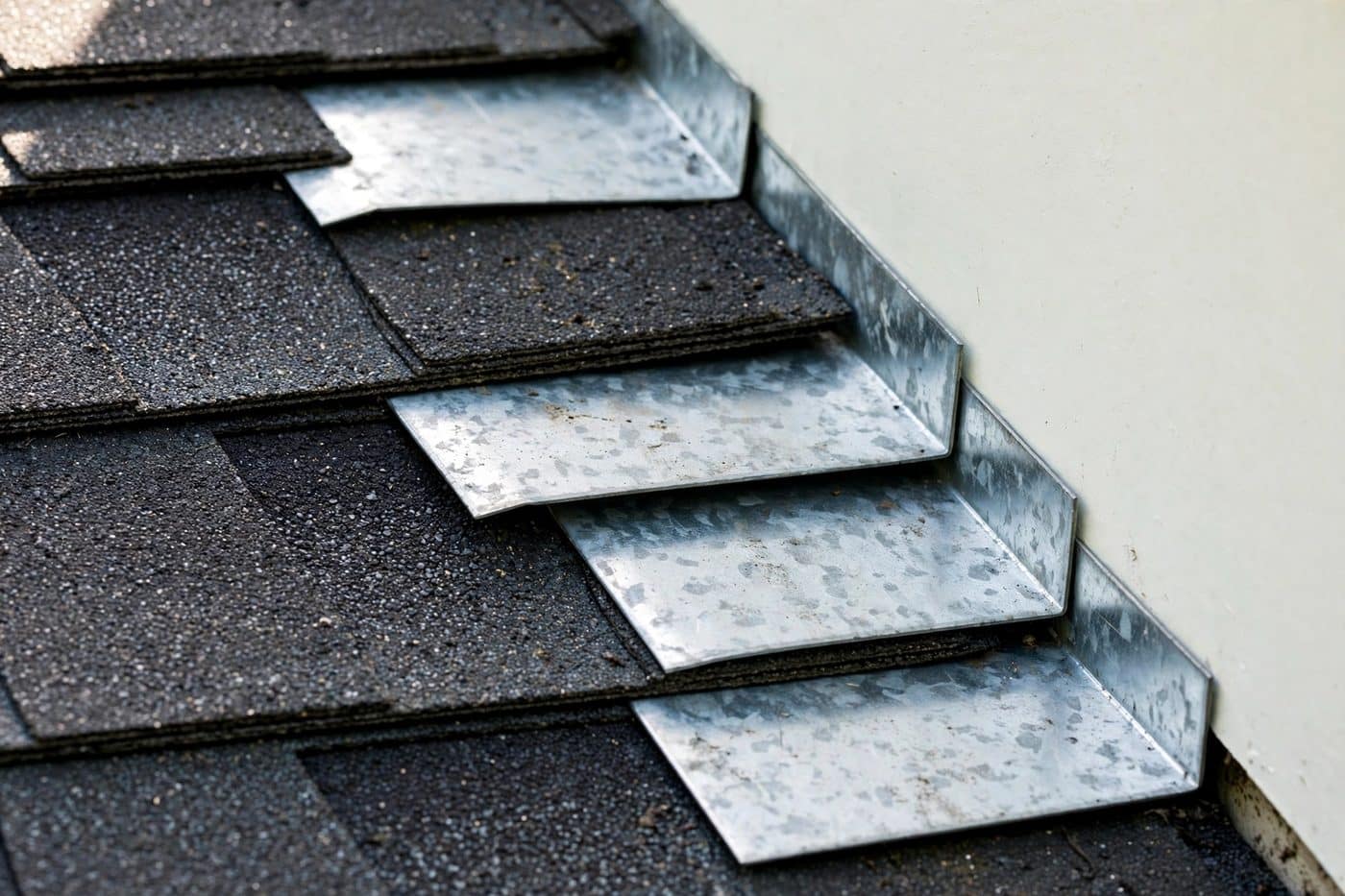
Step flashing is a series of small L-shaped metal pieces installed where a sloped roof meets a vertical wall — a dormer, a sidewall, an addition. Each piece is woven into the shingle courses as they go up: shingle, flashing, shingle, flashing, in a stair-step pattern. Every piece directs water onto the shingle below it, so water never gets a chance to run down the wall line.
This is one of the most common flashing details on any house, and one of the most frequently botched. The classic mistake is a single long bent sheet — ‘continuous flashing’ — which traps water instead of shedding it. Another is re-roofing without touching the step flashing at all, leaving 20-year-old metal under brand-new shingles. For the full installation, see our Spanish step-by-step guide to installing step flashing without leaks.
Chimney flashing: the most complex system on the roof
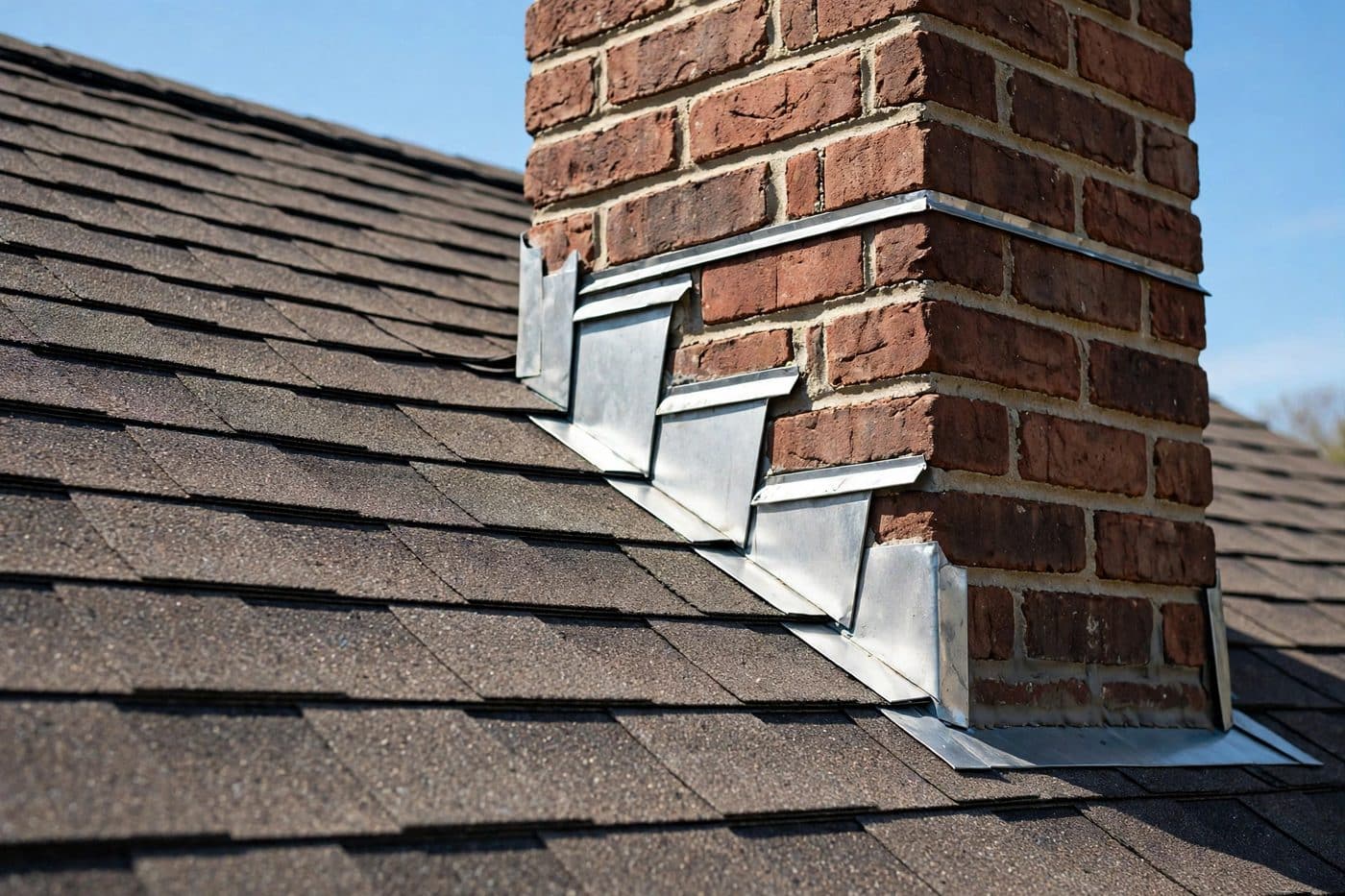
A chimney needs three parts working together: step flashing up both sides, counter flashing set into the mortar joints that laps down over the step flashing, and a cricket — a small peaked saddle — on the uphill side that diverts water around the chimney instead of letting it pool behind it. Chimney flashing is the most labor-intensive flashing on a roof, which is why chimney repairs cost more than any other type. It also fails quietly: counter flashing pulls out of crumbling mortar, letting water run down the brick and rot framing for years before a stain appears inside.
Valley flashing: where two roof planes meet
Valleys carry more water per square foot than any other part of your roof, because they collect runoff from two converging planes and funnel it into a single stream. Valley flashing sits at the bottom of that channel — either open metal or a closed valley woven with shingles — and gives the concentrated flow a continuous watertight path. A valley leak usually shows up as a stain along the valley line inside, and it gets worse fast in heavy rain.
Pipe boots and vent flashing: the part that wears out first
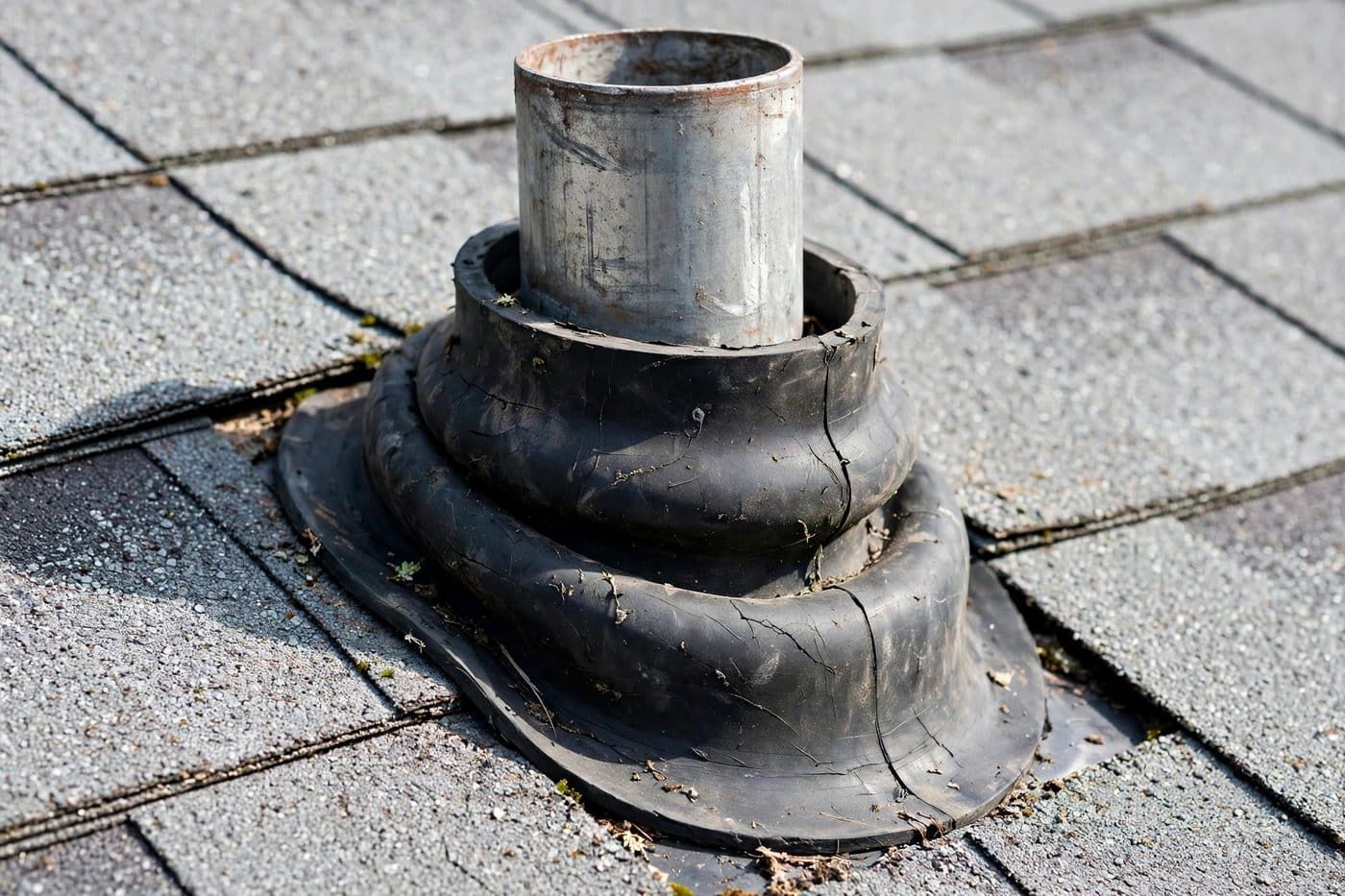
Every plumbing vent, exhaust pipe, and roof vent pokes through the roof, and each one is sealed with a boot — a flat metal base with a rubber collar that grips the pipe. The metal lasts for decades. The rubber does not: sun and temperature cycling crack the collar in roughly 10–15 years, even when the roof itself has another decade of life. A cracked pipe boot is one of the most common — and most fixable — leak sources on any roof: lift the surrounding shingles, pull the old boot, set a new one. If your roof is 12 years old and leaking, check the boots before you panic about the whole roof.
Drip edge and kickout flashing: the small pieces that prevent big rot
Drip edge is the angled metal strip along the eaves and rakes that pushes water off the roof edge and into the gutter instead of letting it wick back under the shingles and rot the fascia. It has been required by code since 2012, but older roofs and cheap re-roofs still skip it.
Kickout flashing is a small diverter at the bottom of a roof-to-wall junction that kicks water out into the gutter instead of letting it run down behind the siding. Missing kickout flashing is one of the most common causes of hidden wall rot on older homes, because the damage stays invisible behind the siding for years. Our step-by-step guide to installing drip edge the right way explains why cheap quotes skip these details.
Why flashing fails — the four usual suspects
Flashing rarely fails all at once. It fails in one of four ways, and most of them are preventable.
1. Age and weather. Galvanized steel flashing lasts 20–30 years and aluminum about the same, according to Angi’s 2026 flashing guide — but sealant fails in 5–10 years and rubber boots in 10–15. The metal outlives its companions, so a roof can look fine while its boots and sealant are already gone.
2. Bad installation. Step flashing installed as one continuous sheet, counter flashing never set into the mortar, a cricket skipped behind a wide chimney, nails driven through the exposed face instead of hidden under the overlap. These are the leaks that show up in the first rain after a new roof — installer errors, not material failures.
3. Reused flashing during a re-roof. This is the one that costs homeowners the most. Old flashing is pried up, bent, re-nailed, and buried under new shingles. It looks fine for a year, then leaks. As one 2026 replacement-cost breakdown puts it, reusing old flashing is the number one source of post-roof leaks — and full flashing replacement on a typical re-roof adds only about $400–$1,200 to the job, against a leak repair that can run into the thousands once water has soaked the deck.
4. Sealant used as a shortcut. Roofing cement and caulk are maintenance items, not flashing. A bead of sealant over a gap holds for a season or two, then shrinks and cracks. Any repair that is only sealant is a repair you will pay for twice.
Signs your flashing is failing
Flashing leaks are sneaky because water travels. It runs along the sheathing and framing before it drips, so the stain on your ceiling is often several feet from the actual failure.
- Stains near a wall, chimney, or skylight — especially stains that run parallel to the roof slope or appear after wind-driven rain.
- Rust streaks or visible corrosion on the metal around chimneys, valleys, or walls.
- Cracked or curled rubber around vent pipes — visible from the ground with binoculars on a low-slope roof.
- Loose or lifted flashing after a storm, or shingles curling up along a wall line.
- Peeling paint or soft drywall on an exterior wall below a roofline — the classic sign of a missing kickout flashing.
- A musty smell in the attic near a chimney or valley, even with no visible drip.
If you spot more than one of these, do not wait for the next big rain. A small flashing leak soaks the deck quietly, and by the time the ceiling stains, the repair has usually grown from a few hundred dollars into deck replacement. Our guide to the 9 signs you need a new roof covers the bigger picture.
What does roof flashing repair cost in 2026?
Flashing repairs are among the cheapest roof work you will ever pay for — which is exactly why putting them off is so expensive. Current 2026 cost guides agree on the ranges below. Prices vary by region, roof pitch, and access.
| Repair | Typical 2026 cost |
|---|---|
| Re-sealing sound flashing | $150–$350 |
| Pipe boot replacement | $150–$300 |
| Kickout flashing installation | $200–$500 |
| Step flashing, per section | $300–$700 |
| Valley flashing replacement | $400–$1,200 |
| Skylight flashing replacement | $400–$900 |
| Chimney flashing replacement | $500–$1,500 |
Most single-area flashing repairs cost $200–$600 in 2026. A full flashing replacement during a re-roof — chimney, valleys, step flashing, and drip edge together — typically runs $300–$1,500 as a line item, per This Old House’s cost figures. Compare that with water-damage remediation once a leak has soaked the deck and framing: $500–$3,000 or more. Catching a flashing problem early keeps the repair in the low hundreds.
Repair or replace? How to make the call
Most flashing problems are repairs, not replacements. The decision comes down to the condition of the metal.
- Repair it when the metal is sound and the problem is a cracked boot, dried sealant, or a single lifted piece. A new pipe boot or a re-seal is a one-hour job.
- Replace the section when the metal is rusted through, bent out of shape, or installed wrong in the first place. Patching bad geometry with more caulk just resets the countdown.
- Replace all of it when you re-roof. Every piece. The shingles are coming off anyway — this is the cheapest moment in the roof’s life to get the flashing right, and the only moment you will not pay for it twice.
If you are weighing a flashing repair against a bigger job, our roof repair vs roof replacement guide walks through the same decision with real numbers. And if you are not sure which side of the line you are on, the Repair or Replace Quiz will narrow it down in two minutes.
What to ask your roofer about flashing
Flashing is where a good crew and a cheap crew part ways, because it is the work a homeowner cannot see from the ground. Before you sign anything, ask these four questions and get the answers in writing.
- “Are you replacing all flashing, or reusing any of it?” The only acceptable answer on a full re-roof is “replacing all of it.”
- “What gauge and material is the flashing?” You want corrosion-resistant metal, at least 26-gauge per IRC R905 — galvanized steel or aluminum for most homes, copper only if you are paying for it on purpose.
- “How are you flashing the chimney?” Listen for three words: step, counter, cricket. If the answer is “we’ll caulk it,” walk away.
- “Is the flashing itemized on the quote?” A line item for flashing — with a price — means the crew is actually budgeting the time to do it. A quote with no flashing line is a quote that plans to skip it.
Frequently asked questions
What is roof flashing?
Roof flashing is thin, waterproof metal — usually galvanized steel, aluminum, or copper — installed at every joint where the roof meets something else: chimneys, walls, valleys, skylights, and vent pipes. It directs water away from seams shingles alone cannot seal, working by overlapping pieces so gravity carries water down and out.
Why do most roof leaks start at flashing?
Because flashing sits at every transition and penetration on the roof — the most complex and vulnerable points. Shingles shed water fine across an open slope, but they cannot seal a joint. According to NRCA guidance, the majority of roof leaks originate at flashing points, and the rubber boots and sealant that support the metal wear out in 10–15 and 5–10 years.
How much does it cost to replace roof flashing in 2026?
Most single-area flashing repairs cost $200–$600 in 2026. A pipe boot replacement runs $150–$300, step flashing per section $300–$700, valley flashing $400–$1,200, and a full chimney flashing replacement $500–$1,500. Full flashing replacement as part of a re-roof typically adds $300–$1,500 to the job. Costs vary by region, roof pitch, and access.
Can you repair roof flashing yourself?
A pipe boot replacement or a re-seal is within reach of a careful DIYer who is comfortable on a roof and has the right safety gear. Step flashing, chimney flashing, and valley work are not — they require removing shingles and siding and reinstalling the pieces in the correct overlapping order.
How long does roof flashing last?
It depends on the material. Galvanized steel and aluminum flashing last 20–30 years, copper 70–100 years, and stainless steel 50 years or more, according to Angi’s 2026 guide. But the supporting parts fail sooner: rubber pipe boots last 10–15 years and sealant 5–10 years. Match the flashing material to your roof’s expected lifespan.
Should flashing be replaced when you get a new roof?
Yes — always, every piece. Reusing old flashing during a re-roof is the most common source of leaks on a new roof. The metal is already aged, it gets bent during tear-off, and reinstalling it correctly is nearly impossible. Full flashing replacement on a re-roof costs roughly $400–$1,200 and is the cheapest insurance a new roof can buy.
Costs vary by region, roof complexity, and material — get local quotes before you commit. This article is general guidance, not a substitute for an in-person roof inspection.
Disclosure: RoofAdviceHub is reader-supported. When you buy through links on our site we may earn an affiliate commission at no extra cost to you. As an Amazon Associate we earn from qualifying purchases.
Last updated: November 2026
Leave a Reply